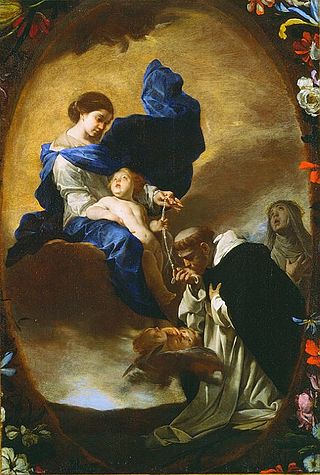
The Rosary, also known as the Dominican Rosary, refers to a set of prayers used primarily in the Catholic Church, and to the physical string of knots or beads used to count the component prayers. When referring to the prayer, the word is usually capitalized ; when referring to the prayer beads as an object, it is written with a lower-case initial letter.
The Confraternity of Christian Doctrine (CCD) is an association established in Rome in 1562 for the purpose of providing religious education. In modern usage, it refers to the Confraternity of Christian Doctrine, Inc., which owns the copyright on the New American Bible Revised Edition, and is a term colloquially used for the catechesis or religious education program of the Catholic Church, normally designed for children. In some Catholic parishes, CCD is called PSR, meaning Parish School of Religion, or SRE, meaning Special Religious Education.
In Christian theology, a sodality, also known as a syndiakonia, is a form of the "Universal Church" expressed in specialized, task-oriented form as opposed to the Christian church in its local, diocesan form. In English, the term sodality is most commonly used by groups in the Anglican Communion, Catholic Church, Eastern Orthodox Church, Lutheran Church and Reformed Church, where they are also referred to as confraternities. Sodalities are expressed among Protestant Churches through the multitude of mission organizations, societies, and specialized ministries that have proliferated, particularly since the advent of the modern missions movement, usually attributed to Englishman William Carey in 1792.
The Confraternities of the Cord are pious associations of Christians, the members of which wear a cord, girdle or cincture in honour of a Catholic saint or Angel whom they wish to honour and emulate.

The Roman Catholic Bona Mors Confraternity was founded 2 October 1648, in the Church of the Gesu, Rome, by Father Vincenzo Carafa, seventh General of the Society of Jesus. In 1729 it was raised to an archconfraternity by Benedict XIII. The object of the association is to prepare its members by a well-regulated life to die in peace with God.

A chaplet is a form of Christian prayer which uses prayer beads, and which is similar to but distinct from the Rosary. Some chaplets have a strong Marian element, others focus more directly on Jesus Christ and his Divine Attributes, or one of the many saints, such as the Chaplet of St Michael. Chaplets are "personal devotionals" and depending on the origins, each one of the chaplets may vary considerably. In the Roman Catholic Church, while the usual five-decade Dominican rosary is also considered to be a chaplet, the other chaplets often have fewer beads and decades than a traditional rosary and may use a different set of prayers. In the Anglican Communion, a chaplet often includes one week of the Anglican rosary.
The Confraternity of the Holy Rosary is a Roman Catholic Archconfraternity or spiritual association, under the care and guidance of the Dominican Order. The members of the confraternity strive to pray the entire Holy Rosary weekly.
An archconfraternity is a Catholic confraternity, empowered to aggregate or affiliate other confraternities of the same nature, and to impart to them its benefits and privileges.

A confraternity is generally a Christian voluntary association of laypeople created for the purpose of promoting special works of Christian charity or piety, and approved by the Church hierarchy. They are most common among Roman Catholics, Anglicans, Lutherans and the Western Orthodox. When a Catholic confraternity has received the authority to aggregate to itself groups erected in other localities, it is called an archconfraternity. Examples include the various confraternities of penitents and the confraternities of the cord, as well as the Confraternity of the Rosary.

Prayer in the Catholic Church is "the raising of one's mind and heart to God or the requesting of good things from God." It is an act of the moral virtue of religion, which Catholic theologians identify as a part of the cardinal virtue of justice.

Reparation is a Christian theological concept closely connected with those of atonement and satisfaction. In ascetical theology, reparation is the making of amends for insults given to God through sin, either one's own or another's. The response of man is to be reparation through adoration, prayer, and sacrifice. In Roman Catholic tradition, an act of reparation is a prayer or devotion with the intent to expiate the "sins of others", e.g. for the repair of the sin of blasphemy, the sufferings of Jesus Christ or as Acts of Reparation to the Virgin Mary.

The veneration of Mary in the Catholic Church encompasses various devotions which include prayer, pious acts, visual arts, poetry, and music devoted to her. Popes have encouraged it, while also taking steps to reform some manifestations of it. The Holy See has insisted on the importance of distinguishing "true from false devotion, and authentic doctrine from its deformations by excess or defect". There are significantly more titles, feasts, and venerative Marian practices among Roman Catholics than in other Western Christian traditions. The term hyperdulia indicates the special veneration due to Mary, greater than the ordinary dulia for other saints, but utterly unlike the latria due only to God.
The Archconfraternity of the Most Precious Blood was founded by Francesco Albertini, canon of the Basilica di San Nicola in Carcere, Rome, in 1808.
The Archconfraternity of the Holy Family is a Roman Catholic archconfraternity, founded in 1844 in Belgium.

The Blue Scapular of the Immaculate Conception is a devotional scapular that traces its roots to Venerable Ursula Benincasa, who founded the Roman Catholic religious order of the Theatine Nuns. This scapular must have a blue woollen cloth and on one side bears a symbolization of the mystery of the Immaculate Conception of Our Lady and on the other the name of the Blessed Virgin Mary.

The Scapular of the Most Precious Blood is a Roman Catholic devotional scapular. It is associated with the Archconfraternity of the Most Precious Blood.

The Scapular of Saint Michael is a Roman Catholic devotional scapular associated with Michael, the Archangel and originated prior to 1878. It was formerly the badge of the now defunct Archconfraternity of the Scapular of Saint Michael.

There are differing views on the history of the rosary, a Christian prayer rope, cord or chain used to count specific prayers, commonly as a Marian devotion. The exact origin of the rosary as a prayer is less than clear and subject to debate among scholars. The use of knotted prayer ropes in Christianity goes back to the Desert Fathers in the 3rd and early 4th centuries. These counting devices were used for prayers such as the Jesus prayer in Christian monasticism. The period after the First Council of Ephesus in 431 witnessed gradual growth in the use of Marian prayers during the Middle Ages.
The Archconfraternity of Holy Agony is a lay association for giving special honour to the mental sufferings of Christ during His Agony in the Garden of Gethsemane. It was founded as a confraternity in 1862, at Valfleury, France, by Antoine Nicolle (1817–90), a Vincentian priest. Joseph A. Komonchak described it as a type of "counterrevolutionary mysticism".

The Teutonic Cemetery is a burial site in Rome adjacent to St. Peter's Basilica. Burial is reserved for members of the Confraternity of Our Lady of the German Cemetery, which owns the cemetery. It is a place of pilgrimage for many German-speaking pilgrims.


