
The Holocene is the current geological epoch. It began approximately 11,650 cal years before present, after the last glacial period, which concluded with the Holocene glacial retreat. The Holocene and the preceding Pleistocene together form the Quaternary period. The Holocene has been identified with the current warm period, known as MIS 1. It is considered by some to be an interglacial period within the Pleistocene Epoch, called the Flandrian interglacial.

Climate variability includes all the variations in the climate that last longer than individual weather events, whereas the term climate change only refers to those variations that persist for a longer period of time, typically decades or more. In the time since the industrial revolution the climate has increasingly been affected by human activities that are causing global warming and climate change.

Global cooling was a conjecture, especially during the 1970s, of imminent cooling of the Earth culminating in a period of extensive glaciation, due to the cooling effects of aerosols and orbital forcing. Some press reports in the 1970s speculated about continued cooling; these did not accurately reflect the scientific literature of the time, which was generally more concerned with warming from an enhanced greenhouse effect.

Dansgaard–Oeschger events are rapid climate fluctuations that occurred 25 times during the last glacial period. Some scientists say that the events occur quasi-periodically with a recurrence time being a multiple of 1,470 years, but this is debated. The comparable climate cyclicity during the Holocene is referred to as Bond events.
This glossary of climate change is a list of definitions of terms and concepts relevant to climate change, global warming, and related topics.
A glacial period is an interval of time within an ice age that is marked by colder temperatures and glacier advances. Interglacials, on the other hand, are periods of warmer climate between glacial periods. The last glacial period ended about 15,000 years ago. The Holocene epoch is the current interglacial. A time with no glaciers on Earth is considered a greenhouse climate state.

An abrupt climate change occurs when the climate system is forced to transition to a new climate state at a rate that is determined by the climate system energy-balance, and which is more rapid than the rate of change of the external forcing. Past events include the end of the Carboniferous Rainforest Collapse, Younger Dryas, Dansgaard-Oeschger events, Heinrich events and possibly also the Paleocene–Eocene Thermal Maximum. The term is also used within the context of global warming to describe sudden climate change that is detectable over the time-scale of a human lifetime, possibly as the result of feedback loops within the climate system.

Heidi M. Cullen is the Director of Communications and Strategic Initiatives at MBARI. Heidi Cullen was the chief scientist for the non-profit environmental organization, Climate Central, located in Princeton, New Jersey. In addition, she is a guest lecturer at nearby Princeton University, and the author of the book, The Weather of the Future. An expert and commentator about issues related to climate change and the environment, she was an on-air personality at The Weather Channel, and is a senior research fellow at the University of Pennsylvania (Penn).

The 4.2-kiloyear BP aridification event was one of the most severe climatic events of the Holocene epoch. It defines the beginning of the current Meghalayan age in the Holocene epoch.

In climatology, the 8.2-kiloyear event was a sudden decrease in global temperatures that occurred approximately 8,200 years before the present, or c. 6,200 BC, and which lasted for the next two to four centuries. It defines the start of the Northgrippian age in the Holocene epoch. Milder than the Younger Dryas cold spell before it but more severe than the Little Ice Age after it, the 8.2-kiloyear cooling was a significant exception to general trends of the Holocene climatic optimum. During the event, atmospheric methane concentration decreased by 80 ppb, an emission reduction of 15%, by cooling and drying at a hemispheric scale.
Bond events are North Atlantic ice rafting events that are tentatively linked to climate fluctuations in the Holocene. Eight such events have been identified. Bond events were previously believed to exhibit a roughly c. 1,500-year cycle, but the primary period of variability is now put at c. 1,000 years.
Dennis T. Avery is the director of the Center for Global Food Issues at the Hudson Institute, where he edits Global Food Quarterly.
The Subatlantic is the current climatic age of the Holocene epoch. It started at about 2,500 years BP and is still ongoing. Its average temperatures were slightly lower than during the preceding Subboreal and Atlantic. During its course the temperature underwent several oscillations which had a strong influence on fauna and flora and thus indirectly on the evolution of human civilizations. With intensifying industrialisation, human society started to stress the natural climatic cycles with increased greenhouse gas emissions.
This is a list of climate change topics.
Gerard Clark Bond was an American geologist.
Unstoppable global warming may refer to:
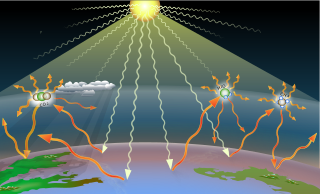
A greenhouse gas (sometimes abbreviated GHG) is a gas that absorbs and emits radiant energy within the thermal infrared range. Greenhouse gases cause the greenhouse effect on planets. The primary greenhouse gases in Earth's atmosphere are water vapor (H
2O), carbon dioxide (CO
2), methane (CH
4), nitrous oxide (N
2O), and ozone (O3). Without greenhouse gases, the average temperature of Earth's surface would be about −18 °C (0 °F), rather than the present average of 15 °C (59 °F). The atmospheres of Venus, Mars and Titan also contain greenhouse gases.
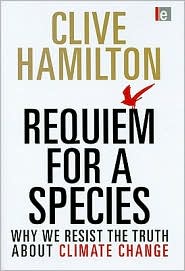
Requiem for a Species: Why We Resist the Truth about Climate Change is a 2010 non-fiction book by Australian academic Clive Hamilton which explores climate change denial and its implications. It argues that climate change will bring about large-scale, harmful consequences for habitability for life on Earth including humans, which it is too late to prevent. Hamilton explores why politicians, corporations and the public deny or refuse to act on this reality. He invokes a variety of explanations, including wishful thinking, ideology, consumer culture and active lobbying by the fossil fuel industry. The book builds on the author's fifteen-year prior history of writing about these subjects, with previous books including Growth Fetish and Scorcher: The Dirty Politics of Climate Change.

The soil carbon feedback concerns the releases of carbon from soils in response to global warming. This response under climate change is a positive climate feedback. There is approximately two to three times more carbon in global soils than the Earth's atmosphere, which makes understanding this feedback crucial to understand future climate change. An increased rate of soil respiration is the main cause of this feedback, where measurements imply that 4 °C of warming increases annual soil respiration by up to 37%.

The Medieval Warm Period (MWP) also known as the Medieval Climate Optimum, or Medieval Climatic Anomaly was a time of warm climate in the North Atlantic region lasting from c. 950 to c. 1250. It was likely related to warming elsewhere while some other regions were colder, such as the tropical Pacific. Average global mean temperatures have been calculated to be similar to early-mid-20th-century warming. Possible causes of the Medieval Warm Period include increased solar activity, decreased volcanic activity, and changes to ocean circulation.

