
Somalia, officially the Federal Republic of Somalia, is the easternmost country in continental Africa. The country is on the Horn of Africa and is bordered by Ethiopia to the west, Djibouti to the northwest, the Gulf of Aden to the north, the Indian Ocean to the east, and Kenya to the southwest. Somalia has the longest coastline on Africa's mainland. In antiquity, Somalia was an important commercial center. During the Middle Ages, several powerful Somali empires dominated the regional trade, including the Ajuran Sultanate, Adal Sultanate, Imamate of Awsame, and the Sultanate of the Geledi. In the late 19th century, Somali sultanates were colonized by the Italian and British Empires, who merged all of these tribal territories into two colonies: Italian Somaliland and British Somaliland. In 1960, the two territories united to form the independent Somali Republic under a civilian government. Siad Barre of the Supreme Revolutionary Council (SRC) seized power in 1969 and established the Somali Democratic Republic, brutally attempting to squash the Somaliland War of Independence in the north of the country. The SRC collapsed in 1991 with the onset of the Somali Civil War. The Transitional National Government of Somalia (TNG) was established in 2000, followed by the formation of the Transitional Federal Government of Somalia (TFG) in 2004, which reestablished the Somali Armed Forces.
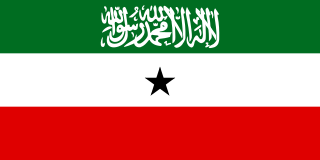
Somaliland, officially the Republic of Somaliland, is an unrecognised country in the Horn of Africa, recognised internationally as de jure part of Somalia. It is located in the southern coast of the Gulf of Aden and bordered by Djibouti to the northwest, Ethiopia to the south and west, and Somalia to the east. Its claimed territory has an area of 176,120 square kilometres (68,000 sq mi), with approximately 5.7 million residents as of 2021. The capital and largest city is Hargeisa. The Government of Somaliland regards itself as the successor state to British Somaliland, which, as the briefly independent State of Somaliland, united from 1960 to 1991 with the Trust Territory of Somaliland to form the Somali Republic.
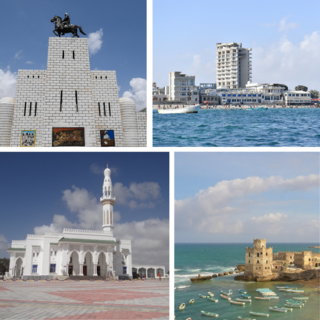
Mogadishu, locally known as Xamar or Hamar, is the capital and most populous city of Somalia. The city has served as an important port connecting traders across the Indian Ocean for millennia and has an estimated urban population of 2,610,483.
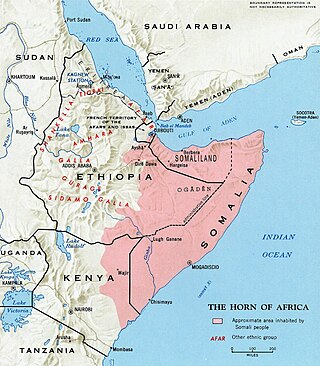
Somali is an Afroasiatic language belonging to the Cushitic branch. It is spoken as a mother tongue by Somalis in Greater Somalia and the Somali diaspora. Somali is an official language in Somalia and Ethiopia, and a national language in Djibouti as well as in northeastern Kenya. The Somali language is written officially with the Latin alphabet although the Arabic alphabet and several Somali scripts like Osmanya, Kaddare and the Borama script are informally used.

The Somali people are a Cushitic ethnic group native to the Horn of Africa who share a common ancestry, culture and history. The Lowland East Cushitic Somali language is the shared mother tongue of ethnic Somalis, which is part of the Cushitic branch of the Afroasiatic language family, and they are predominantly Sunni Muslim. Forming one of the largest ethnic groups on the continent, they cover one of the most expansive landmasses by a single ethnic group in Africa.

The Somali Civil War is an ongoing civil war that is taking place in Somalia. It grew out of resistance to the military junta which was led by Siad Barre during the 1980s. From 1988 to 1990, the Somali Armed Forces began engaging in combat against various armed rebel groups, including the Somali Salvation Democratic Front in the northeast, the Somali National Movement in the northwest, and the United Somali Congress in the south. The clan-based armed opposition groups overthrew the Barre government in 1991.

Daphne Njie Efundem known professionally as Daphne is a Cameroonian urban pop singer. She began her professional musical career with her song "Rastafari" and got popular via the song Calée. Daphné is married with presently no children.

Diabetes and deafness (DAD) or maternally inherited diabetes and deafness (MIDD) or mitochondrial diabetes is a subtype of diabetes which is caused from a mutation in mitochondrial DNA, which consists of a circular genome. It is associated with the genes MT-TL1, MT-TE, and MT-TK. The point mutation at position 3243A>G, in gene MT-TL1 encoding tRNA leucine 1, is most common. Because mitochondrial DNA is contributed to the embryo by the oocyte and not by spermatozoa, this disease is inherited from maternal family members only. As indicated by the name, MIDD is characterized by diabetes and sensorineural hearing loss. Some individuals also experience more systemic symptoms including eye, muscle, brain, kidney, heart, and gastrointestinal abnormalities, similar to other mitochondrial diseases.

Tsagaan-Üür is a sum of Khövsgöl aimag. The area is 8,730 km2, of which only 1,140 km2 are pasture. In 2000, Tsagaan-Üür had a population of 2,421 people, including Khalkha, Uriankhai, and Buriad. The sum center, officially named Bulgan, is located on the banks of the Üür River, 173 km north-east of Mörön and 844 km from Ulaanbaatar.

Erdenebulgan is a sum of Khövsgöl aimag. The area is about 4,960 km². In 2000, the sum had 2739 inhabitants. The center, officially named Eg-Üür, is situated on the banks of the Egiin gol.
Mitochondrially encoded tRNA leucine 1 (UUA/G) also known as MT-TL1 is a transfer RNA which in humans is encoded by the mitochondrial MT-TL1 gene.

Quick '20 is a football club from Oldenzaal, Netherlands. The club was founded in 1920 and is currently playing in the Derde Divisie, which is the second highest tier of amateur football in the Netherlands and the fourth tier in general.

Rudolf Lucieer is a Dutch actor. He has appeared in 36 films and television shows since 1966. He starred in the 1967 film Paranoia, which was entered into the 17th Berlin International Film Festival. In 1992 he won the Golden Calf for Best Actor for his role in the movie The Northerners.
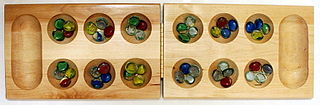
Layli Goobalay is a board game played in parts of Somalia. It is a variant of the classical count and capture game mancala, which is one of the oldest two-player strategy board games played throughout the world. Layli Goobalay means "to exercise with circles" in the Somali language.

Comedy Central is a Dutch pay television channel based on the American channel of the same name. The channel is available on cable, digital terrestrial, IPTV, and satellite operators in the Netherlands. It broadcasts many imports as well as original programming.

Theo van den Boogaard – also known as Theo Bogart – is a Dutch cartoonist. He first came to attention as an underground cartoonist in the early 1970s for the sexually explicit comics series Ans en Hans krijgen de kans. He is best known for co-creating Sjef van Oekel, a long-running comic strip based on the TV character, written by Wim T. Schippers. He received the 1989 Stripschapprijs for his body of work.
Rako Raaxo is a District in the northeastern Bari region of Somalia. It is the center of the Rako District in the autonomous Puntland region. Rako Raaxo has a number of academic institutions. According to the Puntland Ministry of Education, there are 7 primary schools and 1 Secondary School in the Rako District. Among these are Qalwo,Qarar-soor,Uur-Jire, Duud-Hooyo, Adingari and Xumbays.

The Union of the Ukrainians of Romania is an ethnic minority political party in Romania representing the Ukrainian community.
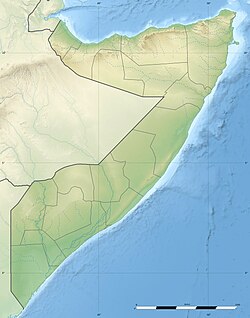

 Somalia
  Puntland