
Sintra is a town and municipality in the Greater Lisbon region of Portugal, located on the Portuguese Riviera. The population of the municipality in 2021 was 385,654, in an area of 319.23 square kilometres (123.26 sq mi). Sintra is one of the most urbanized and densely populated municipalities of Portugal. A major tourist destination famed for its picturesqueness, the municipality has several historic palaces, castles, scenic beaches, parks and gardens.

Amadora is a municipality and urbanized city in the northwest of the Lisbon metropolitan area and 10 km from central Lisbon. The population in 2011 was 175,136, in an area of 23.78 km2. It is the fourth biggest, and most densely populated, city in Portugal.

Cascais is a town and municipality in the Lisbon District of Portugal, located on the Portuguese Riviera. The municipality has a total of 214,158 inhabitants in an area of 97.40 km2. Cascais is an important tourist destination. Its marina hosts events such as the America's Cup and the town of Estoril, part of the Cascais municipality, hosts conferences such as the Horasis Global Meeting.

Cabo da Roca or Cape Roca is a cape which forms the westernmost point of the Sintra Mountain Range, of mainland Portugal, of continental Europe, and of the Eurasian landmass. It is situated in the municipality of Sintra, near Azóia, in the south west of the Lisbon District. Notably, the point includes a lighthouse that started operation in 1772.

Oeiras is a town and municipality in the western part of Lisbon metropolitan area, located within the Portuguese Riviera, in continental Portugal. The municipality is part of the urban agglomeration of Lisbon and the town of Oeiras is about 16 km from Lisbon downtown. The population in 2011 was 172,120 living in an area of 45.88 km2, making the municipality the fifth-most densely populated in Portugal.

Lisbon District is a district located along the western coast of Portugal. The district capital is the city of Lisbon, which is also the national capital. From its creation in 1835 until 1926, it included the area of the current Setúbal District.
Parede is a former civil parish in the municipality of Cascais, Portugal. In 2013, the parish merged into the new parish Carcavelos e Parede. In 2001 its resident population was approximately 17,830 inhabitants, covering an area of 3.6 km2, west of Lisbon on the coast near the mouth of the Tagus estuary. Parede is a community between the larger towns of Oeiras and Cascais, in the district of Lisbon, along the Linha do Estoril railway line that follows the coast from Lisbon to Estoril and Cascais.

São Domingos de Rana is a civil parish of the Portuguese municipality of Cascais, part of the Greater Lisbon subregion. The population in 2011 was 57,502, in an area of 20.36 km². The parish includes the localities Abóboda, Cabeço de Mouro, Caparide, Matarraque, Outeiro de Polima, Polima, Rana, Talaíde, Tires, Trajouce and Zambujal.

The Palace of Sintra, also called Town Palace, is located in the town of Sintra, in the Lisbon District of Portugal. It is a present-day historic house museum.

Tourism in Portugal serves millions of international and domestic tourists. Tourists visit to see cities, historic landmarks, enjoy beaches, or religious sites. As of 2019, Portugal had 27 million visitors. The most popular destinations were Lisbon, Porto, the Algarve, the Portuguese Riviera, Madeira, Sintra, Óbidos and Fátima. The most popular with internationals were Lisbon, the Algarve and Northern Portugal. National tourists prefer Northern Portugal, followed by Central Portugal and the Algarve.
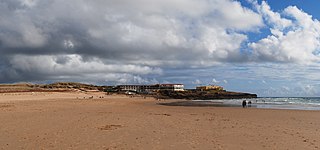
Praia do Guincho is an Atlantic beach located on Portugal's Estoril coast, 5 km from the town of Cascais, and is located in the municipality of Cascais, more precisely in the parishes of Cascais and Alcabideche, in the District of Lisbon. Guincho is situated close to several small villages, including Areia, Charneca, Figueira do Guincho and Biscaia.

Packer Park is a neighborhood in the South Philadelphia section of Philadelphia, Pennsylvania, United States that originally included 1,000 homes built in two unique builder developments, of Packer Park in the 1950s and Brinton Estates during the 1990s. It is now one of four residential communities to be designated as Packer Park. The original footprint community is also one of four adjacent communities that form Philadelphia's Sports Complex Special Services District. The approximate boundaries are Packer Avenue to the north, Hartranft Street to the south including FDR Park farther south, Broad Street to the east known as the Southern Parkway, and I-76 to the far west. Packer Park has been considered home to one of the most organized community groups in the South Philadelphia region.
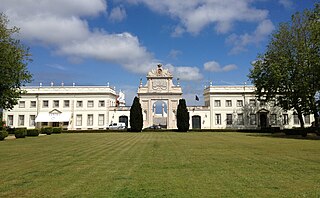
The Seteais Palace is a neoclassical palace located in Sintra, on the Portuguese Riviera, operating as a luxury hotel known as the Tivoli Palácio de Seteais Hotel. The palace is a national landmark and is included in the UNESCO Cultural Landscape of Sintra World Heritage Site listing.

The Oeiras International Cross Country is an annual cross country running competition that takes place in Oeiras, Portugal. Established in 2000, it is usually held in mid-November and is traditionally the first competition of the IAAF's cross country season, which culminates each year in the IAAF World Cross Country Championships.
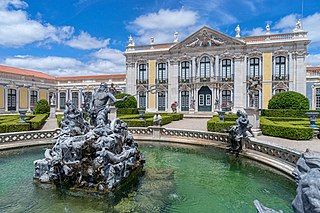
Queluz is a city within the Sintra Municipality, on the Portuguese Riviera, in the Lisbon metropolitan area of Portugal. It is famed as the home of Queluz National Palace, the 18th century pleasure palace of the Portuguese Royal Family, as well as notable institutions like the Portuguese School of Equestrian Art. Queluz had a population 78,273 inhabitants in 2001.
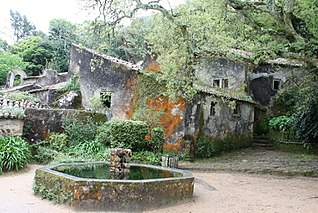
The Convent of the Friars Minor Capuchin, popularly known as the Convent of the Capuchos, but officially the Convento da Santa Cruz da Serra de Sintra, is a historical convent consisting of small quarters and public spaces located in the civil parish of São Pedro de Penaferrim, in Sintra Municipality, Portugal. Its creation was associated with the Portuguese Viceroy of India, D. João de Castro, and his family, but became a pious community of reclusive clergy that continued to occupy cramped humble spaces in the complex until the religious orders were abolished in Portugal.

The Castle of the Moors is a hilltop medieval castle located in the central Portuguese civil parish of Santa Maria e São Miguel, in the municipality of Sintra, about 25 km (16 mi) northwest of Lisbon. Built by the Moors in the 8th and 9th centuries, it was an important strategic point during the Reconquista, and was taken by Christian forces after the fall of Lisbon in 1147. It is classified as a National Monument, part of the Sintra Cultural Landscape, a UNESCO World Heritage Site.
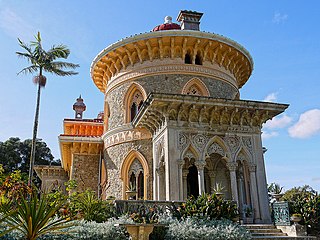
The Portuguese Riviera is a term used in the tourist industry for the affluent coastal region to the west of Lisbon, Portugal, centered on the coastal municipalities of Cascais, Oeiras and Sintra. It is coterminous with the Estoril Coast and occasionally known as the Costa do Sol. Portuguese themselves do not use this expression.

Summer architecture was a Portuguese architectural movement originating in the Portuguese Riviera, in the late 19th and early 20th centuries, when the region became a popular resort destination for the Portuguese royal family and the Portuguese aristocracy. The movement is not characterized by any single architectural style or artistic school, but rather unified by common themes, including leisure, wellness, exoticism, and heterotopia.

SATUOeiras, also known simply as SATU, was a 1.15 km (0.71 mi) elevated automated people mover that operated in Oeiras, Portugal from 2004 to 2015. The line connected Paço de Arcos with Oeiras Parque Shopping Center and consisted of 3 stations and 2 cars. Discussions to possibly reopen and expand the line have been ongoing since 2017.
