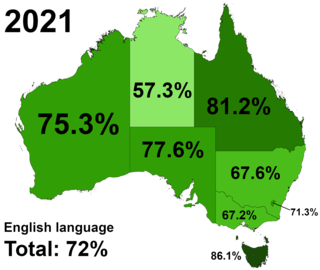
Australian English is the set of varieties of the English language native to Australia. It is the country's common language and de facto national language; while Australia has no official language, English is the first language of the majority of the population, and has been entrenched as the de facto national language since British settlement, being the only language spoken in the home for 72% of Australians. It is also the main language used in compulsory education, as well as federal, state and territorial legislatures and courts.
Mad, mad, or MAD may refer to:
In grammar, the nominative case, subjective case, straight case, or upright case is one of the grammatical cases of a noun or other part of speech, which generally marks the subject of a verb, or a predicative nominal or adjective, as opposed to its object, or other verb arguments. Generally, the noun "that is doing something" is in the nominative, and the nominative is often the form listed in dictionaries.
Newfoundland English is any of several accents and dialects of Atlantic Canadian English found in the province of Newfoundland and Labrador. Most of these differ substantially from the English commonly spoken elsewhere in Canada and North America.

Barbecue or barbeque is a term used with significant regional and national variations to describe various cooking methods that employ live fire and smoke to cook the food. The term is also generally applied to the devices associated with those methods, the broader cuisines that these methods produce, and the meals or gatherings at which this style of food is cooked and served. The cooking methods associated with barbecuing vary significantly but most involve outdoor cooking.
Spoken English shows great variation across regions where it is the predominant language. The United Kingdom has a wide variety of accents, and no single "British accent" exists. This article provides an overview of the numerous identifiable variations in pronunciation. Such distinctions usually derive from the phonetic inventory of local dialects, as well as from broader differences in the Standard English of different primary-speaking populations.

Checkers, also known as draughts, is a group of strategy board games for two players which involve forward movements of uniform game pieces and mandatory captures by jumping over opponent pieces. Checkers is developed from alquerque. The term "checkers" derives from the checkered board which the game is played on, whereas "draughts" derives from the verb "to draw" or "to move".
Han unification is an effort by the authors of Unicode and the Universal Character Set to map multiple character sets of the Han characters of the so-called CJK languages into a single set of unified characters. Han characters are a feature shared in common by written Chinese (hanzi), Japanese (kanji), Korean (hanja) and Vietnamese.
Spelling is a set of conventions that regulate the way of using graphemes to represent a language in its written form. In other words, spelling is the rendering of speech sound (phoneme) into writing (grapheme). Spelling is one of the elements of orthography, and highly standardized spelling is a prescriptive element.

Belgian French, also known as Walloon French, is the variety of French spoken mainly among the French Community of Belgium, alongside related Oïl languages of the region such as Walloon, Picard, Champenois, and Lorrain (Gaumais). The French language spoken in Belgium differs very little from that of France or Switzerland. It is characterized by the use of some terms that are considered archaic in France, as well as loanwords from languages such as Walloon, Picard, and Dutch. The variety is also an official language in former Belgian colonies the Democratic Republic of the Congo, Rwanda and Burundi, with the latter two being co-official with English.
Mackem, Makem or Mak'em is a nickname for residents of and people from Sunderland, a city in North East England. It is also a name for the local dialect and accent ; and for a fan, of whatever origin, of Sunderland A.F.C. It has been used by the people of Sunderland to describe themselves since the 1980s, prior to which it was mainly used in Tyneside as a disparaging exonym. An alternative name for a Mackem is a Wearsider.

Letter case is the distinction between the letters that are in larger uppercase or capitals and smaller lowercase in the written representation of certain languages. The writing systems that distinguish between the upper- and lowercase have two parallel sets of letters: each in the majuscule set has a counterpart in the minuscule set. Some counterpart letters have the same shape, and differ only in size, but for others the shapes are different. The two case variants are alternative representations of the same letter: they have the same name and pronunciation and are typically treated identically when sorting in alphabetical order.
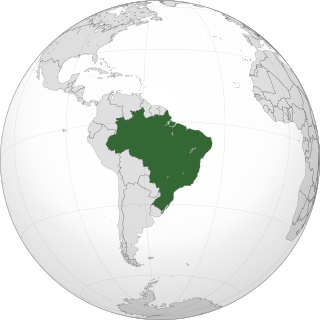
Brazilian Portuguese is the set of varieties of the Portuguese language native to Brazil and the most influential form of Portuguese worldwide. It is spoken by almost all of the 203 million inhabitants of Brazil and spoken widely across the Brazilian diaspora, today consisting of about two million Brazilians who have emigrated to other countries. With a population of over 203 million, Brazil is by far the world's largest Portuguese-speaking nation and the only one in the Americas.

Hong Kong English is a variety of the English language native to Hong Kong. The variant is either a learner interlanguage or emergent variant, primarily a result of Hong Kong's British overseas territory history and the influence of native Hong Kong Cantonese speakers.
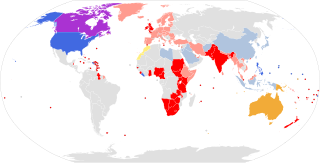
Despite the various English dialects spoken from country to country and within different regions of the same country, there are only slight regional variations in English orthography, the two most notable variations being British and American spelling. Many of the differences between American and British/Commonwealth English date back to a time before spelling standards were developed. For instance, some spellings seen as "American" today were once commonly used in Britain, and some spellings seen as "British" were once commonly used in the United States.
Oxford spelling is a spelling standard, named after its use by the University of Oxford, that prescribes the use of British spelling in combination with the suffix -ize in words like realize and organization instead of -ise endings.
In Islam, Qirāʼah are different linguistic, lexical, phonetic, morphological and syntactical forms permitted with reciting the holy book of Islam, the Quran. Differences between Qiraʼat are slight and include varying rules regarding the prolongation, intonation, and pronunciation of words, but also differences in stops, vowels, consonants, and less frequently entire words. Qiraʼat also refers to the branch of Islamic studies that deals with these modes of recitation.
Disc and disk are both variants of the English word for objects of a generally thin and cylindrical geometry. The differences in spelling correspond both with regional differences and with different senses of the word. For example, in the case of flat, rotational data storage media the convention is that the spelling disk is used for magnetic storage while disc is used for optical storage. When there is no clear convention, the spelling disk is more popular in American English, while the spelling disc is more popular in British English.

Rinconada Bikol or simply Rinconada, spoken in the province of Camarines Sur, Philippines, is one of several languages that compose the Inland Bikol group of the Bikol macrolanguage. It belongs to the Austronesian language family that also includes most Philippine languages, the Formosan languages of Taiwanese aborigines, Malay, the Polynesian languages and Malagasy.
Some of the most notable differences between American English and British English are grammatical.
