
Look up venosa in Wiktionary, the free dictionary.
Venosa is a town and comune in Italy.
Contents
Venosa may also refer to:
Venosa is a town and comune in Italy.
Venosa may also refer to:


Whelks are any of several carnivorous sea snail species with a swirling, tapered shell. Many are eaten by humans, such as the common whelk of the North Atlantic. Most whelks belong to the family Buccinidae and are known as "true whelks." Others, such as the dog whelk, belong to several sea snail families that are not closely related.
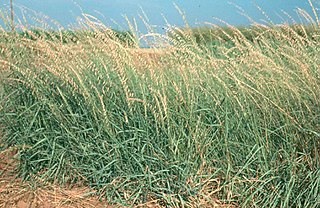
Bouteloua curtipendula, commonly known as sideoats grama, is a perennial, short prairie grass that is native throughout the temperate and tropical Western Hemisphere, from Canada south to Argentina.

Diuris, commonly known as donkey orchids, bee orchids, nanny goat orchids or pansy orchids, is a genus of more than sixty species of flowering plants in the orchid family, Orchidaceae and is endemic to Australia, apart from one species endemic to Timor. The name "Diuris" refers to the hanging sepals but the common name "donkey orchid", derives from the ear-like petals common to all species. Many have mainly yellow flowers with darker markings and are thought to mimic nectar-producing flowers which open at the same time.

Thelymitra, commonly known as sun orchids, is a genus of more than 100 species of plants in the orchid family, Orchidaceae. Unlike most other orchids, sun orchids lack a highly modified labellum and all three petals are similar in size, shape and colour. The column is, however, highly modified and usually has prominent wings or glands which are helpful in identifying the species. Most sun orchids close their flowers at night, in cloudy or cool weather, giving rise to their common name. The scientific name means "woman's hood" and refers to the hooded column present in most, but not all species. Most species are endemic to Australia although some are found as far from there as the Philippines and Indonesia. The type species, Thelymitra longifolia, the first to be formally described, was collected in New Zealand.

Rapana venosa, common name the veined rapa whelk or Asian rapa whelk, is a species of large predatory sea snail, a marine gastropod mollusc or whelk, in the family Muricidae, the rock shells.

Ctenucha is a genus of moths in the family Erebidae.
Palustris is a Latin word meaning "swampy" or "marshy", and may refer to:

Arnica venosa is a rare California species of flowering plant in the family Asteraceae known by the common name Shasta County arnica. It should not be confused with the Mt. Shasta arnica, A. viscosa.
Odoratus is a Latin adjective meaning "fragrant, perfumed", and may refer to:

Ctenucha virginica, the Virginia ctenucha, is a moth of the family Erebidae. The species was first described by Eugenius Johann Christoph Esper in 1794.

Ctenucha cressonana, or Cresson's ctenucha, is a moth of the family Erebidae. The species was first described by Augustus Radcliffe Grote in 1863. It is found in the US Rocky Mountains, including Colorado and New Mexico.
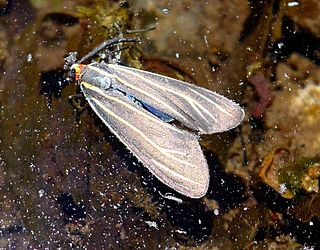
Ctenucha venosa, the veined ctenucha moth, is a moth of the family Erebidae. It was described by Francis Walker in 1854. It is found in the US from southern Nevada and Arizona to Colorado, Kansas, Oklahoma and Texas, as well as in Mexico, Guatemala, Panama and Venezuela.
Lucidus may refer to:
P. maculata may refer to:

Diuris venosa, commonly known as the veined doubletail is a species of orchid which is endemic to New South Wales. It has a few thin, erect leaves and up to four white to lilac-coloured flowers with deep red to purple blotches and lines.
Pterostylis venosa, commonly known as a greenhood, is a species of orchid endemic to New Zealand and which usually grows in colonies. Both flowering and non-flowering plants have a rosette of erect to spreading leaves, and flowering plants have a single yellowish-green to dark green flower with white stripes. It is similar to P. humilis.

Thelymitra venosa, commonly known as the large veined sun orchid, is a species of orchid that is endemic to New South Wales. It has a single fleshy, channelled leaf and up to six relatively large, bright-blue flowers with darker veins. The arms on the side of the column are twisted and yellow, but not toothed at the tip. Unlike most other thelymitras, the flowers do not usually close on cloudy days.
Maritimimonas is a Gram-negative and aerobic genus of bacteria from the family of Flavobacteriaceae with one known species. Maritimimonas rapanae has been isolated from the gut of the whelk Rapana venosa from the South Sea in Korea.
A. aurantiaca may refer to: