
Monza is a city and comune on the River Lambro, a tributary of the Po in the Lombardy region of Italy, about 15 kilometres north-northeast of Milan. It is the capital of the Province of Monza and Brianza. Monza is best known for its Grand Prix motor racing circuit, the Autodromo Nazionale di Monza, which hosts the Formula One Italian Grand Prix with a massive Italian support tifosi for the Ferrari team.

Capriate San Gervasio is a town and comune in the province of Bergamo, in Lombardy, northern Italy. As of 2019, its population was 8,216.
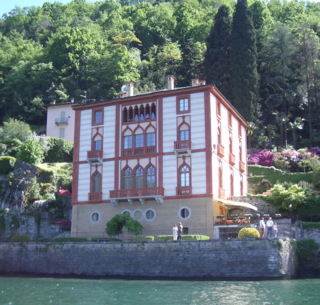
Villa Plinianina is a patrician rural palace on the shores of Lake Como, located in the comune of Torno, Province of Como, region of Lombardy, Italy.

Giuseppe Piermarini was an Italian architect who trained with Luigi Vanvitelli in Rome and designed the Teatro alla Scala in Milan (1776–78), which remains the work by which he is remembered. Indeed, "il Piermarini" serves as an occasional euphemism for the celebrated opera house. Piermarini was appointed professor in the Academy of Fine Arts of Brera, better known as Brera Academy, Milan, when it was formally founded in 1776.

The Royal Villa is a historical building in Monza, northern Italy. It lies on the banks of the Lambro river, surrounded by the large Monza Park, one of the largest enclosed parks in Europe.
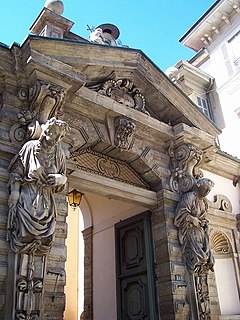
The archiepiscopal seminary of Milan is the seminary of the Archdiocese of Milan.

Neoclassical architecture in Milan encompasses the main artistic movement from about 1750 to 1850 in this northern Italian city. From the final years of the reign of Maria Theresa of Austria, through the Napoleonic Kingdom of Italy and the European Restoration, Milan was in the forefront of a strong cultural and economic renaissance in which Neoclassicism was the dominant style, creating in Milan some of the most influential works in this style in Italy and across Europe. Notable developments include construction of the Teatro alla Scala, the restyled Royal Palace, and the Brera institutions including the Academy of Fine Arts, the Braidense Library and the Brera Astronomical Observatory. Neoclassicism also led to the development of monumental city gates, new squares and boulevards as well as public gardens and private mansions. Latterly two churches, San Tomaso in Terramara and San Carlo al Corso, were completed in Neoclassical style before the period came to an end in the late 1830s.

The Villa Traversi Tittoni, or Villa Cusani Traversi Tittoni is a rural palace in Desio, northern Italy.
Villa Alari, also known as the Villa Visconti di Saliceto, is a Rococo style rural palace in Cernusco sul Naviglio, in the Province of Milan, in the Region of Lombardy, Italy.
The Villa Gernetto is a rural palace located near the town of Lesmo, in the Province of Monza and Brianza, in the Region of Lombardy, Italy.

The Villa Gallarati Scotti is a rural palace located near the town of Vimercate, in the Province of Monza and Brianza, in the Region of Lombardy, Italy.
The Villa Scheilbler Gallarati Scotti is a 16th-century hunting lodge and rural palace located in the town of Rho in the province of Milan, Region of Lombardy, Italy. This villa differs from the Villa Gallarati Scotti at Vimercate.
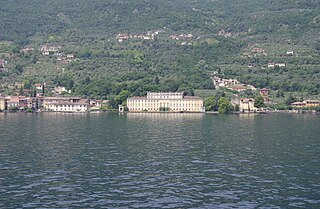
Villa Bettoni is a large lake-side Neoclassical-style rural palace located in the frazione of Bogliaco, on the shores of Lake Garda, within the town limits of Gargnano, Province of Brescia, region of Lombardy, Italy. The massive villa and manicured gardens are a scenographic landmark on the Lake.
Villa Jacini is a large rural palace located on Via Conte Stefano Jacini the frazione of Zuccone Robasacco, within the town limits of Triuggio, Province of Monza and Brianza, region of Lombardy, Italy.
The Villa Valdettaro, also called Villa Viansson, is a 19th-century Baroque and Gothic Revival architecture rural palace located on Via Cavour #46 outside of the town of Lentate sul Seveso in the Province of Monza and Brianza, region of Lombardy, Italy.
The Villa Litta Modignani is a 17th-century rural palace and park located on Via Taccioli in the north suburbs of Milan, in the Province of Milan, Lombardy, Italy.

Santa Maria in Brera was a church in Milan, in Lombardy in northern Italy. It was built by the Humiliati between 1180 and 1229, given a marble façade and Gothic portal by Giovanni di Balduccio in the fourteenth century, and deconsecrated and partly demolished under Napoleonic rule in the early nineteenth century. The Napoleonic rooms of the Pinacoteca di Brera occupy the upper floor of what was the nave.
The old farmhouses of Brugherio were agricultural structures typical of the Po-Valley in Lombardy, which gave its name to the surrounding areas as well, roughly corresponding to fractional towns in which Brugherio was divided. The union of the various small rural municipalities in which the territory was fragmented gave birth in 1866 to the municipality of Brugherio. Some are still visible: Bindellera, Casecca, Cattoni, Comolli, Dorderio, Guzzina, Increa, Modesta, Moia, Occhiate, Pareana, San Cristoforo, Sant'Ambrogio, San Paolo and Torazza.

Ermenegildo Pini (1739–1825) was an Italian clergyman, naturalist, mathematician, geologist and philosopher. He belonged to the Barnabite Order and worked mainly in northern Italy. He attempted to examine scientific ideas on geological phenomena and fossils and show them as being consistent with the framework of Biblical Genesis.
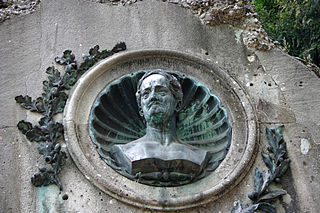
Giuseppe Balzaretto or Balzaretti was an Italian landscape architect and architect.

