
Enschede is a city and municipality in the province of Overijssel and the Twente region of the eastern Netherlands. The east of the urban area reaches the border of the German city of Gronau.

The Massachusetts Museum of Contemporary Art is a museum in a converted Arnold Print Works factory building complex located in North Adams, Massachusetts. It is one of the largest centers for contemporary visual art and performing arts in the United States.

Anni Albers was a German-Jewish visual artist and printmaker. A leading textile artist of the 20th century, she is credited with blurring the lines between traditional craft and art. Born in Berlin in 1899, Fleischmann initially studied under impressionist painter Martin Brandenburg from 1916 to 1919 and briefly attended the Kunstgewerbeschule in Hamburg in 1919. She later enrolled at the Bauhaus, an avant-garde art and architecture school founded by Walter Gropius in Weimar in 1922, where she began exploring weaving after facing restrictions in other disciplines due to gender biases at the institution.
The Rijksmuseum Twenthe in Enschede, the Netherlands, was founded in 1927 by textile industry Baron Jan Bernard Van Heek. He donated his own private collection and the museum building to the government, thus making it a national museum. The museum is situated in the quarter of Roombeek, 10 minutes on foot north-east from the railway station.

Laura Parnes is contemporary American artist who creates non-linear narratives that engage strategies of film and video art and blur the lines between storytelling conventions and experimentation. Her work is often episodic, references pop culture, female stereotypes, history and the anxiety of influence. She was the co-director of Momenta Art with Eric Heist and helped relaunch the not-for-profit exhibition space in New York City; at first as a nomadic space and then as a permanent space in Williamsburg, Brooklyn. She continued to her involvement as a Board Chair until 2011. Parnes received her BFA from the Tyler School of Art, Temple University, and lives and works in Brooklyn, NY. She currently teaches in MFA departments at MICA, Parsons, and SVA.

Serralves is a cultural institution located in Porto, Portugal. It includes a contemporary art museum, a park, and a villa, with each one of these being an example of contemporary architecture, Modernism, and Art Deco architecture. The museum, designed by Álvaro Siza Vieira, is now the second most visited museum in Portugal.
Hans Vandekerckhove is a Belgian painter, living and working in Ghent. From 1975 to 1997 Vandekerckhove studied Art History at University Ghent, where he wrote his graduation thesis on David Hockney.
René Daniëls is a Dutch artist.

MoMu is the fashion museum of the City of Antwerp, Belgium. Founded on 21 September 2002, the museum collects, conserves, studies and exhibits Belgian fashion. The museum is specifically focusing on Belgian contemporary fashion designers due to the arising of a group of Antwerp-trained fashion designers during the Eighties and Nineties. The museum's first director was Linda Loppa who was also the founder and the director of the Fashion school of the Royal Academy of Fine Arts (Antwerp). The current director is Kaat Debo.

Catherine de Zegher is a Belgian curator and a modern and contemporary art historian. She has a degree in art history and archaeology from the University of Ghent.

Xaviera Simmons is an American contemporary artist. She works in photography, performance, painting, video, sound art, sculpture, and installation. Between 2019 and 2020, Simmons was a visiting professor and lecturer at Harvard University. Simmons was a Harvard University Solomon Fellow from 2019 to 2020. Simmons has stated in her lectures and writings that she is a descendant of Black American enslaved persons, European colonizers and Indigenous persons through the institution of chattel slavery on both sides of her family's lineage.
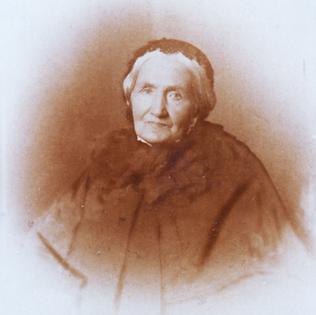
Adriana Johanna Haanen was a Dutch painter.

Sibyl Heijnen (1961) is a Dutch visual artist, part of the second generation after 1960. She graduated from the Gerrit Rietveld Academy in Amsterdam, the Netherlands in 1985. She is known for working with a wide range of materials and techniques, not limited to a particular spatial scale, transcending all boundaries of art.
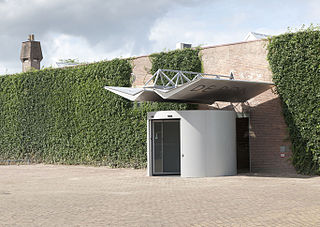
The De Pont Museum is a contemporary art museum in Tilburg, North Brabant, the Netherlands. It was named after the lawyer and businessman Jan de Pont (1915-1987). After his death his estate provided for the establishment of a foundation to stimulate contemporary visual art. With its founding director Hendrik Driessen, the decision was made to transform a Tilburg wool-spinning mill into a museum. Since its opening in 1992, the collection has grown to include more than 800 works by approximately eighty nationally and internationally known artists, among them Marlene Dumas, Bill Viola and Anish Kapoor.
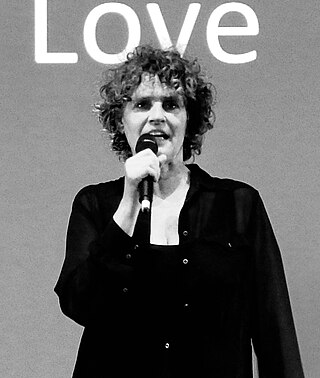
Ine Gevers is a Dutch curator of contemporary art, writer and activist. Gevers is known for large themed exhibitions in which she explores the relationships between technology, power and identity. She has been called one of The Netherlands' most radical curators.

Kamiel Verschuren is a Dutch conceptual interdisciplinary visual artist, living and working in Rotterdam.
Amber Robles-Gordon is an American mixed media visual artist. She resides in Washington, DC and predominantly works with found objects and textiles to create assemblages, large-scale sculptures, installations and public artwork.
Roos Theuws is a Dutch media and video artist.
Jop Horst was a Dutch visual artist and filmmaker, living and working in Hengelo. His oeuvre includes various types of media and techniques, such as kinetic installations, drawings, paintings, experimental films, video art and performances.
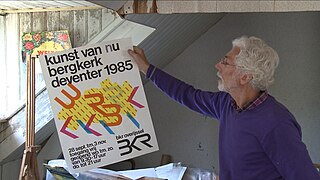
Euphrasius Franciscus Hendricus "Fra" Paalman, was a Dutch graphic designer, visual artist and art teacher, who lived and worked in Hengelo (Overijssel), the Netherlands. Paalman designed, among other, book covers, brochures, posters, vignettes and corporate identities. As a graphic artist he made autonomous work too, especially etchings, screen prints and monotypes. His oeuvre also includes photographs, collages, sculptures, drawings and paintings, which he focused more on from the 1990s onwards. This work encompasses representations of everyday things, portraits of people, animals and landscapes, visions of the city and commentary on political events, as well as constructivist compositions and abstract images. The work often has a somewhat alienating element. As a teacher, Paalman has passed on his vision, knowledge and skills to countless people, young and old, through educational programs, courses and workshops.


