
The Tărtăria tablets are three tablets, reportedly discovered in 1961 at a Neolithic site in the village of Tărtăria in Săliștea commune, from Transylvania.
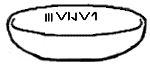
The Vinča symbols or Vinča–Turdaș signs, Old European script, Danube script are a set of untranslated symbols found on Neolithic era artifacts from the Vinča culture and other related "Old European" cultures of Central and Southeastern Europe. Whether this is one of the earliest writing systems or simply symbols of some sort is disputed. They have sometimes been described as an example of proto-writing. The symbols went out of use around 3,500 BC.
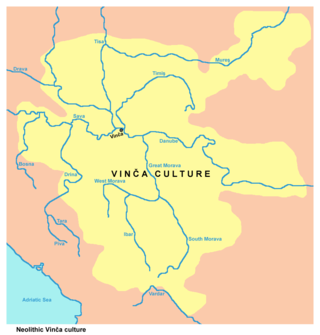
The Vinča culture (ʋîːntʃa), also known as Turdaș culture, Turdaș–Vinča culture or Vinča-Turdaș culture, is a Neolithic archaeological culture of Southeast Europe, dated to the period 5400–4500 BC. Named for its type site, Vinča-Belo Brdo, a large tell settlement discovered by Serbian archaeologist Miloje Vasić in 1908, it represents the material remains of a prehistoric society mainly distinguished by its settlement pattern and ritual behaviour.

The Starčevo culture is an archaeological culture of Southeastern Europe, dating to the Neolithic period between c. 6200 and 4500 BCE. It originates in the spread of the Neolithic package of peoples and technological innovations including farming and ceramics from Anatolia to the area of Sesklo. The Starčevo culture marks its spread to the inland Balkan peninsula as the Cardial ware culture did along the Adriatic coastline. It forms part of the wider Starčevo–Körös–Criş culture which gave rise to the central European Linear Pottery culture c. 700 years after the initial spread of Neolithic farmers towards the northern Balkans.
In archaeology, a type site is the site used to define a particular archaeological culture or other typological unit, which is often named after it. For example, discoveries at La Tène and Hallstatt led scholars to divide the European Iron Age into the La Tène culture and Hallstatt culture, named after their respective type sites.
Sesklo is a village in Greece that is located near Volos, a city located within the municipality of Aisonia. The municipality is located within the regional unit of Magnesia that is located within the administrative region of Thessaly. During the prehistory of Southeastern Europe, Sesklo was a significant settlement of Neolithic Greece, before the advent of the Bronze Age and millennia before the Mycenaean period.

Grocka or Grocka na Dunavu is a municipality of the city of Belgrade. According to the 2022 census results, the municipality has 82,810 inhabitants.
Rudna Glava is a mining site in present-day eastern Serbia, a village and an archeological site.

Radmilovac is a suburban settlement of Belgrade, the capital of Serbia, and an experimental farm of the University of Belgrade's Faculty of Agriculture. It is located in the Belgrade municipality of Grocka. It is also known for the hotel of the same name.
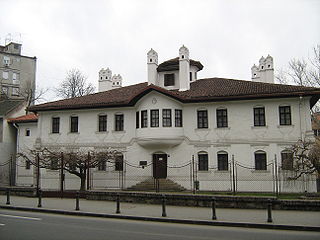
The Belgrade City Museum is a museum located in Belgrade, Serbia. Founded in 1903, the museum operates with several cultural institutions: Ivo Andrić Museum, Princess Ljubica's Residence, Paja Jovanović Museum, Banjica Concentration Camp Museum, Collection of Icons Sekulić, Archaeological Site Vinča and Jovan Cvijić Museum.

Vinča-Belo Brdo is an archaeological site in Vinča, a suburb of Belgrade, Serbia. The tell of Belo Brdo is almost entirely made up of the remains of human settlement, and was occupied several times from the Early Neolithic through to the Middle Ages. The most substantial archaeological deposits are from the Neolithic-Chalcolithic Vinča culture, of which Vinča-Belo Brdo is the type site.
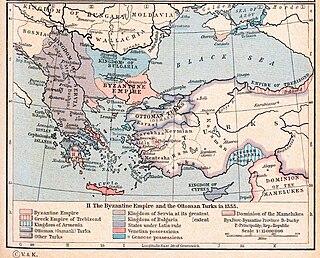
The best known cultural archaeological discoveries from the prehistoric period on the territory of modern-day Serbia are the Starčevo and Vinča cultures dating back to 6400–6200 BC.
Old Europe or Old European may refer to:
Selevac is a village in the municipality of Smederevska Palanka, Serbia. According to the 2002 census, the village has a population of 3864 people.
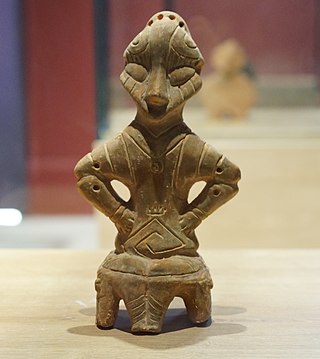
Goddess on the Throne (Albanian: Hyjnesha në fron; figurine found at the site of the Tjerrtorja spinning mill in Pristina, the capital city of Kosovo, in 1956. The seated terracotta figure is a well-preserved specimen of small Neolithic plastic Vinca culture. It measures 18.5 cm high and is dated to 5700–4500 BC.
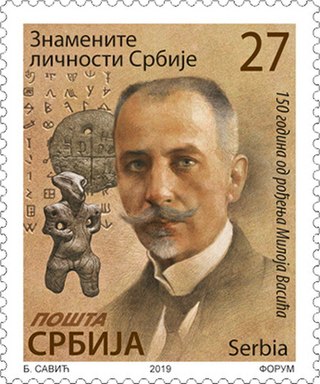
Miloje Vasić was a Serbian archaeologist, regarded as one of the most distinguished representatives of the humanistic studies in Serbia.

Vladimir Pecikoza is a Serbian archaeologist and Head of the Archaeology Department at the Petnica Science Center.

Draga Garašanin was a Serbian archaeologist who studied the Copper and Bronze Age of eastern Europe. She became one of the leading prehistorians of Yugoslavia, later Serbia, after World War II and with her husband produced the first map of archaeological sites in Serbia.
Crkvine is a Neolithic locality and an archaeological site in the village of Stubline in the municipality of Obrenovac, which is part of the City of Belgrade, the capital of Serbia. The Neolithic settlement is dated to the 5th millennium BC and was part of the Vinča culture. The research of the site began in 1962 and the locality was declared a cultural monument in 2014.
