Related Research Articles

Tarbela Dam is an earth-filled dam along the Indus River in Pakistan's Khyber Pakhtunkhwa province. It is mainly located in Haripur Tehsil. It is about 20 km (10 mi) from the city of Swabi KPK, 105 km (65 mi) northwest of Islamabad, and 125 km (80 mi) east of Peshawar. It is the largest earth-filled dam in the world. The dam is 143 metres (470 ft) high above the riverbed and its reservoir, Tarbela Lake, has a surface area of approximately 250 square kilometres (97 sq mi).
Statkraft AS is a hydropower company, fully owned by the Norwegian state. The Statkraft Group is Europe's largest generator of renewable energy, as well as Norway’s largest and the Nordic region's third largest energy producer. Statkraft develops and generates hydropower, wind power, gas power, district heating and solar power. It is also a player in the international energy markets. The company has 5300 employees in 21 countries with their headquarters located in Oslo, Norway.

Energy in Armenia is mostly from natural gas. Armenia has no proven reserves of oil or natural gas and currently imports most of its gas from Russia. The Iran-Armenia Natural Gas Pipeline has the capacity to equal imports from Russia.

The Mingachevir Dam is an earth-fill embankment dam on the Kura River just north of Mingachevir in Azerbaijan. It serves several purposes, including hydroelectric power production and water storage for irrigation. The Mingachevir reservoir, behind the dam, supplies water to the Upper Qarabag and Upper Sirvan channels which help irrigate about 1,000,000 ha of farmland in the country. Its six Francis turbine-generators were overhauled or replaced with 70 megawatts (94,000 hp) sets in 2000. Mingachevir reservoir has a storage capacity of 15.730 cubic kilometres (12,753,000 acre⋅ft), covering 605 km2 (234 sq mi). The length of the dam is 1,550 metres (5,090 ft), its width is 16 metres (52 ft) and height is 80 m (260 ft). It is the largest hydroelectric power station in the South Caucasus, and is located on Kura river, not far from Mingachevir city.
The Buk Bijela Hydro Power Plant is proposed hydroelectric power plant (HPP) on the Drina River in Bosnia and Herzegovina.
Vardnili Hydro Power Plant Cascade is a cascade of hydropower plants in the Gali Municipality of Georgia. Included in the Cascade of Enguri Hydropower Plants. It consists of four relatively smaller power plants. It is built on the outlet channel of the Enguri Hydro Power Plant, by discharging the main runoff of the Enguri River into the Eristskali riverbed. The total projected installed capacity is 340 MW, and the average annual projected electricity output is 1111 million kWh. The Vardnil HPP-I has 3 turbines with a nominal capacity of 73 MW each having a total capacity of 220 MW.
The Moinak Hydro Power Plant or is a hydro power plant on the Sharyn River south of Almaty in Almaty Province of Kazakhstan.
Two-thirds of energy in Azerbaijan comes from fossil gas and almost a third from oil. Azerbaijan is a major producer of oil and gas, much of which is exported. Most electricity is generated by gas-fired power plants. Energy is all types of energy products, including fuel, renewable energy, water energy, electrical and heat energy.

Technopromexport is a Russian engineering company that builds energy facilities in Russia and abroad, including hydropower, thermal, geo-thermal and diesel power plants, power lines and electricity substations. The company was formed in 1955, and was transformed into a joint stock company in April 2006. The company's charter capital is 15.7 billion rubles. The company is headquartered in Moscow.

PJSC «Ukrhydroenergo» is a Ukrainian state-owned enterprise that administers many major hydro power plants along the Dnieper and Dniester rivers. It is Ukraine's main hydropower generating company. It is capable of covering peak loads and providing FCAS for the United Energy Systems of Ukraine (UESU). Hydroelectricity is a renewable energy source, and does not require the combustion of fossil fuels in its operation. The company operates ten power plants on the Dnieper and Dniester rivers: Kyivska HPP, Kyivska PSP, Kanivska HPP, Kremenchutska HPP, Seredniodniprovska HPP, Dniprovska HPP No. 1, Dniprovska HPP No. 2, Kakhovska HPP, Dnistrovska HPP, and Dnistrovska PSP. Enabling works are underway at Kanivska PSP and Kakhovska HPP No. 2.
The South Yakutia Hydroelectric Complex or South Yakutia HPP is a set of proposed hydroelectric plants in the South Yakutia region of the Russian Far East, on rivers including the Uchur, Timpton, Aldan, and Olyokma.
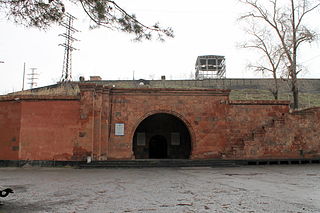
Sevan–Hrazdan Cascade is a complex of hydroelectric power plants on the Hrazdan River and its tributaries between the Lake Sevan and Yerevan in Armenia. They use irrigation water flow from the Lake Sevan and streams waters of Hrazdan River. The cascade is owned by the International Energy Corporation (IEC), a subsidiary of Tashir Group owned by Samvel Karapetyan.
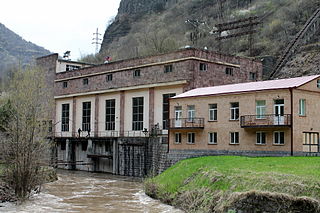
The Dzoraget Hydroelectric Power Station is situated in Dzoraget village, Lori Region, Armenia. The plant is located on the coast of Debed River, but it uses the flows of the waters of Dzoraget River. Construction of the Dzoraget HPP started in 1927 and it was launched on 15 November 1932 with the full installed capacity of 22.32 MW. As of 1980, the plant uses three generators with an installed capacity of 26.2 MW. The Dzoraget Hydro Power Plant is considered to be small size power plant. There is a little water storage behind the weir, as Dzoraget HPP is a run-of-the-river plant.
There is enormous potential for renewable energy in Kazakhstan, particularly from wind and small hydropower plants. The Republic of Kazakhstan has the potential to generate 10 times as much power as it currently needs from wind energy alone. But renewable energy accounts for just 0.6 percent of all power installations. Of that, 95 percent comes from small hydropower projects. The main barriers to investment in renewable energy are relatively high financing costs and an absence of uniform feed-in tariffs for electricity from renewable sources. The amount and duration of renewable energy feed-in tariffs are separately evaluated for each project, based on feasibility studies and project-specific generation costs. Power from wind, solar, biomass and water up to 35 MW, plus geothermal sources, are eligible for the tariff and transmission companies are required to purchase the energy of renewable energy producers. An amendment that introduces and clarifies technology-specific tariffs is now being prepared. It is expected to be adopted by Parliament by the end of 2014. In addition, the World Bank's Ease of Doing Business indicator shows the country to be relatively investor-friendly, ranking it in 10th position for investor protection.
Nenskra Hydro Power Plant is a proposed hydroelectric power station to be located on the southern slopes of the Central Caucasus mountains in Svaneti, Georgia.

The electricity sector of Armenia includes several companies engaged in electricity generation and distribution. Generation is carried out by multiple companies both state-owned and private. In 2020 less than a quarter of energy in Armenia was electricity.
Vietnam utilizes four main sources of renewable energy: hydroelectricity, wind power, solar power and biomass. At the end of 2018, hydropower was the largest source of renewable energy, contributing about 40% to the total national electricity capacity. In 2020, wind and solar had a combined share of 10% of the country's electrical generation, already meeting the government's 2030 goal, suggesting future displacement of growth of coal capacity. By the end of 2020, the total installed capacity of solar and wind power had reached over 17 GW. Over 25% of total power capacity is from variable renewable energy sources. The commercial biomass electricity generation is currently slow and limited to valorizing bagasse only, but the stream of forest products, agricultural and municipal waste is increasing. The government is studying a renewable portfolio standard that could promote this energy source.

The power generation potential of the rivers in Azerbaijan is estimated at 40 billion kilowatt per hour, and feasible potential is 16 billion kilowatt per hour. Small-scale hydro has significant developmental potential in Azerbaijan. In particular, the lower reaches of the Kura river, the Aras river and other rivers flowing into the Caspian Sea. Hydropower could conceivably provide up to 30% of Azerbaijan’s electricity requirements. Currently, hydropower, dominated by large-scale dams, provides 11.4% of Azerbaijan’s electricity.
Hydro is an important source of electricity in Ukraine. State operating company is Ukrhydroenergo and Energoatom. Design of main power plants is carried out by Ukrhydroproject.

Hydropower generates about 30% of Armenia's electricity but its share varies a lot from year to year.


