Vondelstraat Riots

Last updated
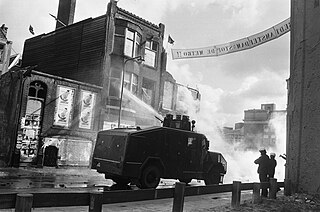
A photo during the riots Vondelstraat.JPG
A photo during the riots
A tank clearing barricades Mobiele Eenheid , tanks en pantservoertuigen ruimen barricades rond kraakpand in, Bestanddeelnr 253-8155.jpg
A tank clearing barricades

The Vondelstraat Riots (Dutch : Vondelstraatrellen) were violent disturbances on Vondelstraat in Amsterdam, the Netherlands between squatters and the state in March 1980. It also involved the deployment of military tanks on the streets for the first time since World War II, and was one of the most serious disturbances involving squatters in the country.

Dutch language A West Germanic language

Dutch(Nederlands ) is a West Germanic language spoken by around 24 million people as a first language and 5 million people as a second language, constituting the majority of people in the Netherlands and Belgium. It is the third-most-widely spoken Germanic language, after its close relatives English and German.

Amsterdam Capital of the Netherlands

Amsterdam is the capital and most populous city of the Netherlands, with a population of 866,737 within the city proper, 1,380,872 in the urban area, and 2,410,960 in the metropolitan area. Amsterdam is in the province of North Holland. Amsterdam is colloquially referred to as the "Venice of the North" due to its large number of canals which are a UNESCO World Heritage Site.

Netherlands Constituent country of the Kingdom of the Netherlands in Europe

The Netherlands, sometimes mislabeled as Holland, is a country in Northwestern Europe with some overseas territories in the Caribbean. In Europe, it consists of 12 provinces that border Germany to the east, Belgium to the south, and the North Sea to the northwest, with maritime borders in the North Sea with those countries and the United Kingdom. Together with three island territories in the Caribbean Sea—Bonaire, Sint Eustatius and Saba—it forms a constituent country of the Kingdom of the Netherlands. The official language is Dutch, but a secondary official language in the province of Friesland is West Frisian. In the northern parts of the country, Low Saxon is also spoken.

Contents

Background

During the 1970s, squatting became increasingly prevalent in Amsterdam due to the lack of housing and the high number of decayed buildings in the city centre. Many of the squatters occupying land were youngsters from the baby boom generation, having trouble finding homes to live in. A previous riot in Amsterdam happened in 1966. Authorities did little to stop them before the events of 1980. [1] Many riots occurred between the squatters and the authorities (overall referred to as Krakersrellen), the biggest being the Nieuwmarkt Riots in 1975.

Baby boomers are the demographic cohort following the Silent Generation and preceding Generation X. The Baby Boom generation is most often defined as those individuals born between 1946 and 1964.

Riot form of civil disorder

A riot is a form of civil disorder commonly characterized by a group lashing out in a violent public disturbance against authority, property or people. Riots typically involve theft, vandalism, and destruction of property, public or private. The property targeted varies depending on the riot and the inclinations of those involved. Targets can include shops, cars, restaurants, state-owned institutions, and religious buildings.

Nieuwmarkt Riots

The Nieuwmarkt riots, also referred to as the Amsterdam metro riots, is a series of serious disturbances in the Nieuwmarkt neighbourhood of Amsterdam, Netherlands. On 24 March 1975, which later became known as Blue Monday, and on 8 April 1975, protests against the planned demolition of homes ended in confrontations with over a hundred municipal police supported by 500 military police. The homes were considered by residents and protesters to be in good condition, but had to make way for the construction of the East Line tunnel of the Amsterdam metro. This was needed because the construction of the 3.5 km tunnel was largely done by sinking large concrete caissons. As a result of the riots, the city council of Amsterdam decided to abandon further plans for additional metro lines.

By the late 1970s the mood changed as politicians and real estate owners called for action against squatters. The mayor of Amsterdam at the time, Wim Polak, decided to start cracking down on squatters. [1]

Wim Polak mayor of Amsterdam

Willem "Wim" Polak was a Dutch politician of the Labour Party (PvdA) and economist.

Events on Vondelstraat

Vondelstraat is a major street in the centre of Amsterdam and was the location of a large squatting squad who occupied property. On 29 February the state evicted squatters from a building on the corner of Vondelstraat and Eerste Constantijn Huygensstraat. Amid violent protests from hundreds of squatters who re-occupied the building and built huge barricades, over a thousand police officers and soldiers were deployed to stop their actions. [1]

The rioters threw objects and petrol bombs whilst police responded with tear gas. Street fights continued until 3 March. A tank that was deployed, driven by Major Tom van Erk, managed to demolish the barricades. Calm returned that day. [2]

Molotov cocktail incendiary weapon using flammable liquid in a bottle

A Molotov cocktail, also known as a petrol bomb, gasoline bomb, bottle bomb, poor man's grenade, Molotovin koktaili (Finnish), polttopullo (Finnish), fire bomb, fire bottle or just Molotov, sometimes shortened as Molly, is a generic name used for a variety of bottle-based improvised incendiary weapons. Due to the relative ease of production, Molotov cocktails have been used by street criminals, rioters, criminal gangs, urban guerrillas, terrorists, irregular soldiers, or even regular soldiers short on equivalent military-issue weapons. They are primarily intended to ignite rather than completely destroy targets, and are often used just as much to cause chaos as to actually do damage.

Tear gas Non-lethal chemical weapon

Tear gas, formally known as a lachrymator agent or lachrymator, sometimes colloquially known as mace, is a chemical weapon that causes severe eye and respiratory pain, skin irritation, bleeding, and blindness. In the eye, it stimulates the nerves of the lacrimal gland to produce tears. Common lachrymators include pepper spray, PAVA spray (nonivamide), CS gas, CR gas, CN gas, bromoacetone, xylyl bromide, syn-propanethial-S-oxide, and Mace, and household vinegar.

Tank Tracked heavy armored fighting vehicle

A tank is an armoured fighting vehicle designed for front-line combat. Tanks have heavy firepower, strong armour, and good battlefield manoeuvrability provided by tracks and a powerful engine; usually their main armament is mounted in a turret. They are a mainstay of modern 20th and 21st century ground forces and a key part of combined arms combat.

Fifty police officers were hurt during the events. [1]

Aftermath

Another huge squatting protest happened on 30 April 1980 during the coronation of Queen Beatrix. Other riots, albeit smaller, also happened in August, September and December, as well as in 1981 and 1982. In the late 1980s the squatting movement became less prevalent, particularly after the increase of house building in the city. In 2010, the Dutch parliament voted to ban squatting entirely. [3] [4]

See also

Related Research Articles

Squatting The occupation of derelict land or an empty building without the permission of the owner

Squatting is the action of occupying an abandoned or unoccupied area of land or a building, usually residential, that the squatter does not own, rent or otherwise have lawful permission to use. Author Robert Neuwirth suggested in 2004 that there were one billion squatters globally.

De Blauwe Aanslag Demolished building in The Hague

De Blauwe Aanslag was a squat and autonomous social centre in the Dutch city of The Hague. The large building formerly housed tax offices and was occupied in 1980. When the local council took over the ownership of the building, it was agreed to renovate it in three stages, with the squatters living there. However the plans changed and since 1995 the council decided to widen the roads next to the building; for this reason the squat needed to be demolished. After many efforts to block the demolition with lawsuits, the squatters were evicted by military police on 3 October, 2003.

Eurodusnie Collective was an anarchist collective based in Leiden, the Netherlands. It was established in 1997, in opposition to a summit of the European Council at which the Treaty of Amsterdam was signed. A small school was squatted for the purpose of holding a 'counter summit' as a protest over the official EU summit. From that, a more permanent anarchist project evolved which was of national importance.
Nørrebro district of Copenhagen

Nørrebro is one of the 10 official districts of Copenhagen, Denmark. It is northwest of the city centre, beyond the location of the old Northern Gate (Nørreport), which, until dismantled in 1856, was near the current Nørreport station.

Villa Amalia (Athens)

Villa Amalia is the name of the building that hosted the former Second High School of Athens in Greece. It is located on the corner of Acharnon and Heiden streets, near Victoria metro station. It was an anarchist squat before its eviction in 2012. It reopened as a school in 2016.
St Agnes Place Street in Kennington, South London

St Agnes Place was a squatted street in Kennington, south London, which resisted eviction orders for more than 30 years. When a number of derelict houses were scheduled for demolition to extend Kennington Park in 1969, squatters occupied the properties and a High Court injunction prevented the demolition. The street was run by a housing cooperative until 2005, when Lambeth London Borough Council obtained an eviction order. Demolition was completed in 2007.

Ungdomshuset

Ungdomshuset was the popular name of the building formally named Folkets Hus located on Jagtvej 69 in Nørrebro, Copenhagen, which functioned as an underground scene venue for music and rendezvous point for varying autonomist and leftist groups from 1982 until 2007 when—after prolonged conflict—it was torn down, and later also for its successor, located on Dortheavej 61 in the adjacent Bispebjerg neighbourhood. Due to the ongoing conflict between the Copenhagen Municipality and the activists occupying the premises, the building on Jagtvej was the subject of intense media attention and public debate from the mid-1990s till 2008.

The Battle of Ryesgade was a nine-day series of street fights in mid-September 1986, in the Copenhagen street Ryesgade. It was the most violent event in a long-standing conflict between the Copenhagen city council and the city's community of squatters. Faced with an ultimatum to leave their illegally occupied housing or face eviction, the squatters instead fortified the streets around their building so strongly that it became a cop-free zone. They took advantage of this lack of control by burning down a building belonging to the Sperry Corporation. For nine days, massed police unsuccessfully attempted to evict the squatters. The civil disorder was of a magnitude never before seen in Denmark. After communicating a manifesto through the media, the defenders finally abandoned the squat and dispersed without being apprehended.

RHINO (squat) Former self-managed Swiss cultural project

RHINO was a famous squat in Geneva, Switzerland. It occupied two buildings on the Boulevard des Philosophes in downtown Geneva, a few blocks away from the main campus of the University of Geneva. RHINO housed seventy people until its eviction in July 2007. It had been occupied by the squatters since 1988.

The Frances Street Squats were a set of six squatted houses, including one women-only squat, that existed between February and November 27, 1990 in Vancouver in one of the most successful public squats in Canada.
Dutch squatting ban

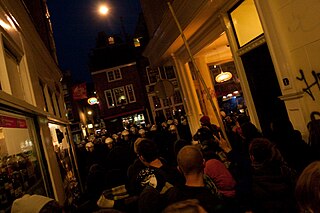
The Dutch squatting ban refers to the law ) introduced on 1 October 2010, under which squatting in the Netherlands became de jure illegal. There were riots in Amsterdam and Nijmegen and several other protests. Squatters converged, occupying a former fire station.

Squatting in England and Wales Occupation of unused land or derelict buildings in England and Wales

Squatting in England and Wales usually refers to a person who is not the owner, taking possession of land or an empty house. People squat for a variety of reasons which include needing a home, protest, poverty, and recreation. Many squats are residential, some are also opened as social centres. Land may be occupied by New Age travellers or treesitters.

Can Vies Self-managed social centre in Barcelona

Can Vies is a building located in the Sants neighborhood of Barcelona, built in 1879. It has been squatted since 1997 when a group of youths occupied it and began using it as an autonomous social centre and infoshop. In late May 2014 riots broke out in a successful attempt to stop an eviction. The building was partially demolished and rebuilt by the local community.

This article lists some of the events from 1980 related to the Netherlands.
Binz occupation Former squat in Switzerland

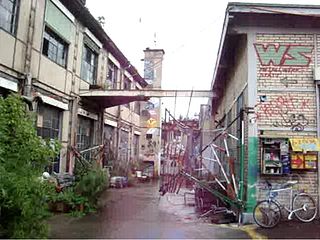
Binz was a factory building squatted as an autonomous social centre from 2006 until 2013 in the district of Wiedikon in Zürich. The occupation housed 50 people and provided workspace for 100.
Amsterdam coronation riots

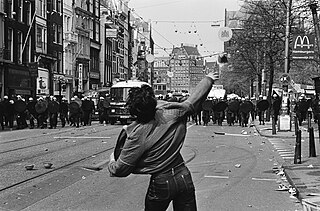
The Amsterdam coronation riots refers to major violence and rioting in Amsterdam, the Netherlands on the day of the accession of Queen Beatrix, 30 April 1980. It was the biggest episode of such disturbances in the country since the end of World War II and the most significant event of the Dutch squatters' movement (Krakersrellen).

We Are Here (collective) Human rights campaign of migrants in Amsterdam

We Are Here is a collective of migrants based in Amsterdam, the Netherlands, which campaigns for human rights for its members and all undocumented migrants. The asylum seekers have in many cases had their applications to remain in the Netherlands denied but they either cannot go back or refuse to return to their country of origin. They ask for access to social services such as medical care and housing.

Vrankrijk Legalised squat and self-managed social centre in Amsterdam

Vrankrijk is a legalised squat and self-managed social centre on the Spuistraat in central Amsterdam. There is an events space on the ground floor and above it a separate housing group.

Squatting in the Netherlands Occupation of unused land or derelict buildings in the Netherlands

Squatting in the Netherlands refers to the occupation of unused or derelict buildings or land without the permission of the owner. The modern squatters movement began in the 1960s in the Netherlands and became a powerful housing movement in the 1980s. At its height the squatters movement regularly came into conflict with the state, particularly in Amsterdam. Notable squats include ADM and Vrankrijk in Amsterdam, the Landbouwbelang in Maastricht, Grote Broek in Nijmegen, the Poortgebouw in Rotterdam, ACU in Utrecht and the Ruigoord village. Squatting was criminalised in 2010 and continues in diminished form.

References

  1. 1 2 3 4 "Amsterdam squatters and police mark 1980 riots". Archived from the original on 3 July 2018.
  2. "Squatting in Amsterdam - DutchAmsterdam.com". 19 January 2009.
  3. Stroobants, Jean-Pierre (20 July 2011). "Amsterdam vs. the Squatters: Evictions, Arrests and Protests" via content.time.com.
  4. "Violent protests after Dutch outlaw squatting - World news - Europe - NBC News". 3 October 2010.