 |
Wahweveh (Black Eagle) was a leader of the Oregon Walpapi Paiute (related to the Shoshone). [1] He was head war chief in the final phase of the Shoshoni Rebellion, known to Americans as the Sheepeater War of 1879. [1]
| |
Wahweveh (Black Eagle) was a leader of the Oregon Walpapi Paiute (related to the Shoshone). [1] He was head war chief in the final phase of the Shoshoni Rebellion, known to Americans as the Sheepeater War of 1879. [1]
Little is known of Wahweveh's early life. His full siblings were Chief Paulina, Bright Eyes, and Puna (Cactus Fruit). [2] His half-brother was Weahwewa (Wolf Dog). [1] [2]
On June 7, 1878, during the leadup to what became known as the Bannock War, Malheur Reservation Indian agent William V. Rinehart reported to the Commissioner of Indian Affairs that Wahweveh, with 55 braves, had picked up supplies and was heading east. [1] On Saturday, June 22, 1878, Black Eagle rescued the severely injured Pony Blanket (Egan) from the battlefield—saving his life, but signaling the end of Egan's tenure as war chief. [1] By July, news of a new Tukadika (Mountain Sheep Eater) Snake outbreak in Idaho drew Wahweveh and his Hunipui (Bear Killer) Snake dog-soldiers onto the battlefront. [1] On their way, on July 4 Black Eagle and his warriors attacked four heavily laden supply wagons at La Grande on their way to Pendleton. They destroyed the wagons, killed and mutilated their drivers, and scattered the freight.
On August 13, 1878, more than 60 warriors rode into the Malheur Indian Agency and were arrested after they surrendered to American troops. Among the warriors were Cheegibah (Leggins), son of Natchez (Boy) and grandson of Chief Winnemucca the Younger; Otiz (Left Hand), grandson of Owitze (Twisted Hand) and Ochiho (Red Willow), son of Chochoco (Has No Horse). [1] Under intense interrogation, Leggins identified the ranking war chiefs: Oytes (Left Hand), Bannock Joe Pohave (Racehorse), Captain Bearskin (Honalelo (Little Bearskin Dick)), Big John Ponce (Three Coyotes), Eagle Eye Wahweveh (Black Eagle), Charley Chongyo (Pipe), D.E. Johnson, Beads, and Surger Wahi (Fox). [1] Most of the leaders whom Leggins named were shot in 1878. [1] Lieutenant Colonel James Forsyth reported that his troops had killed Wahweveh (Black Eagle) on July 31, 1878; however, in spring 1879 Wahweveh and medicine chief Tamanmo (Black Spirit), with a few Snake dog soldiers, raided a mining camp on the Oregon-Idaho border and killed several Chinese laborers. [1] American troops under several leaders responded with a series of battles which became known as the Sheepeater War. [1]
Black Eagle was killed in late August 1879 on the south fork of the Salmon River. [1]

Sarah Winnemucca Hopkins was a Northern Paiute author, activist and educator.

Benjamin Louis Eulalie de Bonneville was an American officer in the United States Army, fur trapper, and explorer in the American West. He is noted for his expeditions to the Oregon Country and the Great Basin, and in particular for blazing portions of the Oregon Trail.
The Shoshone or Shoshoni are a Native American tribe with four large cultural/linguistic divisions:
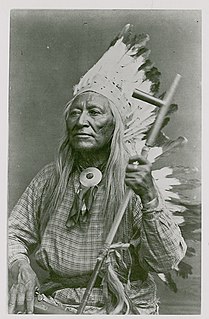
Washakie was a prominent leader of the Shoshone people during the mid-19th century. He was first mentioned in 1840 in the written record of the American fur trapper, Osborne Russell. In 1851, at the urging of trapper Jim Bridger, Washakie led a band of Shoshones to the council meetings of the Treaty of Fort Laramie (1851). Essentially from that time until his death, he was considered the head of the Eastern Shoshones by the representatives of the United States government. In 1979, he was inducted into the Hall of Great Westerners of the National Cowboy & Western Heritage Museum.
The Indian Campaign Medal is a decoration established by War Department General Orders 12, 1907. The medal was retroactively awarded to any soldier of the U.S. Army who had participated in the American Indian Wars against the Native Americans between 1865 and 1891.
The Bannock War of 1878 was an armed conflict between the U.S. military, Bannock and Paiute warriors in Idaho and Northeastern Oregon from June to August 1878. The Bannock totaled about 600 to 800 in 1870 because of other Soshonean peoples being included with Bannock numbers; they were led by Chief Buffalo Horn, who was killed in action on June 8, 1878. After his death, Chief Egan led the Bannocks. He and some of his warriors were killed in July, by a Umatilla party that entered his camp in subterfuge.
The Snake War (1864–1868) was an irregular war fought by the United States of America against the "Snake Indians," the settlers' term for Northern Paiute, Bannock and Western Shoshone bands who lived along the Snake River. Fighting took place in the states of Oregon, Nevada, and California, and in Idaho Territory. Total casualties from both sides of the conflict numbered 1,762 dead, wounded, or captured.
Old Toby, whose name was Pikee Queenah(Swooping Eagle), was war chief of the Tuziyammo band of Western Shoshone and a Shoshone dog soldier.

Winnemucca,, was a Northern Paiute war chief. He was born a Shoshone around 1820 in what would later become the Oregon Territory.

Established in 1849, the Vancouver Barracks was the first U.S. Army base located in the Pacific Northwest. Built on a rise 20 feet above the Hudson's Bay Company (HBC) trading station Fort Vancouver. Its buildings were formed in a line adjacent to the Columbia River about 2,000 yards from the water. It is now located within modern Vancouver, Washington.
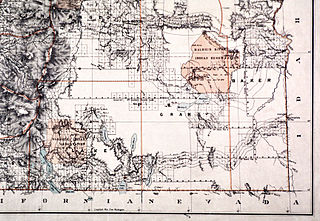
The Malheur Indian Reservation was an Indian reservation established for the Northern Paiute in eastern Oregon and northern Nevada from 1872 to 1879. The federal government discontinued the reservation after the Bannock War of 1878, under pressure from European-American settlers who wanted the land. This negative recommendation against continuing by its agent William V. Rinehart, the internment of more than 500 Paiute on the Yakama Indian Reservation, also the reluctance of the Bannock and Paiute to return to the lands after the war.
In August, 1851, a band of Shoshoni Indians led by Cho Cho Co reportedly attacked a wagon train led by Thomas Clark on the Oregon Trail near where the Raft River joins the Snake River in present-day Idaho. Afterward, reports held that the Indians' primary objective was to steal horses from Thomas Clark's wagon train party, and that the Indians killed Clark's mother and brother and another man traveling with them during the horse robbery.
Egan is the American name given to Pony Blanket. Pony Blanket was a Northern Paiute leader in the Oregon Country in the 19th century.

Fort Harney was a United States Army outpost in eastern Oregon in the United States. It was named in honor of Brigadier General William S. Harney. Fort Harney was used as a supply depot and administrative headquarters from 1867 to 1880 during the Army's campaign against Northern Paiute bands in Eastern Oregon and the Bannock uprising in the same area. Today, nothing remains of Fort Harney except a small cemetery.

Chief Paulina or Pahninee was a Northern Paiute war leader noted for his successful guerrilla tactics. He is known to have been active from 1859 until his death in 1867.

The Lemhi Reservation was a United States Indian Reservation for the Lemhi Shoshone from 1875 to 1907. During almost all this time their main chief was Tendoy.

The Bannock War of 1895, or the Bannock Uprising, refers to a minor conflict centered in Jackson Hole, Wyoming, in the United States. During the early 1890s, Wyoming passed a state law prohibiting the killing of elk for their teeth, which led to the arrests of several Bannock hunters in 1895. The arrests and the death of one Bannock created wildly exaggerated rumors that the natives would revolt; at one point, the Eastern press reported that the Bannocks had massacred a large group of settlers in Jackson Hole. In response, the United States Army launched an expedition into the area- when troops arrived, it was found that the situation was peaceful and that the fears of uprising were unjustified.

Numaga was a Paiute leader during the Paiute War of 1860 that centered on Pyramid Lake in what is now Nevada in the United States. The war was caused by an influx of miners and ranchers after silver was discovered in the Comstock Lode near to Carson City. The newcomers assaulted the Paiutes and destroyed their foods supplies. When the Paiutes responded, the U.S. Army used force to suppress them. Both before and after the war, Numaga was a strong advocate of peace and did much to reduce the violence on both sides. He died of tuberculosis, a "white man's disease", in 1871.
Northern Shoshone are Shoshone of the Snake River Plain of southern Idaho and the northeast of the Great Basin where Idaho, Wyoming and Utah meet. They are culturally affiliated with the Bannock people and are in the Great Basin classification of Indigenous People.

William Vance Rinehart was an American soldier who served as a Union Army officer in both the 1st Oregon Volunteer Cavalry Regiment and 1st Oregon Volunteer Infantry Regiment during the American Civil War. He was later appointed as Indian agent at the Malheur Indian Reservation in eastern Oregon. Rinehart then moved to Seattle, Washington where he engaged in business and was active in state and local politics. He was elected to Washington state's first legislature, serving as a state senator from 1889 through 1890.