
Max Ludwig Henning Delbrück was a German–American biophysicist who participated in launching the molecular biology research program in the late 1930s. He stimulated physical scientists' interest into biology, especially as to basic research to physically explain genes, mysterious at the time. Formed in 1945 and led by Delbrück along with Salvador Luria and Alfred Hershey, the Phage Group made substantial headway unraveling important aspects of genetics. The three shared the 1969 Nobel Prize in Physiology or Medicine "for their discoveries concerning the replication mechanism and the genetic structure of viruses". He was the first physicist to predict what is now called Delbrück scattering.

The University of Jena, officially the Friedrich Schiller University Jena, is a public research university located in Jena, Thuringia, Germany.

The Gottfried Wilhelm Leibniz Prize, or Leibniz Prize, is awarded by the German Research Foundation to "exceptional scientists and academics for their outstanding achievements in the field of research". Since 1986, up to ten prizes have been awarded annually to individuals or research groups working at a research institution in Germany or at a German research institution abroad. It is considered the most important research award in Germany.

Günter Matthias Ziegler is a German mathematician who has been serving as president of the Free University of Berlin since 2018. Ziegler is known for his research in discrete mathematics and geometry, and particularly on the combinatorics of polytopes.
The Max Delbrück Center for Molecular Medicine in the Helmholtz Association (MDC) in Berlin, Germany is one of the sixteen research centers of the Helmholtz Association of German Research Centres.
Martin J. Lohse is a German physician and pharmacologist.

The Beutenberg Campus is a science and research site situated in southern Jena, Germany. The physician Hans Knöll founded the first biomedical research institute at Beutenberg in 1950. From 1970, it was run as the Central Institute of Microbiology and Experimental Therapy of the Academy of Sciences of the GDR. From 1982 institutes focussing on physics were also set up on the site. Following German reunification in 1990, a multidisciplinary science and research centre was created in response to a recommendation by the German Council of Science and Humanities.

Peter-André Alt is a German literary scholar, former president of the Freie Universitaet of Berlin and, since August 2018, president of the German Rectors' Conference (HRK). Alt is married to the writer Sabine Alt and has two adult sons.

Roger Sidney Goody is an English biochemist who served as director at the Max Planck Institute for Molecular Physiology in Dortmund from 1993 until 2013. Since 2013 he is Emeritus Director of the institute.

The German Centre for Integrative Biodiversity Research (iDiv) Halle-Jena-Leipzig is a DFG research center with staff and members at its main locations in Halle, Jena and Leipzig. It is a central facility of Leipzig University, and is run together with the Martin Luther University Halle-Wittenberg and Friedrich Schiller University Jena, as well as in cooperation with the Helmholtz Centre for Environmental Research - UFZ. In addition, seven non-university research institutions belong to the iDiv consortium. iDiv was founded in 2012 and is funded by the DFG.
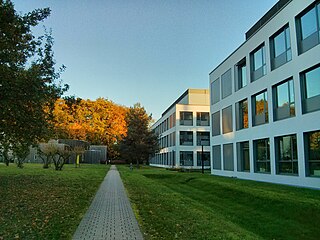
The Leibniz-Forschungsinstitut für Molekulare Pharmakologie (FMP) is a research institute in the Leibniz Association, focussing on proteins as basic structures of cellular organisms. It is one of the large number of research institutions based in Berlin. The institute is situated on a research campus in Buch, a northern district of Berlin. Legally, the FMP and seven other Leibniz Institutes based in Berlin are represented by the Forschungsverbund Berlin .

Volker Haucke is a biochemist and cell biologist. He is Director of the Leibniz-Forschungsinstitut für Molekulare Pharmakologie Berlin (FMP) Berlin and Professor of Molecular Pharmacology at the Institute for Pharmacy of the Free University of Berlin.
The Max Delbrück Medal has been awarded annually from 1992 to 2013 by the Max Delbrück Center for Molecular Medicine. Named after the German biophysicist Max Delbrück, it is presented in Berlin to an outstanding scientist on the occasion of the annual "Berlin Lecture on Molecular Medicine", which the MDC organizes together with other Berlin research institutions and Bayer HealthCare. The award recipient usually delivers a lecture after the award.
Karl-Wolfgang Zschiesche was a German physician and pathologist.

Detlev Ganten is a specialist in pharmacology and molecular medicine and is one of the leading scientists in the field of hypertension. He founded the World Health Summit in 2009. He was Chairman of the Foundation Board of the Charité Foundation (2005–2015), editor of the Journal of Molecular Medicine, Chairman of the Board of Trustees of the Max Planck Institute of Colloids and Interfaces and Max Planck Institute of Molecular Plant Physiology as well as Chairman of the Board of Trustees of the Ethnological Museum Dahlem of the Prussian Cultural Heritage Foundation.

Helge Reinhold Braun is a German physician and politician of the Christian Democratic Union (CDU). Between 2018 and 2021, he served as Head of the Chancellery and Federal Minister for Special Affairs in the fourth coalition government of Chancellor Angela Merkel. He was the Parliamentary Secretary of State for Bureaucracy Reduction and Federal-State Relations at the Chancellery between 2013 and 2018.
Ana Pombo is an appointed Professor (W3) of Biology at Humboldt University and senior group leader at the Berlin Institute for Medical Systems Biology (BIMSB) at the Max Delbrück Center for Molecular Medicine (MDC) in Berlin-Buch with the focus on "Epigenetic Regulation and Chromatin Architecture". Since May 2018, Pombo is an elected member of the European Molecular Biology Organization (EMBO).

Nikolaus Rajewsky is a German system biologist at the Max-Delbrück-Center for Molecular Medicine (MDC) and at the Charité in Berlin. He founded and directs the “Berlin Institute for Medical Systems Biology”.. He leads the Rajewsky lab, where he studies how RNA regulates gene expression. He also co-chairs LifeTime, a pan-European research initiative of more than 90 academic institutions and 70 companies, which aims to revolutionize healthcare by mapping, understanding, and targeting cells during disease progression. LifeTime integrates several technologies: single-cell multiomics, machine learning, and personalized disease models such as organoids. Rajewsky has received numerous awards and honors, including the most prestigious German award, the Gottfried Wilhelm Leibniz Prize, endowed with 2.5 million euros by the German Research Foundation (DFG).
Carmen Birchmeier-Kohler is a German geneticist and developmental biologist. The focus of her research group is the development of embryonic tissues and the nervous system. The model organism for her investigations is the mouse.

Christian Hertweck is a German chemist, deputy director and head of the department of biomolecular chemistry at the Leibniz Institute for Natural Products Research and Infection Biology.

