Water privatization in Albania

Last updated

Water privatization in Albania was initiated by the Albanian government in the early 2000s with the support of the World Bank and German development cooperation. The stated objective was to improve the quality and efficiency of urban water supply and sanitation. At the time, many households received water only for a few hours every day, utilities were overstaffed, water tariffs were low and many customers did not pay their water bills. There was no single municipal wastewater treatment plant in the country of 3 million, which is among Europe's poorest countries. In 2002-03 three contracts were signed with foreign private operators covering six secondary cities. Water privatization never covered more than a fifth of the country’s population. The contracts expired or were terminated early five years later with few tangible improvements in service quality.

Contents

Situation before privatization

Much of the water and sewerage infrastructure in Albania was built between the 1950s and early 70s with help from the People’s Republic of China. When Chinese aid ended in 1978 after the two communist governments fell out with each other, the infrastructure deteriorated with little or no maintenance. The responsibility for water supply rested with the central government with no participation by local governments and communities. With the fall of communism in the 1992 elections, the provision of water supply and sanitation services was assigned to 52 state-owned regional water enterprises in an effort to empower local government. Typically, the service area of a regional water enterprise comprises several municipalities. The mayors of Albania's 373 municipalities (Albanian: bashki or komunë) nominate the members of the management councils of the regional water company which serves their territory.

However, all important decisions about investments and staffing actually continued to be taken by the central government, so that local governments felt that they had no actual responsibility for water supply. Revenues were insufficient to cover even operating expenses, and electricity bills or even salaries went unpaid unless the central government provided subsidies. Investments picked up with Western aid after 1992, but service quality continued to remain poor. [1]

About 70% of all water produced was non-revenue water and only 30% was billed. Only 70% of these bills were actually paid, so that ultimately only 21% of the water produced was actually paid for. Furthermore, the regional water and sewer companies had about three times more staff per connection than in other Eastern European and Central Asian utilities. Low revenues and high costs led to an average operating cost recovery rate of only 60%. On all these counts, the performance of Albanian water companies was much lower than the performance of utilities in other former communist countries ten years after the beginning of the transition process. [2] Concerning service quality, on average water was available only 3–4 hours per day. Certain areas received water only once in three days, which was partly due to intermittent power supply for pumps. There was no wastewater treatment. Sewers were often clogged causing seepage and cross-contamination with drinking water. Many covers for manholes were missing so that they filled with rubbish. [1]

Reforms

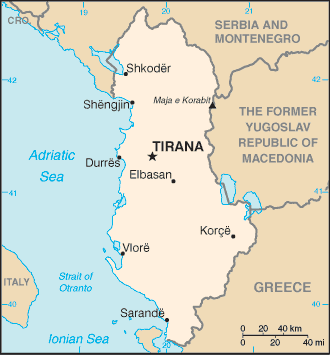
Map of Albania showing three provincial cities - Elbasan, Durres and Sarande - out of six whose water supply has been privatized in 2002-03. Albania map.png
Map of Albania showing three provincial cities - Elbasan, Durrës and Sarandë - out of six whose water supply has been privatized in 2002–03.

The reform strategy for the urban water and sanitation sector included three main elements: decentralization, private sector participation and increased cost recovery. [1] The reforms were decided and implemented by governments under socialist Prime Ministers that ruled from 1997 to 2005. The reform process was supported by German development cooperation and the World Bank with financing and technical assistance. The government also decided that 6 companies would enter into public-private partnerships with foreign companies through 3 contracts. Water privatization thus never covered more than a fifth of the country’s population. The water supply for the capital Tirana was not privatized.

In 1998 the government instructed 18 of the 52 regional water enterprises to transform themselves into joint stock companies whose shares were held by the central government. However, in 2000 the government passed the "Law on Organization and Functioning of Local Governments, No. 8652" which gave the exclusive responsibility for water supply and sanitation to the municipalities. Thus the government sent what appears to be contradictory signals: keeping the shares of joint stock companies in the hands of central government, while passing the responsibility for the sector to the municipalities.

It is thus perhaps not surprising that the transformation of regional water companies to joint stock companies was slow: as of 2003 only 10 had completed the transformation and the by-laws necessary for the implementation of the local government law were not yet issued. The continued strong role of central government is shown by the fact that in the privatization process the central government, and not local governments, selected the private companies and signed the contracts with them.

Elbasan concession

In the central Albanian city of Elbasan the first private sector water supply contract in Albania was signed. Elbasan 1.jpg
In the central Albanian city of Elbasan the first private sector water supply contract in Albania was signed.

The first private sector contract, a 30-year concession for Elbasan, took effect in April 2002. It was awarded to Berlinwasser International. It was supported by German development cooperation, which was to finance 70% of investment while the remainder was to be financed by the private concessionnaire. [3] The contract had been negotiated between Berlinwasser and the Albanian government since 1999, when it had been expected the contract would be signed in 2000. [4]

Kavajë management contract

The second contract, a 4-year management contract for the Kavajë district, took effect in early 2003. The contract was meant to “prepare the ground for more substantial private sector participation at a later stage.” [3] It was awarded to Aquamundo and was also financed by German development cooperation. Aquamundo was initially a joint venture owned by ABB, Bilfinger Berger and MVV Energie, the utility that serves the German city of Mannheim. [5] However, according to other sources Aquamundo was two third-owned by the Saudi Arabian Amiantit Company, through its subsidiary AmiWater, when it signed the contract. [6] According to the company website, Aquamundo has only been part of Amiantit Company since 2004.

The objectives were to introduce continuous water supply, reduce water losses and increase bill collection. Furthermore, the contract included the construction and operation of the first wastewater treatment plant in Albania. [7]

Four cities management contract

In the port city of Durres where the water supply system was run by a private company from 2003 to 2008, continuity of water supply stagnated at 2-3 hours per day, short of the modest target of 6 hours per day. Durres Albania 2.jpg
In the port city of Durrës where the water supply system was run by a private company from 2003 to 2008, continuity of water supply stagnated at 2-3 hours per day, short of the modest target of 6 hours per day.

The third contract, a 5-year management contract for the districts of Durrës, Fier, Lezhë and Sarandë, took effect in June 2003. It was financed by the World Bank. The objectives of this contract were to increase the continuity of water supply, to improve water quality, to increase bill collection and cost recovery. It was signed with Berlinwasser International, but Aquamundo was involved as a subcontractor.

Impact

There is little public information available about the impact of the privatization in Elbasan and Kavajë. However, the World Bank has published detailed information on the impact of the four cities concession in the completion report for the project that financed the management contract.

In the city of Lezhe the compliance with drinking water quality standards increased from 55% to almost 100% during the management contract. However, cost recovery remained poor. View of Lezhe.jpg
In the city of Lezhë the compliance with drinking water quality standards increased from 55% to almost 100% during the management contract. However, cost recovery remained poor.

Service quality. The continuity of supply in Fier and Sarandë increased significantly, but it remained unchanged at a low level of 2–3 hours per day in Durrës and equally unchanged at a high level of 20 hours per day in Lezhë. Water quality compliance improved markedly in Lehzë and Sarandë; it had already been good in the other two cities.

Cost recovery. Financial indicators for the four utilities had been below the Albanian average at the beginning of the management contract, although the Albanian average was already below the average of other formerly communist countries. From this dismal starting point the collection efficiency and cost recovery improved somewhat, but remained far from satisfactory: Collection efficiency was 56-81% and operating cost recovery 40-60% at the beginning of the contract. The objective of 79% collection efficiency was reached in only one city, while the objective of operation cost recovery was not reached in any city despite tariff increases. [8] Residential water tariffs almost doubled in two cities and almost tripled in the other two between 2002 and 2008. They were 15-20 Lek per cubic meter in 2002 (11-15 Euro Cent) and stood at 35-43 Lek (29-36 Euro Cent) in 2008. [9] In order to protect the poor from tariff increases, the Government supported the four municipalities to test a free basic water policy. Low-income metered households were to be provided 20 liters per capita per day free of charge beginning in 2004. [1] However, the policy was difficult to implement, because metering is a precondition for free basic water and only about 20% of residential customers were metered. Without free basic water, a tariff of 40 Lek per cubic meter corresponded to about 3% of the income of a poor household in 2006. [2]

Supervisory Boards of the utilities retained ultimate authority for key decisions such as staffing. This limited the control of the private operator over key decisions, making it more difficult to achieve the objectives. [10]

Remunicipalisation

The Elbasan concession with Berlinwasser was terminated early in 2007 in mutual agreement, while the management contracts expired in 2007 and 2008 without being renewed. The responsibility for water supply and sanitation reverted to the municipal utilities.

See also

Related Research Articles

Water supply and sanitation in Latin America

Water supply and sanitation in Latin America is characterized by insufficient access and in many cases by poor service quality, with detrimental impacts on public health. Water and sanitation services are provided by a vast array of mostly local service providers under an often fragmented policy and regulatory framework. Financing of water and sanitation remains a serious challenge.

Access to at least basic water increased from 94% to 97% between 2000 and 2015; an increase in access to at least basic sanitation from 73% to 86% in the same period;
Water supply and sanitation in Argentina

Drinking water supply and sanitation in Argentina is characterized by relatively low tariffs, mostly reasonable service quality, low levels of metering and high levels of consumption for those with access to services. At the same time, according to the WHO, 21% of the total population remains without access to house connections and 52% of the urban population do not have access to sewerage. The responsibility for operating and maintaining water and sanitation services rests with 19 provincial water and sewer companies, more than 100 municipalities and more than 950 cooperatives, the latter operating primarily in small towns. Among the largest water and sewer companies are Agua y Saneamientos Argentinos (AYSA) and Aguas Bonarenses S.A. (ABSA), both operating in Greater Buenos Aires, Aguas Provinciales de Santa Fe, and Aguas Cordobesas SA, all of them now publicly owned. In 2008 there were still a few private concessions, such as Aguas de Salta SA, which is majority-owned by Argentine investors, and Obras Sanitarias de Mendoza (OSM).

Water supply and sanitation in Indonesia is characterized by poor levels of access and service quality. Almost 30 million people lack access to an improved water source and more than 70 million of the country's 264 million population has no access to improved sanitation. Only about 2% of people have access to sewerage in urban areas; this is one of the lowest in the world among middle-income countries. Water pollution is widespread on Bali and Java. Women in Jakarta report spending US$11 per month on boiling water, implying a significant burden for the poor.
Water supply and sanitation in India Drinking water supply and sanitation in India continue to be inadequate

The water supply and sanitation in India has improved greatly from 1980 to present. However, many people lack access to clean water, toilets, and sewage infrastructure. Various government programs at national, state, and community level have brought rapid improvements in sanitation and the drinking water supply. Some of these programs are ongoing.

Water supply and sanitation in China is undergoing a massive transition while facing numerous challenges such as rapid urbanization, increasing economic inequality, and the supply of water to rural areas. Water scarcity and pollution also impact access to water.

The Water supply and sanitation services in Portugal have seen important advances in access to services, technologies used and service quality over the past decades (1980s–1990s), partially achieved thanks to important funds from the European Union. Nevertheless, sanitation still remains relatively low in mountain rural areas and some people have their own sources of water controlled by municipalities.

Water supply and sanitation in Yemen is characterized by many challenges as well as some achievements. A key challenge is severe water scarcity, especially in the Highlands, prompting The Times of London to write "Yemen could become the first nation to run out of water". A second key challenge is a high level of poverty, making it very difficult to recover the costs of service provision. Access to water supply sanitation in Yemen is as low or even lower than that in many sub-Saharan African countries. Yemen is both the poorest country and the most water-scarce country in the Arab world. Third, the capacity of sector institutions to plan, build, operate and maintain infrastructure remains limited. Last but not least the security situation makes it even more difficult to improve or even maintain existing levels of service.

Water supply and sanitation in Rwanda

Water supply and sanitation in Rwanda is characterized by a clear government policy and significant donor support. In response to poor sustainability of rural water systems and poor service quality, in 2002 local government in the Northern Byumba Province contracted out service provision to the local private sector in a form of public–private partnership. Support for public-private partnerships became a government policy in 2004 and locally initiated public-private partnerships spread rapidly, covering 25% of rural water systems as of 2007.

The Philippines’ water supply system dates back to 1946, after the country declared independence. Government agencies, local institutions, non-government organizations, and other corporations are primarily in charge of the operation and administration of water supply and sanitation in the country.

Drinking water supply and sanitation in Pakistan is characterized by some achievements and many challenges. Despite high population growth the country has increased the share of the population with access to an improved water source from 85% in 1990 to 87% in 2010, although this does not necessarily mean that the water from these sources is safe to drink. The share with access to improved sanitation increased from 27% to 48% during the same period, according to the Joint Monitoring Program for Water Supply and Sanitation. There has also been considerable innovation at the grass-root level, in particular concerning sanitation. The Orangi Pilot Project in Karachi and community-led total sanitation in rural areas are two examples of such innovation.

Water supply and sanitation in Zambia

Water supply and sanitation in Zambia is characterized by achievements and challenges. Among the achievements are the creation of regional commercial utilities for urban areas to replace fragmented service provision by local governments; the establishment of a regulatory agency that has substantially improved the availability of information on service provision in urban areas; the establishment of a devolution trust fund to focus donor support on poor peri-urban areas; and an increase in the access to water supply in rural areas.

Water supply and sanitation in Senegal

Water supply and sanitation in Senegal is characterized by a relatively high level of access compared to the average of Sub-Saharan Africa. One of the interesting features is a public-private partnership (PPP) that has been operating in Senegal since 1996, with Senegalaise des Eaux (SDE), a subsidiary of Saur International, as the private partner. It does not own the water system but manages it on a 10-year lease contract with the Senegalese government. Between 1996 and 2014, water sales doubled to 131 million cubic meters per year and the number of household connections increased by 165% to more than 638,000. According to the World Bank, "the Senegal case is regarded as a model of public-private partnership in sub-Saharan Africa". Another interesting feature is the existence of a national sanitation company in charge of sewerage, wastewater treatment and stormwater drainage, which has been modeled on the example of the national sanitation company of Tunisia and is unique in Sub-Saharan Africa.

Drinking water supply and sanitation in Egypt is characterized by both achievements and challenges. Among the achievements are an increase of piped water supply between 1998 and 2006 from 89% to 100% in urban areas and from 39% to 93% in rural areas despite rapid population growth; the elimination of open defecation in rural areas during the same period; and in general a relatively high level of investment in infrastructure. Access to an at least basic water source in Egypt is now practically universal with a rate of 98%. On the institutional side, the regulation and service provision have been separated to some extent through the creation of a national Holding Company for Water and Wastewater in 2004, and of an economic regulator, the Egyptian Water Regulatory Agency (EWRA), in 2006.

Water supply and sanitation in Turkey is characterized by achievements and challenges. Over the past decades access to drinking water has become almost universal and access to adequate sanitation has also increased substantially. Autonomous utilities have been created in the 16 metropolitan cities of Turkey and cost recovery has been increased, thus providing the basis for the sustainability of service provision. Intermittent supply, which was common in many cities, has become less frequent. In 2004, 61% of the wastewater collected through sewers was being treated. In 2020 77% of water was used by agriculture, 10% by households and the rest by industry.

Water supply and sanitation in Malaysia is characterised by numerous achievements, as well as some challenges. Universal access to water supply at affordable tariffs is a substantial achievement. The government has also shown a commitment to make the sector more efficient, to create a sustainable funding mechanism and to improve the customer orientation of service providers through sector reforms enacted in 2006. The reform creates a modern institutional structure for the water sector, including an autonomous regulatory agency, an asset management company and commercialised state water companies that have to reach certain key performance indicators that will be monitored by the regulatory agency. The government has also stated its intention not to embark on new private sector contracts for water provision, after a bout of such contracts during the 1990s showed mixed results.

Water supply and sanitation in Lebanon is characterized by a number of achievements and challenges. The achievements include the reconstruction of infrastructure after the 1975–90 Civil War and the 2006 war with Israel, as well as the reform of the water and sanitation sector through a water law passed in 2000. The law created four Regional Water Establishments to consolidate numerous smaller utilities.

Water supply and sanitation in Italy is characterized by mostly good services at prices that are lower than in other European countries with similar income levels. For example, the average monthly residential water and sewer bill in Italy is 20 Euro compared to 31 Euro in France. According to the OECD, water in Italy has been underpriced for a long time. With about 240 liter per day, per capita water use for residential uses in Italy is higher than in Spain or in France, where it is about 160 liter per day. Water resources in Italy are distributed unevenly, with more abundant resources in the North and scarcer resources in the South. Most water withdrawals are for agriculture and industry, with only 18 percent of water withdrawals made for drinking water supply. About one third of the water withdrawn for municipal supply is not billed to the customers because of leakage, malfunctioning water meters and water theft.

Water supply and sanitation in Vietnam is characterized by challenges and achievements. Among the achievements is a substantial increase in access to water supply and sanitation between 1990 and 2010, nearly universal metering, and increased investment in wastewater treatment since 2007. Among the challenges are continued widespread water pollution, poor service quality, low access to improved sanitation in rural areas, poor sustainability of rural water systems, insufficient cost recovery for urban sanitation, and the declining availability of foreign grant and soft loan funding as the Vietnamese economy grows and donors shift to loan financing. The government also promotes increased cost recovery through tariff revenues and has created autonomous water utilities at the provincial level, but the policy has had mixed success as tariff levels remain low and some utilities have engaged in activities outside their mandate.

Water supply and sanitation in Georgia is characterized by achievements and challenges. Among the achievements is the improvement of water services in the capital Tbilisi where the water supply is now continuous and of good quality, major improvements in the country's third-largest city Batumi on the Black Sea where the country's first modern wastewater treatment plant now is under operation, as well as a general increase in access to drinking water in the entire country. Water and sewer tariffs remain affordable, with the private water company Georgian Water and Power (GWP) serving the capital being financially viable and profitable, while the public water company serving most of the rest of the country remains financially weak. The improvements were achieved after the Rose Revolution of 2004 when the government decided to reform the sector and to invest in it after many years of neglect.
References

  1. 1 2 3 4 Andreas Rohde; Toru Konishi; Subramaniam Janakira (May 25–27, 2004). "Case Study on Albania: Reforming the Irrigation and Domestic Water Supply and Sanitation Services to Benefit the Poor" (PDF). Conference on Scaling Up Poverty Reduction. Beijing: World Bank. Retrieved 22 October 2011.
  2. 1 2 World Bank:Albania Public Expenditure and Institutional Review:Restructuring Public Expenditure to Sustain Growth - Sector related presentations-Water, 15 March 2007; retrieved on 23 October 2011
  3. 1 2 German Development Co-operation with Albania :Abstract of the Evaluation “Public-Private Partnership (PPP) in German Development Cooperation” - Country Study Albania
  4. Berlinwasser (2 December 1999). "Berliner Wasser und KfW: Public-Private-Partnership für Albanien. Wieczorek-Zeul: Modellfall wirtschaftlichen Know-how-Transfers" . Retrieved 23 October 2011.
  5. Global Water Intelligence: Aquamundo wins Albanian management contract, February 2003
  6. Amiantit:Saudi Arabian Amiantit Subsidiary Aquamundo Takes Over Drinking Water Supply And Sewage Disposal Operations In Four Albanian Cities, June 6, 2003; retrieved on 23 October 2011
  7. Aquamundo:Provision of Water and Sewerage Services to U.K. Kavajë sh.a., Republic of Albania; retrieved on 23 October 2011
  8. World Bank:Municipal Water And Wastewater Project Implementation Completion Report, 10 July 2010, p. 10; retrieved on 23 October 2011
  9. World Bank:Municipal Water And Wastewater Project Implementation Completion Report, 10 July 2010, p. 22; retrieved on 23 October 2011
  10. World Bank:Municipal Water And Wastewater Project Implementation Completion Report, 10 July 2010, p. 6; retrieved on 23 October 2011