
Emmeline Pankhurst was a British political activist who organised the British suffragette movement and helped women to win in 1918 the right to vote in Great Britain and Ireland. In 1999, Time named her as one of the 100 Most Important People of the 20th Century, stating that "she shaped an idea of objects for our time" and "shook society into a new pattern from which there could be no going back". She was widely criticised for her militant tactics, and historians disagree about their effectiveness, but her work is recognised as a crucial element in achieving women's suffrage in the United Kingdom.

The Women's Social and Political Union (WSPU) was a women-only political movement and leading militant organisation campaigning for women's suffrage in the United Kingdom founded in 1903. Known from 1906 as the suffragettes, its membership and policies were tightly controlled by Emmeline Pankhurst and her daughters Christabel and Sylvia. Sylvia was eventually expelled.
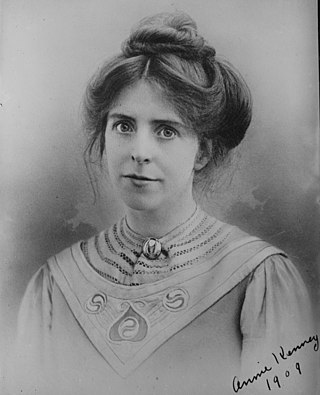
Ann "Annie" Kenney was an English working-class suffragette and socialist feminist who became a leading figure in the Women's Social and Political Union. She co-founded its first branch in London with Minnie Baldock. Kenney attracted the attention of the press and public in 1905 when she and Christabel Pankhurst were imprisoned for several days for assault and obstruction related to the questioning of Sir Edward Grey at a Liberal rally in Manchester on the issue of votes for women. The incident is credited with inaugurating a new phase in the struggle for women's suffrage in the UK with the adoption of militant tactics. Annie had friendships with Emmeline Pethick-Lawrence, Baroness Pethick-Lawrence, Mary Blathwayt, Clara Codd, Adela Pankhurst, and Christabel Pankhurst.

Emmeline Pethick-Lawrence, Baroness Pethick-Lawrence was a British women's rights activist and suffragette.

A movement to fight for women's right to vote in the United Kingdom finally succeeded through acts of Parliament in 1918 and 1928. It became a national movement in the Victorian era. Women were not explicitly banned from voting in Great Britain until the Reform Act 1832 and the Municipal Corporations Act 1835. In 1872 the fight for women's suffrage became a national movement with the formation of the National Society for Women's Suffrage and later the more influential National Union of Women's Suffrage Societies (NUWSS). As well as in England, women's suffrage movements in Wales, Scotland and other parts of the United Kingdom gained momentum. The movements shifted sentiments in favour of woman suffrage by 1906. It was at this point that the militant campaign began with the formation of the Women's Social and Political Union (WSPU).

A suffragette was a member of an activist women's organisation in the early 20th century who, under the banner "Votes for Women", fought for the right to vote in public elections in the United Kingdom. The term refers in particular to members of the British Women's Social and Political Union (WSPU), a women-only movement founded in 1903 by Emmeline Pankhurst, which engaged in direct action and civil disobedience. In 1906, a reporter writing in the Daily Mail coined the term suffragette for the WSPU, derived from suffragistα, in order to belittle the women advocating women's suffrage. The militants embraced the new name, even adopting it for use as the title of the newspaper published by the WSPU.

Mary Elizabeth Phillips was an English suffragette, feminist and socialist. She was the longest prison serving suffragette. She worked for Christabel Pankhurst but was sacked; she then worked for Sylvia Pankhurst as Mary Pederson or Mary Paterson. In later life she supported women's and children's organisations.

Lucy Minnie Baldock was a British suffragette. Along with Annie Kenney, she co-founded the first branch in London of the Women's Social and Political Union.

Gladice Georgina Keevil was a British suffragette who served as head of the Midlands office of the Women's Social and Political Union between 1908 and 1910.

Women's Sunday was a suffragette march and rally held in London on 21 June 1908. Organised by Emmeline Pankhurst's Women's Social and Political Union (WSPU) to persuade the Liberal government to support votes for women, it is thought to have been the largest demonstration to be held until then in the country.

Ada Susan Flatman (1876–1952) was a British suffragette who worked in the United Kingdom and the United States.

Edith Hudson was a British nurse and suffragette. She was an active member of the Edinburgh branch of the Women's Social and Political Union (WSPU) and was arrested several times for her part in their protests in Scotland and London. She engaged in hunger strikes while in prison and was forcibly fed. She was released after the last of these strikes under the so-called Cat and Mouse Act. Hudson was awarded a Hunger Strike Medal 'for Valour' by the WSPU.
Sara Jessie Stephenson (1873–1966) was a British suffragette and a member of the WSPU who organised census boycott in Manchester.

Eleanor Grace Watney Roe was Head of Suffragette operations for the Women's Social and Political Union. She was released from prison after the outbreak of World War I due to an amnesty for suffragettes negotiated with the government by the WSPU.
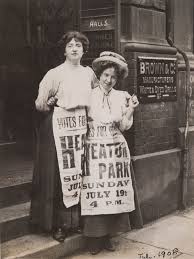
Patricia Woodlock was a British artist and suffragette who was imprisoned seven times, including serving the longest suffragette prison sentence in 1908 ; she was awarded a Women's Social and Political Union (WSPU) Hunger Strike Medal for Valour. Her harsh sentence caused outrage among supporters and inspired others to join the protests. Her release was celebrated in Liverpool and London and drawn as a dreadnought warship, on the cover of the WSPU Votes for Women newspaper.

The WSPU Holloway Banner is a suffragette banner designed by Scottish artist Ann Macbeth.

Hilda Mary Dallas (1878–1958) was a British artist and a suffragette who designed suffrage posters and cards and took a leadership role for the Women's Social and Political Union (WSPU). A pacifist, she raised funds from a cross-section of society, produced and designed set & costumes for the 1929 Court Theatre production of the anti-war satirical play The Rumour.

Barbara Fanny Wylie was a British suffragette. In 1909 she joined the Women's Social and Political Union (WSPU) and in 1910 she joined the Glasgow branch of WSPU as an activist and organizer. Wylie is best known for delivering a speech in support of women's suffrage during her 1912 Canadian speaking tour where she spoke the phrase "deeds not words".
Elizabeth Ellen Hesmondhalgh began working around 1885 as a cotton spinner in Preston, and became a British suffragette, imprisoned twice for militant protesting on behalf of women's franchise, and awarded the Women's Social and Political Union (WSPU) Hunger Strike Medal for valour.

The Suffragette was a newspaper associated with the women's suffrage movement in the United Kingdom, as "the Official Organ of the Women’s Social and Political Union" (WSPU). It replaced the previous journal of the organization, Vote for Women, in 1912, and it's name changed to Britannia after the outbreak of World War I.

