Wemindji, Quebec

Last updated

Coordinates: 53°0′N78°48′W / 53.000°N 78.800°W / 53.000; -78.800

Geographic coordinate system Coordinate system

A geographic coordinate system is a coordinate system that enables every location on Earth to be specified by a set of numbers, letters or symbols. The coordinates are often chosen such that one of the numbers represents a vertical position and two or three of the numbers represent a horizontal position; alternatively, a geographic position may be expressed in a combined three-dimensional Cartesian vector. A common choice of coordinates is latitude, longitude and elevation. To specify a location on a plane requires a map projection.

Contents

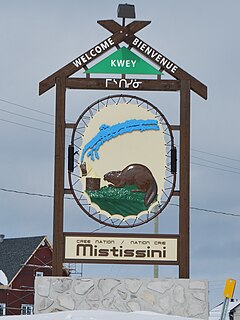
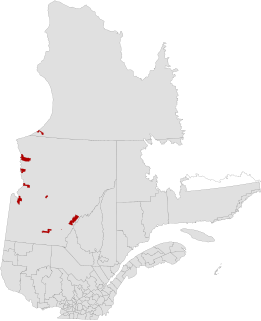
Wemindji (Cree : ᐐᒥᓂᒌ/Wîminicî) is a small Cree community on the east coast of James Bay at the mouth of the Maquatua River in Quebec, Canada. Its legal name is the Cree Nation of Wemindji. Wemindji is apart of the Abitibi-Baie-James-Nunavik-Eeyou district which is presented by NDP [Romeo Saganash] .The community has a population of approximately 1400 people. 1600 are affiliated to the Cree Nation of Wemindji, around 200 do not reside on the territory of Wemindji.

Cree language Algonquian language spoken by people across Canada, from the Northwest Territories and Alberta to Labrador, making it the aboriginal language with the highest number of speakers in Canada

Cree is a dialect continuum of Algonquian languages spoken by approximately 117,000 people across Canada, from the Northwest Territories to Alberta to Labrador. If classified as one language, it is the aboriginal language with the highest number of speakers in Canada. The only region where Cree has any official status is in the Northwest Territories, alongside eight other aboriginal languages. There, Cree is spoken mainly in Fort Smith and Hay River.

James Bay A bay on the southern end of the Hudson Bay, Canada

James Bay is a large body of water on the southern end of Hudson Bay in Canada. Both bodies of water extend from the Arctic Ocean, of which James Bay is the southernmost part. It borders the provinces of Quebec and Ontario. Islands within the bay are part of the Nunavut territory.
Quebec Province of Canada

Quebec is one of the thirteen provinces and territories of Canada. It is bordered to the west by the province of Ontario and the bodies of water James Bay and Hudson Bay; to the north by Hudson Strait and Ungava Bay; to the east by the Gulf of Saint Lawrence and the province of Newfoundland and Labrador; and to the south by the province of New Brunswick and the U.S. states of Maine, New Hampshire, Vermont, and New York. It also shares maritime borders with Nunavut, Prince Edward Island, and Nova Scotia. Quebec is Canada's largest province by area and its second-largest administrative division; only the territory of Nunavut is larger. It is historically and politically considered to be part of Central Canada.

The Chief and Council is consistent of a Chief, Deputy Chief and 5 councillors. The chief and council are all elected by the beneficiaries of the Cree Nation of Wemindji. The current chief is Christina Gilpin, alongside Arden Visitor as Deputy Chief. The current councillors are Elmer Georgekish, Bradley A.J Georgekish, Paul John Murdoch, Stanley Shashweskum, Ernest Tomatuk. [1] The Chief & Council get elected every four years, the current Chief & Council was elected in September 2017.

Wemindji is accessible by air (Wemindji Airport) and, since 1995, by car over a gravel road linking it to the James Bay Road. The nearest largest city is Montreal which is about 1,400 kilometres south of Wemindji.
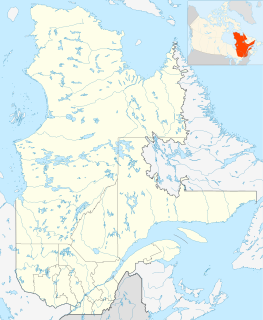
Wemindji Airport

Wemindji Airport,, is located near the town of Wemindji, Quebec, Canada.
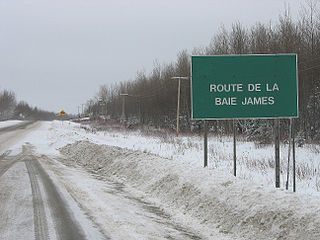
James Bay Road highway in Quebec

The James Bay Road is a remote wilderness highway winding its way through the Canadian Shield in northwestern Quebec and reaches into the James Bay region. It starts in Matagami as an extension of Route 109 and ends at Radisson. The road is fully paved, well maintained, and plowed during the winter. It was originally constructed to carry loads of 300 tons, and has mostly gentle curves and hills with wide shoulders. The road is maintained by the Eeyou Istchee James Bay Regional Government. Connecting to other routes such as the Trans-Taiga Road and the Route du Nord, the highway draws tourists interested in reaching the remote wilderness surrounding James Bay, part of Hudson Bay.

Although Wemindji is a fairly small community about 3,266 hectares, it has variety of services a schools (an elementary and high school), clinic, wellness department, motels, bed and breakfast, mini mall (shopping centre), police station, two daycares, after school program (C.O.O.L.), tradition centres, sports facilities, fire station and more.

History

Wemindji is a fairly new community comprising Cree families originally living at the trading post in cree named “Paakumshumwashtikw”, in French Vieux-Comptoir River, known as Vieux-Comptoir or its English equivalent "Old Factory". This trading post was founded in the 17th century and was alternately under British or French control. In 1959 the community was relocated about 45 km north to its present location (where Wemindji is now).

Vieux-Comptoir or Old Factory was a small Cree community at the mouth of Vieux-Comptoir River off James Bay in Quebec, Canada. The community was established as a trading post in the 17th Century, but abandoned when the Cree were relocated to Wemindji, Quebec 45 kilometres (28 mi) to the north in 1959.

Wemindji (Cree for "red ochre mountain") gets its name from the red pigment found in the hills surrounding it. It has also been known in French as "Nouveau-Comptoir".

The Cree Nation of Wemindji is one of the 9 communities under the [James Bay and Northern Quebec Agreement] signed on 1975 by the Cree, Inuit, Quebec Government and Federal Government. The crees went on an injunction to make an agreement on the project of Hydro development because the Quebec government and hydro development failed to recognized the cree rights to their land. [2]

In 1975, The [James Bay and Northern Quebec Agreement] between the Crown and the indigenous people in Canada was the first leading agreement since the numbered treaties of the 19th and early 20th centuries. From 1973 to 1975, this agreement was negotiated and on November 11, 1975, it was signed. As specified in the agreement, the Aboriginal people traded their rights and territorial interests for different rights and benefits. Special membership was insisted by the Aboriginal people to allow them to take charge in their local and regional government, The creation of their own health and school boards, measures for economic and community development, special regimes for police and justice and environmental protection.

The agreement allowed them to gain a technical definition of the La Grande Project which included limitations on water levels and a remedial works corporation for social, environmental damages, and relocation of the first dam. In the agreement, the land was divided into three categories. The first category of land is controlled mainly by the residents in and around the aboriginal communities. The second category known as crown land is used as hunting, fishing, and trapping territories shared between the Cree and Inuit. Lastly, the third category of land is used for traditional hunting and harvesting which was designated exclusively for Aboriginal people to use. [3]

Culture and traditions

Cree have always identified themselves as "Iyiyuuch" which means "the people". The Cree have continued practising their traditions way of hunting, trapping and fishing. Parts of Wemindji's populations still lives off the land year round. [4]

Languages

There are two mainly languages in Wemindji, which are Cree and English. [5]

Education

The Cree School Board is a regional entity that presents all 9 cree communities. In Wemindji, Cree School Board operates the Maquatua Eeyou School (ᐧᒫᑯᐧᑖᐤ ᐄᔨᔨᐤ ᒋᔅᑯᑎᒫᑑᑭᒥᒄ)/ Joy Ottereyes Rainbow Memorial School. The Maquatua Eeyou School is a high school, and Joy Ottereyes Rainbow Memorial School is an elementary school. the high school and elementary school have an importance of Cree language. English is the second language within both of these institutions. [6]

Health

The Cree Board of Health operates the clinic within the Cree Nation of Wemindji. The clinic provides services a variety of programs such as the awash (child) program, the uschinisuu (youth) program, chishayiuu (elder) program, Multi Service Day Centre (MSDC), Physiotherapy, Psycho-education, Nutritionist, Youth protection, Dental Services, Administration. [7]

Cree First Nations Communities

Wemindji is one of the nine Cree First Nations Communities from The Cree Nation of Eeyou Istchee. The Cree Nation live on the land of Eeyou Istchee, which means people’s land. The people call themselves “Eeyou”. Along with their eleven Cree Communities, there are over three hundred traditional family hunting and trapping grounds which they call “Traplines”. Each of the Cree First Nations Communities has their own different and individual history. Every community through their local government is administered independently, while Cree Nation issues are discussed by the elected chiefs on the board of directors of the Grand Council of Cree and the Council of the Cree Nation Government. [8]

Related Research Articles

Nunavik Proposed autonomous area in Quebec, Canada

Nunavik comprises the northern third of the province of Quebec, Canada in Kativik, part of the Nord-du-Québec region. Covering a land area of 443,684.71 km2 (171,307.62 sq mi) north of the 55th parallel, it is the homeland of the Inuit of Quebec. Almost all of the 12,090 inhabitants of the region, of whom 90% are Inuit, live in fourteen northern villages on the coast of Nunavik and in the Cree reserved land (TC) of Whapmagoostui, near the northern village of Kuujjuarapik.

Nord-du-Québec Place in Quebec, Canada

Nord-du-Québec is the largest, but the least populous, of the seventeen administrative regions of Quebec, Canada. With nearly 750,000 square kilometres (290,000 sq mi) of land area, and very extensive lakes and rivers, it covers much of the Labrador Peninsula and about 55% of the total land surface area of Quebec, while containing a little more than 0.5% of the population.

Jamésie equivalent territory in Quebec, Canada

Jamésie is a territory equivalent to a regional county municipality (TE) of Nord-du-Québec, Canada.

Kativik Regional Government

The Kativik Regional Government encompasses most of the Nunavik region of Quebec. Nunavik is the northern half of the Nord-du-Québec administrative region and includes all the territory north of the 55th parallel. The administrative capital is Kuujjuaq, on the Koksoak River, about 50 kilometres inland from the southern end of the Ungava Bay.

Ted Moses, is a Cree politician from Eastmain, a small remote village in northern Quebec, Canada. He is a former Grand Chief of the Grand Council of the Crees. In addition, Mr. Moses is a recipient of the title of "Officer" of the National Order of Quebec.

Indigenous peoples in Quebec total 11 distinct ethnic groups. The 10 First Nations and the Inuit communities number 141,915 people and account for approximately 2% of the population of Quebec, Canada.

Waskaganish cree community in Quebec, Canada

Waskaganish is a Cree community of over 2,200 people at the mouth of the Rupert River on the south-east shore of James Bay in Northern Quebec, Canada. Waskaganish is part of the territory referred to as "Eeyou Istchee" encompassing the traditional territories of Cree people in the James Bay regions of what is now Northern Quebec and Ontario.

The James Bay and Northern Quebec Agreement is an Aboriginal land claim settlement, approved in 1975 by the Cree and Inuit of northern Quebec, and later slightly modified in 1978 by the Northeastern Quebec Agreement, through which Quebec's Naskapi First Nation joined the treaty. The agreement covers economic development and property issues in northern Quebec, as well as establishing a number of cultural, social and governmental institutions for Indigenous people who are members of the communities involved in the treaties.

Chisasibi Place in Quebec, Canada

Chisasibi is a village on the eastern shore of James Bay, in the Eeyou Istchee TE in northern Quebec, Canada. It is situated on the south shore of La Grande River, less than 10 km (6.2 mi) from the river's mouth. Chisasibi is one of nine Cree villages in the region, and is a member of the Grand Council of the Crees of Quebec. The territory surrounding Chisasibi is part of the Eeyou Istchee James Bay Territory, of which parts are jointly managed by the municipalities of the Jamésie TE and the Cree Regional Authority of the Eeyou Istchee TE.

Baie-James Municipality in Quebec, Canada

The Municipality of Baie-James was a municipality in northern Quebec, Canada, which existed from 1971 to 2012. Located to the east of James Bay, Baie-James covered 297,332.84 km2 (114,800.85 sq mi) of land, making it the largest incorporated municipality in Canada — only eight unorganized territories were larger. Its territory almost entirely covered the administrative region of Jamésie, although it contained less than five percent of the population. Essentially, it was the remainder of the Jamésie Territory's land after all of the major population centres were removed.

Mistissini, Quebec cree reserved land in Quebec, Canada

Mistissini is a Cree town located in the south-east corner of the largest natural lake in Quebec, Lake Mistassini. The town is inside the boundaries of the Baie-James Municipality and is the second largest Cree community with a population of 3,427 people in 2011. The surface area of the town is 1380 km².

The Agreement Respecting a New Relationship Between the Cree Nation and the Government of Quebec is an agreement between the Government of Quebec, Canada, and the Grand Council of the Crees. It was signed on February 7, 2002 in Waskaganish, Jamésie, Quebec, after decades of court battles between the Cree and the Government of Quebec. The name was inspired by the 1701 Great Peace of Montreal, also known as "La Paix des Braves".

Eeyou Istchee (territory) equivalent territory

Eeyou Istchee is a territory equivalent to a regional county municipality (TE) of Quebec, represented by the Grand Council of the Crees. On July 24, 2012, the Quebec government signed an accord with the Cree Nation that resulted in the abolition of the neighbouring municipality of Baie-James and the creation of the new Eeyou Istchee James Bay Regional Government, providing for the residents of neighbouring Jamésie TE and Eeyou Istchee to jointly govern the territory formerly governed by the municipality of Baie-James.

Grand Council of the Crees tribal council in Canada

The Grand Council of the Crees or the GCC(EI), is the political body that represents the about 18,000 Crees or "Eeyou" of the territory called Eeyou Istchee in the James Bay and Nunavik regions of Northern Quebec, Canada. The Grand Council has twenty members: a Grand Chief and Deputy-Grand Chief elected at large by the Cree people, the Chiefs elected by each of the ten communities, and one other representative from each community.

Wemindji (Cree village municipality) Cree village municipality in Quebec, Canada

Wemindji is a Cree village municipality in the territory of Eeyou Istchee in northern Quebec; it has a distinct legal status and classification from other kinds of village municipalities in Quebec: Naskapi village municipalities, northern villages, and ordinary villages.

Eeyou Istchee James Bay Regional Government is a local municipality in the Jamésie (TE) in administrative region of Nord-du-Québec.

Indigenous or Aboriginal self-government refers to proposals to give governments representing the Indigenous peoples in Canada greater powers of government. These proposals range from giving Aboriginal governments powers similar to that of local governments in Canada to demands that Indigenous governments be recognized as sovereign, and capable of "nation-to-nation" negotiations as legal equals to the Crown, as well as many other variations.

Cree Nation of Wemindji First Nation in Quebec, Canada

The Cree Nation of Wemindji is a Cree First Nation of Northern Quebec, Canada. It is headquartered at the Cree village of Wemindji and also has the terre réservée crie of the same name, both located in the Eeyou Istchee territory. In 2016, it has a registered population of 1,589 members. It is in negotiation with the government of Canada to obtain its self-governance.

Cree School Board

Cree School Board is a school district in northern Quebec, headquartered in Mistissini, with an additional office in the James Bay Eeyou School in Chisasibi.

Abel Bosum is a Cree leader and negotiator who is currently serving as Grand Chief of the Grand Council of the Crees of Northern Quebec. He has worked for the Grand Council of the Crees of Quebec since 1977 in various capacities. From 1984 to 1998, Bosum served as the Chief of his home nation the Oujé-Bougoumou Cree Nation. During his time as chief, he was able to negotiate a multimillion-dollar deal with the governments of Quebec and Canada to build a new village for the nation following the peoples' seventh forcible relocation due to mining and forestry activity in Northern Quebec. In 1998, he became the head negotiator of the Grand Council of the Crees of Quebec. Since 2015, Abel Bosum has also served as President of the Aanischaaukamikw Foundation and of the Aanischaaukamikw Cree Cultural institute.

References

  1. Indigenous and Northern Affairs Canada Retrieved on November, 10th 2018
  2. https://en.wikipedia.org/wiki/James_Bay_and_Northern_Quebec_Agreement James Bay and Northern Quebec Agreement Retrieved on November, 10th 2018
  3. https://www.thecanadianencyclopedia.ca/en/article/james-bay-and-northern-quebec-agreement
  4. "Maquatua Eeyou School." Cree School Board. Retrieved on November, 10th 2018
  5. https://www.cscree.qc.ca/en/youth/wemindji Cree Board of Health and Social Services of James Bay Retrieved on November, 10th 2018
  6. "Maquatua Eeyou School." Cree School Board. Retrieved on November, 10th 2018
  7. ” [Cree Board of Health and Social Services of James Bay] .Retrieved on November 10th 2018.
  8. https://www.cngov.ca/community-culture/communities/

See also