
The Ediacaran period is a geological period of the Neoproterozoic era that spans 96 million years from the end of the Cryogenian period at 635 Mya, to the beginning of the Cambrian period at 538.8 Mya. It is the last period of the Proterozoic eon as well as the last of the so-called "Precambrian supereon", before the beginning of the subsequent Cambrian period marks the start of the Phanerozoic eon where recognizable fossil evidence of life becomes common.
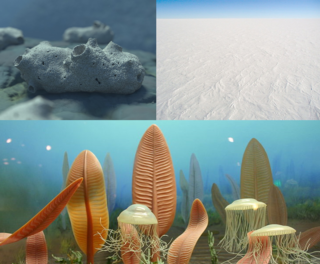
The Neoproterozoic Era is the unit of geologic time from 1 billion to 538.8 million years ago.

Acritarchs are organic microfossils, known from approximately 1800 million years ago to the present. The classification is a catch all term used to refer to any organic microfossils that cannot be assigned to other groups. Their diversity reflects major ecological events such as the appearance of predation and the Cambrian explosion.
The Doushantuo Formation is a geological formation in western Hubei, eastern Guizhou, southern Shaanxi, central Jiangxi, and other localities in China. It is known for the fossil Lagerstätten in Zigui in Hubei, Xiuning in Anhui, and Weng'an in Guizhou, as one of the oldest beds to contain minutely preserved microfossils, phosphatic fossils that are so characteristic they have given their name to "Doushantuo type preservation". The formation, whose deposits date back to the Early and Middle Ediacaran, is of particular interest because it covers the poorly understood interval of time between the end of the Cryogenian geological period and the more familiar fauna of the Late Ediacaran Avalon explosion, as well as due to its microfossils' potential utility as biostratigraphical markers. Taken as a whole, the Doushantuo Formation ranges from about 635 Ma at its base to about 551 Ma at its top, with the most fossiliferous layer predating by perhaps five Ma the earliest of the 'classical' Ediacaran faunas from Mistaken Point on the Avalon Peninsula of Newfoundland, and recording conditions up to a good forty to fifty million years before the Cambrian explosion at the beginning of the Phanerozoic.
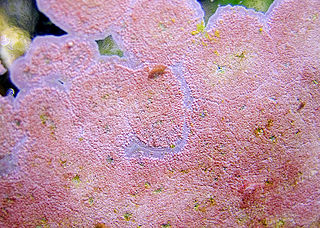
Coralline algae are red algae in the order Corallinales. They are characterized by a thallus that is hard because of calcareous deposits contained within the cell walls. The colors of these algae are most typically pink, or some other shade of red, but some species can be purple, yellow, blue, white, or gray-green. Coralline algae play an important role in the ecology of coral reefs. Sea urchins, parrot fish, and limpets and chitons feed on coralline algae. In the temperate Mediterranean Sea, coralline algae are the main builders of a typical algal reef, the Coralligène ("coralligenous"). Many are typically encrusting and rock-like, found in marine waters all over the world. Only one species lives in freshwater. Unattached specimens may form relatively smooth compact balls to warty or fruticose thalli.
Paramecia is a non-mineralized Ediacaran alga with a differentiated, compartmentalized thallus. This alga probably had multiple phases in its lifecycle, as possible reproductive structures have been identified.

The Ediacaranbiota is a taxonomic period classification that consists of all life forms that were present on Earth during the Ediacaran Period. These were enigmatic tubular and frond-shaped, mostly sessile, organisms. Trace fossils of these organisms have been found worldwide, and represent the earliest known complex multicellular organisms. The term "Ediacara biota" has received criticism from some scientists due to its alleged inconsistency, arbitrary exclusion of certain fossils, and inability to be precisely defined.
Embryo fossils are the preserved remains of unhatched or unborn organisms. Many fossils of the 580 million year old Doushantuo Formation have been interpreted as embryos; embryos are also common throughout the Cambrian fossil record.

Eoandromeda is an Ediacaran organism consisting of eight radial spiral arms, and known from two taphonomic modes: the standard Ediacara type preservation in Australia, and as carbonaceous compressions from the Doushantuo formation of China, where it is abundant.
The Rhodogorgonales are an order of red algae, a sister group to the corallines. They are always thalloid and calcified; their calcification is very different from the corallines, as individual calcite crystals are deposited in the cell wall of specialised cells; this suggests that the evolution of calcification may have been independent from the corallines. They have no fossil record.
Archaeolithophyllum is a genus of conceptacle-bearing red alga that falls in the coralline stem group. It somewhat resembles Lithophyllum.
Arenigiphyllum is a genus of alga from the Ordovician that falls in the coralline stem group. Only its vegetative anatomy is known.
Petrophyton is a genus of alga that falls in the coralline stem group.
Thallophycoides is an undifferentiated, globular, non-mineralized alga from the Ediacaran period.
Gremiphyca is a lobed, non-mineralized alga with a pseudoparenchymatous thallus, dating to the Ediacaran period. The genus was reinvestigated by Xiao et al. and was interpreted to be a stem-group florideophyte.
Thallophyca is a non-mineralized Ediacarian alga that probably dwelt on the sea floor. Its thallus is differentiated into a cortex and a medulla. Possible reproductive structures have been identified.
Miaohephyton is a carbonaceous compression fossil of a thalloid organism that has been interpreted as a brown alga. Its Neoproterozoic age is incompatible with molecular clocks that estimate the divergence of the brown algae around 300 million years ago, leading to suggestions that its "brown algal" features are the result of convergence.

The Dengying Formation is an upper Ediacaran fossiliferous geologic formation found in South China. It was deposited on a shallow marine carbonate platform.
Events from the year 1998 in South Korea.
Shuhai Xiao is a Chinese-American paleontologist and professor of geobiology at Virginia Tech, Blacksburg, Virginia, U.S.A.


