Sources
 This article incorporates text from a publication now in the public domain : Herbermann, Charles, ed. (1913). Catholic Encyclopedia . New York: Robert Appleton Company.
{{cite encyclopedia}}: Missing or empty|title=(help)
Wenrich of Trier was a German ecclesiastico-political writer of the eleventh century.
He was a canon at Verdun, and afterwards scholasticus at Trier.
Sigebert of Gembloux ( Patrologia Latina , CXL, 584 sq.) calls him also Bishop of Vercelli, but the early documents of the diocese leave no place for him in the list of bishops.
Wenrich is the author of an able controversial treatise on behalf of Holy Roman Emperor Henry IV during his struggle with Pope Gregory VII (the Conflict of Investitures). It was probably written in the summer of 1081, at the urgency of Bishop Dietrich of Verdun, to whom it has also been ascribed.
The form is that of an open letter to the pope; the tone is friendly, as though what he had to say was painful to the author. Wenrich disputes the efficiency of the emperor's excommunication (1080), opposes the laws of celibacy promulgated by the pope, condemns the inciting of the people against the emperor, defends investitures by texts of Scripture and the history of the Church, upbraids Gregory for being an accomplice in the setting up of a rival king, and reminds the pope that he himself has been accused of unlawful striving after the papal dignity, and even of the use of force to attain this end. A reply was written by Manegold of Lautenbach.
 This article incorporates text from a publication now in the public domain : Herbermann, Charles, ed. (1913). Catholic Encyclopedia . New York: Robert Appleton Company.
{{cite encyclopedia}}: Missing or empty |title= (help) | International | |
|---|---|
| National | |
| People | |
| Other | |
Pope Agapetus I was the bishop of Rome from 13 May 535 to his death. His father, Gordianus, was a priest in Rome and he may have been related to two popes, Felix III and Gregory I.
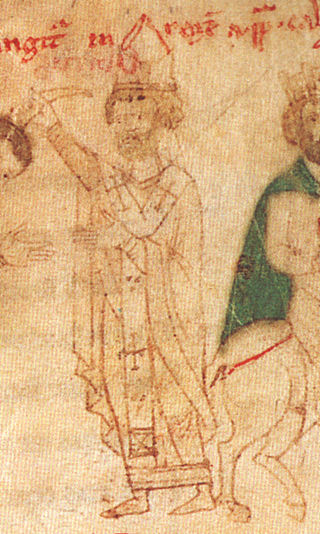
Pope Callixtus II or Callistus II, born Guy of Burgundy, was head of the Catholic Church and ruler of the Papal States from 1 February 1119 to his death in 1124. His pontificate was shaped by the Investiture Controversy, which he was able to settle through the Concordat of Worms in 1122.

Pope Sixtus II, also written as Pope Xystus II, was bishop of Rome from 31 August 257 until his death on 6 August 258. He was martyred along with seven deacons, including Lawrence of Rome, during the persecution of Christians by the Emperor Valerian.

Pope Sylvester I was the bishop of Rome from 31 January 314 until his death. He filled the see of Rome at an important era in the history of the Western Church, yet very little is known of him. The accounts of his pontificate preserved in the seventh- or eighth-century Liber Pontificalis contain little more than a record of the gifts said to have been conferred on the church by Constantine I, although it does say that he was the son of a Roman named Rufinus. His feast is celebrated as Saint Sylvester's Day, on 31 December in Western Christianity, and on 2 January in Eastern Christianity.
Pope Felix III was the bishop of Rome from 13 March 483 to his death. His repudiation of the Henotikon is considered the beginning of the Acacian schism. He is commemorated on March 1.

The Investiture Controversy or Investiture Contest was a conflict between the Church and the state in medieval Europe over the ability to choose and install bishops (investiture) and abbots of monasteries and the pope himself. A series of popes in the 11th and 12th centuries undercut the power of the Holy Roman Emperor and other European monarchies, and the controversy led to nearly 50 years of conflict.
Pope John XV was the bishop of Rome and ruler of the Papal States from August 985 until his death. A Roman by birth, he was the first pope who canonized a saint. The origins of the investiture controversy stem from John XV's pontificate, when the dispute about the deposition of Archbishop Arnulf of Reims soured the relationship between the Capetian kings of France and the Holy See.

Guibert or Wibert of Ravenna was an Italian prelate, archbishop of Ravenna, who was elected pope in 1080 in opposition to Pope Gregory VII and took the name Clement III. Gregory was the leader of the movement in the church which opposed the traditional claim of European monarchs to control ecclesiastical appointments, and this was opposed by supporters of monarchical rights led by the Holy Roman Emperor. This led to the conflict known as the Investiture Controversy. Gregory was felt by many to have gone too far when he excommunicated the Holy Roman Emperor Henry IV and supported a rival claimant as emperor, and in 1080 the pro-imperial Synod of Brixen pronounced that Gregory was deposed and replaced as pope by Guibert.

Febronianism was a powerful movement within the Catholic Church in Germany, in the latter part of the 18th century, directed towards the nationalizing of Catholicism, the restriction of the power of the papacy in favor of that of the episcopate, and the reunion of the dissident Churches with Catholic Christendom. It was thus, in its main tendencies, the equivalent of what in France is known as Gallicanism. Friedrich Lauchert describes Febronianism, in the Catholic Encyclopedia, as a politico-ecclesiastical system with an ostensible purpose to facilitate the reconciliation of the Protestant bodies with the Catholic Church by diminishing the power of the Holy See.

Sigebert of Gembloux was a medieval author, known mainly as a pro-Imperial historian of a universal chronicle, opposed to the expansive papacy of Gregory VII and Pascal II. Early in his life he became a monk in the Benedictine abbey of Gembloux.

Anselm of Lucca, born Anselm of Baggio, was a medieval bishop of Lucca in Italy and a prominent figure in the Investiture Controversy amid the fighting in central Italy between Matilda, countess of Tuscany, and Emperor Henry IV. His uncle Anselm preceded him as bishop of Lucca before being elected to the papacy as Pope Alexander II and so he is sometimes distinguished as Anselm the Younger or Anselm II.

Dictatus papae is a compilation of 27 statements of authority claimed by the pope that was included in Pope Gregory VII's register under the year 1075.
Jacobus Palladinus de Teramo (1349–1417), a member of the powerful family of Palladini, was an Italian canon lawyer and bishop. His birthplace, Teramo, was then part of the Kingdom of Naples.

Albero de Montreuil was Archbishop of Trier from 1132 to 1152 and is the subject of the Gesta Alberonis.

Lupold of Bebenburg was the Bishop of Bamberg from 1353. He is best known for his political writings.

Hillin of Falmagne (German: Hillin von Fallemanien, also spelled Falemagne, Fallemanien, Fallenmaigne, etc.) (c. 1100 – 23 October 1169), was the Archbishop of Trier from 1152. He was an imperialist and a partisan of Frederick Barbarossa in the Investiture Controversy of the twelfth century.
Manegold of Lautenbach was a religious and polemical writer and Augustinian canon from Alsace, active mostly as a teacher in south-west Germany. William of Champeaux may have been one of his pupils, but this is disputed. He was one of the first magisters, recognised masters of theology.

Saint Nicetius was a bishop of Trier, born in the latter part of the fifth century, exact date unknown; died in 563 or more probably 566.
Hugh or Hugo was a Benedictine monk and historian. He served as abbot of Flavigny from 1097 to 1100.
Theoderic, or Thierry, was a royalist bishop of Verdun from 1047 to 1089. Before his consecration, he was a chaplain of Henry III.
