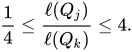
In vector calculus, Green's theorem relates a line integral around a simple closed curve C to a double integral over the plane region D bounded by C. It is the two-dimensional special case of Stokes' theorem.
In mathematics, the Lucas–Lehmer test (LLT) is a primality test for Mersenne numbers. The test was originally developed by Édouard Lucas in 1876 and subsequently improved by Derrick Henry Lehmer in the 1930s.
In probability theory, the total variation distance is a distance measure for probability distributions. It is an example of a statistical distance metric, and is sometimes called the statistical distance, statistical difference or variational distance.
In mathematics, the Riesz–Thorin theorem, often referred to as the Riesz–Thorin interpolation theorem or the Riesz–Thorin convexity theorem, is a result about interpolation of operators. It is named after Marcel Riesz and his student G. Olof Thorin.
In mathematics, a complex differential form is a differential form on a manifold which is permitted to have complex coefficients.
In mathematics, the Poincaré inequality is a result in the theory of Sobolev spaces, named after the French mathematician Henri Poincaré. The inequality allows one to obtain bounds on a function using bounds on its derivatives and the geometry of its domain of definition. Such bounds are of great importance in the modern, direct methods of the calculus of variations. A very closely related result is Friedrichs' inequality.
In differential geometry, a subfield of mathematics, the Margulis lemma is a result about discrete subgroups of isometries of a non-positively curved Riemannian manifold. Roughly, it states that within a fixed radius, usually called the Margulis constant, the structure of the orbits of such a group cannot be too complicated. More precisely, within this radius around a point all points in its orbit are in fact in the orbit of a nilpotent subgroup.
In mathematics, the Schur orthogonality relations, which were proven by Issai Schur through Schur's lemma, express a central fact about representations of finite groups. They admit a generalization to the case of compact groups in general, and in particular compact Lie groups, such as the rotation group SO(3).
In mathematics, the Hardy–Littlewood maximal operatorM is a significant non-linear operator used in real analysis and harmonic analysis. It takes a locally integrable function f : Rd → C and returns another function Mf that, at each point x ∈ Rd, gives the maximum average value that f can have on balls centered at that point. More precisely,
In mathematics, the Calderón–Zygmund lemma is a fundamental result in Fourier analysis, harmonic analysis, and singular integrals. It is named for the mathematicians Alberto Calderón and Antoni Zygmund.
In mathematics, particularly numerical analysis, the Bramble–Hilbert lemma, named after James H. Bramble and Stephen Hilbert, bounds the error of an approximation of a function by a polynomial of order at most in terms of derivatives of of order . Both the error of the approximation and the derivatives of are measured by norms on a bounded domain in . This is similar to classical numerical analysis, where, for example, the error of linear interpolation can be bounded using the second derivative of . However, the Bramble–Hilbert lemma applies in any number of dimensions, not just one dimension, and the approximation error and the derivatives of are measured by more general norms involving averages, not just the maximum norm.
In the mathematical study of functional analysis, the Banach–Mazur distance is a way to define a distance on the set of -dimensional normed spaces. With this distance, the set of isometry classes of -dimensional normed spaces becomes a compact metric space, called the Banach–Mazur compactum.
In mathematics, the Babenko–Beckner inequality is a sharpened form of the Hausdorff–Young inequality having applications to uncertainty principles in the Fourier analysis of Lp spaces. The (q, p)-norm of the n-dimensional Fourier transform is defined to be
The electron-LA phonon interaction is an interaction that can take place between an electron and a longitudinal acoustic (LA) phonon in a material such as a semiconductor.
In mathematics, the dyadic cubes are a collection of cubes in Rn of different sizes or scales such that the set of cubes of each scale partition Rn and each cube in one scale may be written as a union of cubes of a smaller scale. These are frequently used in mathematics as a way of discretizing objects in order to make computations or analysis easier. For example, to study an arbitrary subset of A of Euclidean space, one may instead replace it by a union of dyadic cubes of a particular size that cover the set. One can consider this set as a pixelized version of the original set, and as smaller cubes are used one gets a clearer image of the set A. Most notable appearances of dyadic cubes include the Whitney extension theorem and the Calderón–Zygmund lemma.
Multipole radiation is a theoretical framework for the description of electromagnetic or gravitational radiation from time-dependent distributions of distant sources. These tools are applied to physical phenomena which occur at a variety of length scales - from gravitational waves due to galaxy collisions to gamma radiation resulting from nuclear decay. Multipole radiation is analyzed using similar multipole expansion techniques that describe fields from static sources, however there are important differences in the details of the analysis because multipole radiation fields behave quite differently from static fields. This article is primarily concerned with electromagnetic multipole radiation, although the treatment of gravitational waves is similar.
In mathematics, the connective constant is a numerical quantity associated with self-avoiding walks on a lattice. It is studied in connection with the notion of universality in two-dimensional statistical physics models. While the connective constant depends on the choice of lattice so itself is not universal, it is nonetheless an important quantity that appears in conjectures for universal laws. Furthermore, the mathematical techniques used to understand the connective constant, for example in the recent rigorous proof by Duminil-Copin and Smirnov that the connective constant of the hexagonal lattice has the precise value , may provide clues to a possible approach for attacking other important open problems in the study of self-avoiding walks, notably the conjecture that self-avoiding walks converge in the scaling limit to the Schramm–Loewner evolution.
In the field of mathematical analysis, an interpolation inequality is an inequality of the form
In mathematics, the Whitney inequality gives an upper bound for the error of best approximation of a function by polynomials in terms of the moduli of smoothness. It was first proved by Hassler Whitney in 1957, and is an important tool in the field of approximation theory for obtaining upper estimates on the errors of best approximation.
In number theory, the prime omega functions and count the number of prime factors of a natural number Thereby counts each distinct prime factor, whereas the related function counts the total number of prime factors of honoring their multiplicity. That is, if we have a prime factorization of of the form for distinct primes , then the respective prime omega functions are given by and . These prime factor counting functions have many important number theoretic relations.