Related Research Articles
A trade union or labor union, often simply referred to as a union, is an organisation of workers intent on "maintaining or improving the conditions of their employment", such as attaining better wages and benefits, improving working conditions, improving safety standards, establishing complaint procedures, developing rules governing status of employees and protecting and increasing the bargaining power of workers.
Human resources (HR) is the set of people who make up the workforce of an organization, business sector, industry, or economy. A narrower concept is human capital, the knowledge and skills which the individuals command. Similar terms include manpower, labor, personnel, associates or simply: people.

A market economy is an economic system in which the decisions regarding investment, production and distribution to the consumers are guided by the price signals created by the forces of supply and demand. The major characteristic of a market economy is the existence of factor markets that play a dominant role in the allocation of capital and the factors of production.
The historical school of economics was an approach to academic economics and to public administration that emerged in the 19th century in Germany, and held sway there until well into the 20th century. The professors involved compiled massive economic histories of Germany and Europe. Numerous Americans were their students. The school was opposed by theoretical economists. Prominent leaders included Gustav von Schmoller (1838–1917), and Max Weber (1864–1920) in Germany, and Joseph Schumpeter (1883–1950) in Austria and the United States.

An academic discipline or field of study is a branch of knowledge, taught and researched as part of higher education. A scholar's discipline is commonly defined by the university faculties and learned societies to which they belong and the academic journals in which they publish research.
Employment is a relationship between two parties regulating the provision of paid labour services. Usually based on a contract, one party, the employer, which might be a corporation, a not-for-profit organization, a co-operative, or any other entity, pays the other, the employee, in return for carrying out assigned work. Employees work in return for wages, which can be paid on the basis of an hourly rate, by piecework or an annual salary, depending on the type of work an employee does, the prevailing conditions of the sector and the bargaining power between the parties. Employees in some sectors may receive gratuities, bonus payments or stock options. In some types of employment, employees may receive benefits in addition to payment. Benefits may include health insurance, housing, disability insurance. Employment is typically governed by employment laws, organisation or legal contracts.

Public Administration or Public Policy and Administration is the implementation of public policy, administration of government establishment, management of non-profit establishment, and also a subfield of political science taught in public policy schools that studies this implementation and prepares civil servants, especially those in administrative positions for working in the public sector, voluntary sector, some industries in the private sector dealing with government relations and regulatory affairs, and those working as think tank researchers. As a "field of inquiry with a diverse scope" whose fundamental goal is to "advance management and policies so that government can function." Some of the various definitions which have been offered for the term are: "the management of public programs"; the "translation of politics into the reality that citizens see every day"; and "the study of government decision making, the analysis of the policies themselves, the various inputs that have produced them, and the inputs necessary to produce alternative policies." The word public administration is the combination of two words—public and administration. In every sphere of social, economic and political life there is administration which means that for the proper functioning of the organization or institution it must be properly ruled or managed and from this concept emerges the idea of administration.
Welfare capitalism is capitalism that includes social welfare policies and/or the practice of businesses providing welfare services to their employees. Welfare capitalism in this second sense, or industrial paternalism, was centered on industries that employed skilled labor and peaked in the mid-20th century.
Critical management studies (CMS) is a loose but extensive grouping of theoretically informed critiques of management, business and organisation, grounded originally in a critical theory perspective. Today it encompasses a wide range of perspectives that are critical of traditional theories of management and the business schools that generate these theories.
Neil Joseph Smelser (1930–2017) was an American sociologist who served as professor of sociology at the University of California, Berkeley. He was an active researcher from 1958 to 1994. His research was on collective behavior, sociological theory, economic sociology, sociology of education, social change, and comparative methods. Among many lifetime achievements, Smelser "laid the foundations for economic sociology."
In modern usage, the term grammatology refers to the scientific study of writing systems or scripts. This usage was first elucidated in English by linguist Ignace Gelb in his 1952 book A Study of Writing. The equivalent word is recorded in German and French use long before then. Grammatology can examine the typology of scripts, the analysis of the structural properties of scripts, and the relationship between written and spoken language. In its broadest sense, some scholars also include the study of literacy in grammatology and, indeed, the impact of writing on philosophy, religion, science, administration and other aspects of the organization of society. Historian Bruce Trigger associates grammatology with cultural evolution.

The recession of 1937–1938 was an economic downturn that occurred during the Great Depression in the United States.
The history of economic thought is the study of the philosophies of the different thinkers and theories in the subjects that later became political economy and economics, from the ancient world to the present day in the 21st century. This field encompasses many disparate schools of economic thought. Ancient Greek writers such as the philosopher Aristotle examined ideas about the art of wealth acquisition, and questioned whether property is best left in private or public hands. In the Middle Ages, Thomas Aquinas argued that it was a moral obligation of businesses to sell goods at a just price.

The three-sector model in economics divides economies into three sectors of activity: extraction of raw materials (primary), manufacturing (secondary), and service industries which exist to facilitate the transport, distribution and sale of goods produced in the secondary sector (tertiary). The model was developed by Allan Fisher, Colin Clark, and Jean Fourastié in the first half of the 20th century, and is a representation of an industrial economy. It has been criticised as inappropriate as a representation of the economy in the 21st century.
The Deutsche Bank Prize in Financial Economics honors renowned researchers who have made influential contributions to the fields of finance and money and macroeconomics, and whose work has led to practical and policy-relevant results. It is awarded biannually, since 2005, by the Center for Financial Studies (CFS), in partnership with Goethe University Frankfurt, and is sponsored by Deutsche Bank Donation Fund. The award carries an endowment of €50,000, which is donated by the Stiftungsfonds Deutsche Bank im Stifterverband für die Deutsche Wissenschaft.
Mauro F. Guillén is a Spanish/American sociologist, political economist, management educator. In March 2021 he was announced as the new Director (Dean) of the Cambridge Judge Business School, and a Fellow of Queens' College at the University of Cambridge before resigning in 2023 to return to his family and his professorship at Wharton. Until July 2021, he was the Zandman Professor at the Wharton School of the University of Pennsylvania, and Director of the Penn Lauder Center for International Business Education and Research (CIBER). He was the Anthony L. Davis Director of the Joseph H. Lauder Institute of Management and International Studies from 2007 to 2019. He is the Wall Street Journal bestselling author of 2030: How Today's Biggest Trends Will Collide and Reshape the Future of Everything (2020).

Adrian Allinson was a British painter, potter and engraver known for his landscapes of Southern Europe and North Africa, and for a series of notable posters he made for London Transport.
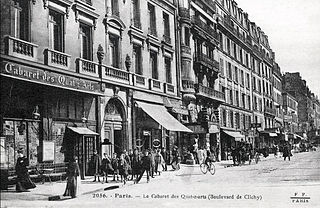
Cabaret des Quat'z'Arts was a venue at 62 Boulevard de Clichy, in Paris, France. The interdisciplinary mixture of the arts created avant-garde collaborative performances. Similar to Le Chat Noir, the Quat'z'Arts was a gathering place for artists, composers, musicians, performers, poets, illustrators, and theater critics, attracting newcomers such as Pablo Picasso and Apollinaire. It provided space for permanent and temporary art exhibits by the likes of Emile Cohl, Jules-Alexandre Grün, Charles Léandre, Georges Redon, Lucien-Victor Guirand de Scévola, Henri de Toulouse-Lautrec, Louis Abel-Truchet, and Adolphe Willette.
Events in the year 1941 in Spain.

Fabulous 208 was a British pop music magazine.
References
- Guillén, Mauro F. Models of Management: Work, Authority, and Organization in a Comparative Perspective. Chicago [u.a.]: Univ. of Chicago Press, 1994.
- Jobling, Paul, and David Crowley. Graphic Design: Reproduction and Representation Since 1800. Manchester: Manchester Univ. Press, 1996.
- Neugebauer, Udo. "Business Ethics in Older German Business Administration: Heinrich Nicklisch, Wilhelm Kalveram, August Marx" in Koslowski, Peter. Methodology of the Social Sciences, Ethics, and Economics in the Newer Historical School: From Max Weber and Rickert to Sombart and Rothacker. Berlin: Springer, 1997.
- Backhaus, Jürgen G. The Beginnings of Scholarly Economic Journalism The Austrian Economist and The German Economist. New York: Springer, 2011, pp 134–135.
