Related Research Articles

Joseph Mallord William Turner, known in his time as William Turner, was an English Romantic painter, printmaker and watercolourist. He is known for his expressive colouring, imaginative landscapes and turbulent, often violent marine paintings. He left behind more than 550 oil paintings, 2,000 watercolours, and 30,000 works on paper. He was championed by the leading English art critic John Ruskin from 1840, and is today regarded as having elevated landscape painting to an eminence rivalling history painting.

John Sell Cotman was an English marine and landscape painter, etcher, illustrator, and a leading member of the Norwich School of painters.

Watercolor or watercolour, also aquarelle, is a painting method in which the paints are made of pigments suspended in a water-based solution. Watercolor refers to both the medium and the resulting artwork. Aquarelles painted with water-soluble colored ink instead of modern water colors are called aquarellum atramento by experts. However, this term has now tended to pass out of use.
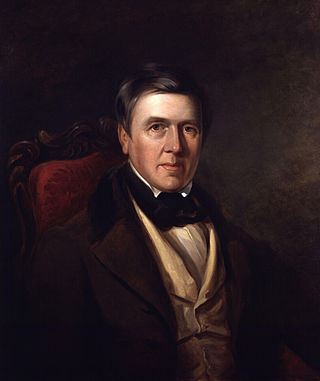
David Cox was an English landscape painter, one of the most important members of the Birmingham School of landscape artists and an early precursor of Impressionism.
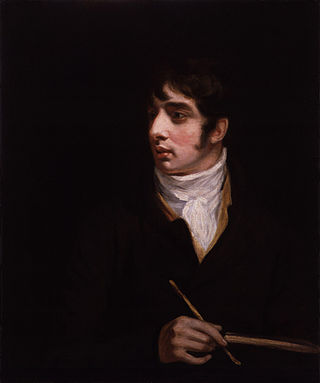
Thomas Girtin was an English watercolourist and etcher. A friend and rival of J. M. W. Turner, Girtin played a key role in establishing watercolour as a reputable art form.
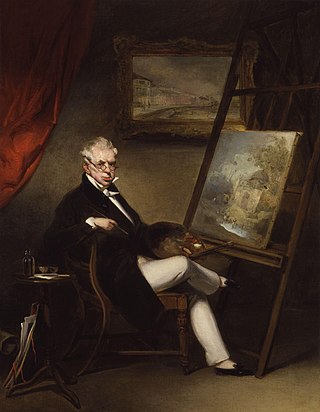
George Chinnery was an English painter who spent most of his life in Asia, especially India and southern China.

William Westall was a British landscape artist best known as one of the first artists to work in Australia.

James William Giles ARSA was a Scottish landscape painter. Several of his landscapes were commissioned and purchased by Queen Victoria and members of the Scottish aristocracy. He was a member of the Royal Scottish Academy.

William Simpson was a Scottish artist, war artist and war correspondent.

Francis Nicholson was a British artist. He worked in watercolour and oil, and is mainly known as a landscape artist.

John Romney was an English artist in printmaking and watercolour who lived and worked in London and Chester. Much of his work consisted of reproductions of the work of other artists, but he produced some original prints, paintings and drawings. Like the great majority of contemporary printmakers he worked in both engraving and etching, often on the same plate, and descriptions of his prints as being in one or the other technique should be taken loosely. His best known original prints are series of views of the Chester area and his part of one on the antiquities in the British Museum. He was apparently not related to the famous portraitist George Romney (1734–1802).

WilliamAnderson was a Scottish artist specialising in maritime and patriotic themes. He was well-regarded for his detailed and accurate portraits of ships under sail, exhibiting his works annually in London between 1787 and 1811 and then occasionally until 1834. Anderson influenced other artists, notably John Ward and others of the Hull school.
William Knight Keeling (1807–1886) was a British (Victorian) artist, an illustrator of Walter Scott's novels and Shakespeare's plays, and a founder member and the third President of the Manchester Academy of Fine Arts.

Thomas Hearne was an English landscape painter, engraver and illustrator. Hearne's watercolours were typified by applying a wash of subtle subdued colours over a clear outline in fine brush, pen or pencil. His techniques were studied by younger artists such as Thomas Girtin and J. M. W. Turner.

John Laporte was an English landscape painter and etcher, who worked in and around London, England.

William Havell was an English landscape painter, one of the Havell family of artists, and a founding member of the Society of Painters in Watercolours.

William Pars was an English watercolour portrait and landscape painter, draughtsman, and illustrator.

James Sillett was an English still life and landscape artist. He showed himself to be one of the most versatile of the Norwich School of painters: although the great majority of his works were still lifes and landscapes, he was also a drawing master and a miniaturist. His botanical paintings illustrations have been praised for their accuracy and attention to detail. These and his still life paintings are considered to be his best work, with some experts ranking him with William Jackson Hooker, whose illustrations were both accurate and charming. Sillett's own accurate depictions of plants were often used for book illustrations. His paintings often have an academic style, influenced by the masters of the eighteenth century in a way that set him apart from his Norwich contemporaries. He exhibited at the Royal Academy between 1796 and 1837.
William Derby (1786–1847) was an English portraitist, miniature painter and copyist.

John Thirtle was an English watercolour artist and frame-maker. Born in Norwich, where he lived for most of his life, he was a leading member of the Norwich School of painters.
References
 This article incorporates text from a publication now in the public domain : Cust, Lionel Henry (1897). "Sherlock, William (fl.1759-1806)". In Lee, Sidney (ed.). Dictionary of National Biography . Vol. 52. London: Smith, Elder & Co.

