The Clio Awards is an annual award program that recognizes innovation and creative excellence in advertising, design, and communication, as judged by an international panel of advertising professionals. Time magazine, in 1991, described the event as the world's most recognizable international advertising awards.

Spoken and written Vietnamese today uses the Latin script-based Vietnamese alphabet to represent native Vietnamese words, Vietnamese words which are of Chinese origin, and other foreign loanwords. Historically, Vietnamese literature was written by scholars using a combination of Chinese characters (Hán) and original Vietnamese characters (Nôm). From 111 BC up to the 20th century, Vietnamese literature was written in Văn ngôn using chữ Hán, and then also Nôm from the 13th century to 20th century.

Áo dài is a modernized Vietnamese national garment consisting of a long split tunic worn over silk trousers. It can serve as formalwear for both men and women. Áo translates as shirt and dài means "long". The term can also be used to describe any clothing attire that consists of a long tunic, such as nhật bình.

The culture of Vietnam are the customs and traditions of the Kinh people and the other ethnic groups of Vietnam. Vietnam is part of Southeast Asia and the Sinosphere due to the influence of Chinese culture on Vietnamese culture.
Direct cinema is a documentary genre that originated between 1958 and 1962 in North America—principally in the Canadian province of Quebec and in the United States—and was developed in France by Jean Rouch. It is a cinematic practice employing lightweight portable filming equipment, hand-held cameras and live, synchronous sound that became available because of new, ground-breaking technologies developed in the early 1960s. These innovations made it possible for independent filmmakers to do away with a truckload of optical sound-recording, large crews, studio sets, tripod-mounted equipment and special lights, expensive necessities that severely hog-tied these low-budget documentarians. Like the cinéma vérité genre, direct cinema was initially characterized by filmmakers' desire to capture reality directly, to represent it truthfully, and to question the relationship between reality and cinema.

Albert Maysles and his brother David Maysles were an American documentary filmmaking team known for their work in the Direct Cinema style. Their best-known films include Salesman (1969), Gimme Shelter (1970) and Grey Gardens (1975).

The Vietnamese Wikipedia is the Vietnamese-language edition of Wikipedia, a free, publicly editable, online encyclopedia supported by the Wikimedia Foundation. Like the rest of Wikipedia, its content is created and accessed using the MediaWiki wiki software.
Laurence Paul Shanet is an American commercial director and film director, also known under his working moniker Kranky. He has also directed music videos, internet content and stage plays, and worked at various times as a writer and producer, in both the advertising and entertainment industries. His work has won the 2004 Young Director Award at the Cannes Lions International Festival, and is part of the permanent collection of the Museum of Modern Art.
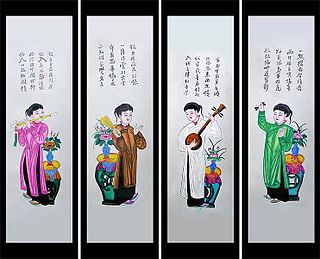
Vietnamese art is visual art that, whether ancient or modern, originated in or is practiced in Vietnam or by Vietnamese artists.

Lesbian, gay, bisexual, and transgender (LGBT) people in Vietnam face legal challenges not experienced by non-LGBTQ residents. From 2000, both male and female forms of same-sex sexual activity are legal and are believed to never have been criminalized in Vietnamese history. However, same-sex couples and households headed by same-sex couples are ineligible for the legal protections available to heterosexual couples. Vietnam provides limited anti-discrimination protections for transgender people. The right to change gender was officially legalized in Vietnam after the National Assembly passed an amendment to the Civil Code in 2015.
Nam quốc sơn hà is a famous 10th- to 11th-century Vietnamese patriotic poem. Dubbed "Vietnam's first Declaration of Independence", it asserts the sovereignty of Vietnam's rulers over its lands. The poem was first dictated to be read aloud before and during battles to boost army morale and nationalism when Vietnam under Lý Thánh Tông and Lý Thường Kiệt fought against two invasions by Song dynasty in 981 and 1075–1076 and would become became an emblematic hymn in the early independence wars. The poem is one of the best-known pieces of Vietnamese literature.
Banking in Vietnam started in 1976 with the State Bank Vietnam, which became the central bank of the country. Vietnam's banks suffer from low public confidence, regulatory and managerial weakness, high levels of non-performing loans (NPL), non-compliance with the Basel capital standards, and the absence of international auditing. Foreign investment limit into national banks of Vietnam is currently set to 30 percent.
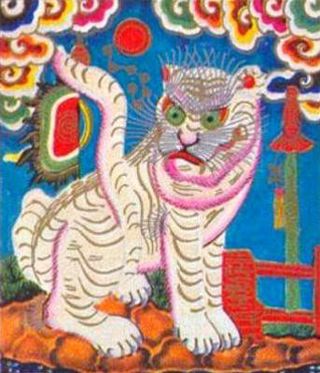
Hàng Trống painting is a genre of Vietnamese woodcut painting that originated from the area of Hàng Trống and Hàng Nón streets in the Old Quarter of Hanoi, Vietnam. In the past, Hàng Trống painting was an essential element of the Tết Nguyên Đán holiday in Hanoi, but today this tradition almost has disappeared and authentic Hàng Trống paintings are found only in museums or fine art galleries. However, the art of making Hàng Trống paintings is always considered a symbol of traditional culture and aesthetic value of Vietnam.

Khúc Hạo was the Vietnamese self-declared jiedushi of northern Vietnam from 907 to 917 succeeding his father Khúc Thừa Dụ.
The Association of Independent Commercial Producers, or AICP, is an American not for profit organization that represents the interests of United States companies that specialize in commercial production. Its members work in various media—film, video, digital—for advertisers and agencies. Founded in 1972, the association has national offices in New York City and Los Angeles as well as regional chapters.

The Propeller Group is a cross-disciplinary structure for creating art projects. The collective is headquartered in Ho Chi Minh City, Vietnam and works in conjunction with creative individuals in Los Angeles, California, United States.
Jerry “The Marble Faun” Torre is an American sculptor. He is best known for his appearance in the 1975 independent documentary films Grey Gardens and The Beales of Grey Gardens by Albert and David Maysles. As a sculptor, his work has been shown in several galleries in New York City and written about in The New York Times, The Wall Street Journal, Vogue, Architectural Digest, Forbes, among other publications. He is affectionately known among cult-film followers as "The Marble Faun"; a nickname that Edith Bouvier Beale gave him upon their first meeting. Torre worked as an assistant to Wayland Flowers, and through Aristotle Onassis obtained a job tending gardens for the Royal Family of Saudi Arabia. He was portrayed in the Tony Award winning Broadway musical Grey Gardens in 2006. His life has been documented in the 2011 film The Marble Faun of Grey Gardens.
The tradition of photography started in the 19th century in Vietnam and has since then given rise to modern photography and photojournalism into the 20th century.

Hủ tiếu or Hủ tíu is a Vietnamese dish eaten in Vietnam as breakfast. It may be served either as a soup or dry with no broth.

Chữ Hán are the Chinese characters that were used to write Sino-Vietnamese vocabulary in Vietnamese and Literary Chinese. They were officially used in Vietnam after the Red River Delta region was incorporated into the Han dynasty and continued to be used until the early 20th century where usage of Literary Chinese was abolished alongside the Confucian court examinations causing chữ Hán to be no longer used in favour of the Vietnamese alphabet.
