Related Research Articles
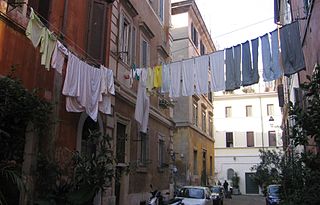
Laundry is the washing of clothing and other textiles, and, more broadly, their drying and ironing as well. Laundry has been part of history since humans began to wear clothes, so the methods by which different cultures have dealt with this universal human need are of interest to several branches of scholarship.

A washing machine is a machine designed to launder clothing. The term is mostly applied to machines that use water. Other ways of doing laundry include dry cleaning and ultrasonic cleaning.

Dry cleaning is any cleaning process for clothing and textiles using a solvent other than water. Clothes are instead soaked in a water-free liquid solvent. Perchloroethylene is the most commonly used solvent, although alternative solvents such as hydrocarbons, and supercritical CO2 are also used.

A clothes dryer is a powered household appliance that is used to remove moisture from a load of clothing, bedding and other textiles, usually after they are washed in the washing machine.

Microfiber is synthetic fibre finer than one denier or decitex/thread, having a diameter of less than ten micrometers.
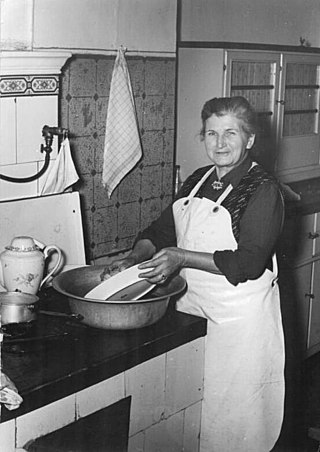
Dishwashing, washing the dishes, doing the dishes, or washing up, is the process of cleaning cooking utensils, dishes, cutlery and other food-soiled items to promote hygiene and health by preventing foodborne illness. This is either achieved by hand in a sink or tub using dishwashing detergent, or by using a dishwasher, and may take place in a kitchen, utility room, scullery or elsewhere.

A mangle is a mechanical laundry aid consisting of two rollers in a sturdy frame, connected by cogs and powered by a hand crank or by electricity.

A bathrobe, also known as a housecoat or a dressing gown, is a loose-fitting outer garment worn by people, often after washing the body or around a pool. A bathrobe is considered to be very informal clothing, and is not worn with everyday clothes.
A fabric softener or fabric conditioner is a conditioner applied to laundry after it has been washed in a washing machine. A similar, more dilute preparation meant to be applied to dry fabric is known as a wrinkle releaser.
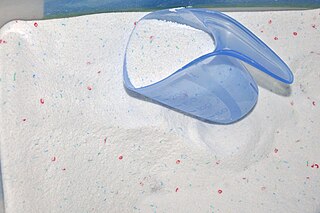
Laundry detergent is a type of detergent used for cleaning dirty laundry (clothes). Laundry detergent is manufactured in powder and liquid form.
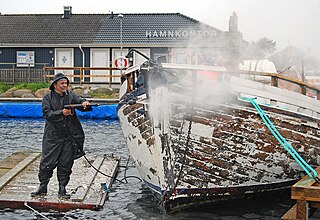
Pressure washing or power washing is the use of high-pressure water spray to remove loose paint, mold, grime, dust, mud, and dirt from surfaces and objects such as buildings, vehicles and concrete surfaces. The volume of a mechanical pressure washer is expressed in gallons or liters per minute, often designed into the pump and not variable. The pressure, expressed in pounds per square inch, pascals, or bar, is designed into the pump but can be varied by adjusting the unloader valve or using specialized nozzle tips. Machines that produce pressures from 750 to 30,000 psi or more are available.

A laundry ball or washing ball is a product made of solid, insoluble material promoted as a substitute for laundry detergent. Producers of laundry balls often make pseudoscientific claims about their mechanisms of action and exaggerate the extent of their benefits.

Carpet cleaning is performed to remove stains, dirt, debris, and allergens from carpets. Common methods include hot water extraction, dry-cleaning, and vacuuming.

A tunnel washer, also called a continuous batch washer, is an industrial washing machine designed specifically to handle heavy loads of laundry.

A combo washer dryer is a combination in a single cabinet of a washing machine and a clothes dryer. It should not be confused with a "stackable" combination of a separate washing machine and a separate clothes dryer.
Staber Industries, Inc. is a manufacturer of residential laundry home appliances, with headquarters in Groveport, Ohio. The products they currently manufacture include a washing machine, a clothes dryer, and a clothes drying cabinet.

Residential water use includes all indoor and outdoor uses of drinking quality water at single-family and multifamily dwellings. These uses include a number of defined purposes such as flushing toilets, washing clothes and dishes, showering and bathing, drinking, food preparation, watering lawns and gardens, and maintaining swimming pools. Some of these end uses are detectable while others are more difficult to gauge.

Detergent enzymes are biological enzymes that are used with detergents. They catalyze the reaction between stains and the water solution, thus aiding stain removal and improving efficiency. Laundry detergent enzymes are the largest application of industrial enzymes.

Fabric treatments are processes that make fabric softer, or water resistant, or enhance dye penetration after they are woven. Fabric treatments get applied when the textile itself cannot add other properties. Treatments include, scrim, foam lamination, fabric protector or stain repellent, anti microbial and flame retardant.
References
- 1 2 "Waterless Washing Machines". Washing Machine Wizard. Retrieved 25 January 2011.
- 1 2 Jha, Alok (9 March 2010). "The 'waterless' Washing Machine That Could save You Money". The Guardian. London. Retrieved 25 January 2011.
- ↑ Quick, Darren (26 June 2009). "'Waterless' Washing Machine Cleans Using Nylon Beads". Gizmag. Retrieved 25 January 2011.
- ↑ "Waterless Washing Machines by Year 2011– Providing Solutions to Our Environmental Problems". Bright Hub. Retrieved 25 January 2011.
- ↑ "Clothes Washers – Energy Choices at the Home". Consumer Energy Center. California Energy Commission. Archived from the original on 21 November 2010. Retrieved 25 January 2011.
- ↑ Suddath, Claire (11 November 2010). "The (Almost) Waterless Washing Machine". The 50 Best Inventions of 2010. Time. Archived from the original on 14 November 2010. Retrieved 25 January 2011.