
Art Nouveau is an international style of art, architecture, and applied art, especially the decorative arts, known in different languages by different names: Jugendstil in German, Stile Liberty in Italian, Modernisme català in Catalan, etc. In English it is also known as the Modern Style. The style was most popular between 1890 and 1910. It was a reaction against the academic art, eclecticism and historicism of 19th century architecture and decoration. It was often inspired by natural forms such as the sinuous curves of plants and flowers. Other characteristics of Art Nouveau were a sense of dynamism and movement, often given by asymmetry or whiplash lines, and the use of modern materials, particularly iron, glass, ceramics and later concrete, to create unusual forms and larger open spaces.

Louis Comfort Tiffany was an American artist and designer who worked in the decorative arts and is best known for his work in stained glass. He is the American artist most associated with the Art Nouveau and Aesthetic movements. He was affiliated with a prestigious collaborative of designers known as the Associated Artists, which included Lockwood de Forest, Candace Wheeler, and Samuel Colman. Tiffany designed stained glass windows and lamps, glass mosaics, blown glass, ceramics, jewelry, enamels, and metalwork. He was the first design director at his family company, Tiffany & Co., founded by his father Charles Lewis Tiffany.

Nancy is the capital of the northeastern French department of Meurthe-et-Moselle, and formerly the capital of the Duchy of Lorraine, and then the French province of the same name. The metropolitan area of Nancy had a population of 511,257 inhabitants at the 2017 census, making it the 16th largest urban area in France and the Lorraine's largest. The population of the city of Nancy proper was 104,885.

Émile Gallé was a French artist and designer who worked in glass, and is considered to be one of the major innovators in the French Art Nouveau movement. He was noted for his designs of Art Nouveau glass art and Art Nouveau furniture, and was a founder of the École de Nancy or Nancy School, a movement of design in the city of Nancy, France.

Louis-Jean-Sylvestre Majorelle, usually known simply as Louis Majorelle, was a French decorator and furniture designer who manufactured his own designs, in the French tradition of the ébéniste. He was one of the outstanding designers of furniture in the Art Nouveau style, and after 1901 formally served as one of the vice-presidents of the École de Nancy.

A Tiffany lamp is a type of lamp with a glass shade made with glass designed by Louis Comfort Tiffany and his design studio. The most famous was the stained leaded glass lamp. Tiffany lamps are considered part of the Art Nouveau movement.
Daum is a crystal studio based in Nancy, France, founded in 1878 by Jean Daum (1825–1885). His sons, Auguste Daum (1853–1909) and Antonin Daum (1864–1931), oversaw its growth during the burgeoning Art Nouveau period. Currently Daum is the only commercial crystal manufacturer employing the pâte de verre process for art glass and crystal sculptures, a technique in which crushed glass is packed into a refractory mould and then fused in a kiln.

The Musée des Arts Décoratifs is a museum dedicated to the exhibition and preservation of the decorative arts. Located at 107 Rue de Rivoli in the city’s 1starrondissement, the museum occupies the most north-western wing of the Palais du Louvre, known as the Pavillon de Marsan. With over one million objects in its collection, the Musée des Arts Décoratifs is the largest museum of decorative arts in continental Europe.

Eugène Vallin was a French furniture designer and manufacturer, as well as an architect.

The Modern Style is a style of architecture, art, and design that first emerged in the United Kingdom in the mid-1880s. It is the first Art Nouveau style worldwide, and it represents the evolution of Arts and Crafts movement which was native to Great Britain. Britain not only provided the base and intellectual background for the Art Nouveau movement which was adapted by other countries to give birth to local variants; they also played an over-sized role in its dissemination and cultivation through the Liberty department store and The Studio magazine. The most important person in the field of design in general and architecture, in particular, was Charles Rennie Mackintosh. He created one of the iconic symbols of the movement, known as the Mackintosh rose or Glasgow rose. The Glasgow school was also of tremendous importance, particularly due to a group closely associated with Mackintosh, known as The Four. The Liberty store nurturing of style gave birth to two metalware lines, Cymric and Tudric.

The Musée de l'École de Nancy is a museum devoted to the École de Nancy, an Art Nouveau movement founded in 1901 by Émile Gallé, Victor Prouvé, Louis Majorelle, Antonin Daum and Eugène Vallin in the city of Nancy in Lorraine, north-eastern France. They were joined by other artists, notably Jacques Grüber.

Dan Dailey is an artist who, with the support of a team of artists and crafts people, creates sculptures and functional objects in glass and metal.

École de Nancy, or the Nancy School, was a group of Art Nouveau artisans and designers working in Nancy, France between 1890 and 1914. Major figures included the furniture designer Louis Majorelle, ebenist and glass artist Jacques Grüber, the glass and furniture designer Émile Gallé, and the crystal manufactory of Daum. Their work was largely inspired by floral and vegetal forms found in the region. The goal of the group was to produce in series ordinary objects, such as furniture, glassware, and pottery, with fine craftsmanship and in original forms, making art objects available for people's homes.
Phoenix Island Villa Condo & Club House is an ocean resort complex located in Seopjikoji on the eastern coast of Jeju Island. Glass House, designed by Tadao Ando, houses the Parang-i gallery. Ando also designed Genius Loci, home of the resort’s meditation hall and media art zone. Mario Botta designed the glass pyramid-shaped Club House Agora.
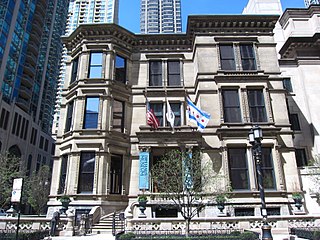
The Richard H. Driehaus Museum is a museum located at 40 East Erie Street on the Near North Side in Chicago, Illinois, near the Magnificent Mile. The museum is housed within the historic Samuel M. Nickerson House, the 1883 residence of a wealthy Chicago banker. Although the mansion has been restored, the Driehaus Museum does not re-create the Nickerson period but rather broadly interprets and displays the prevailing design, architecture, and decorating tastes of Gilded Age America and the art nouveau era in permanent and special exhibitions.

Furniture created in the Art Nouveau style was prominent from the beginning of the 1890s to the beginning of the First World War in 1914. It characteristically used forms based on nature, such as vines, flowers and water lilies, and featured curving and undulating lines, sometimes known as the whiplash line, both in the form and the decoration. Other common characteristics were asymmetry and polychromy, achieved by inlaying different colored woods.

Victor Prouvé, born 13 August 1858 in Nancy, dead 15 February 1943 at Sétif (Algeria), was a French painter, sculptor and engraver of the Art Nouveau École de Nancy.
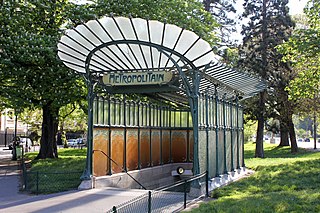
The Art Nouveau movement of architecture and design flourished in Paris from about 1895 to 1914, reaching its high point at the 1900 Paris International Exposition. with the Art Nouveau metro stations designed by Hector Guimard. It was characterized by a rejection of historicism and traditional architectural forms, and a flamboyant use of floral and vegetal designs, sinuous curving lines such as the whiplash line, and asymmetry. It was most prominent in architecture, appearing in department stores, apartment buildings, and churches; and in the decorative arts, particularly glassware, furniture, and jewelry. Besides Guimard, major artists included René Lalique in glassware, Louis Majorelle in furniture, and Alphonse Mucha in graphic arts, It spread quickly to other countries, but lost favor after 1910 and came to an end with the First World War.
The whiplash or whiplash line is a motif of decorative art and design that was particularly popular in Art Nouveau. It is an asymmetrical, sinuous line, often in an ornamental S curve, usually inspired by natural forms such as plants and flowers, which suggests dynamism and movement. It took its name from a woven fabric panel called "Coup de Fouet" ("Whiplash") by the German artist Hermann Obrist (1895) which depicted the stems and roots of the cyclamen flower. The panel was later reproduced by the textile workshop of the Darmstadt Artists Colony.

Art Nouveau glass is fine glass in the Art Nouveau style. Typically the forms are undulating, sinuous and colorful art, usually inspired by natural forms. Pieces are generally larger than drinking glasses, and decorative rather than practical, other than for use as vases and lighting fittings; there is little tableware. Prominently makers, from the 1890s onwards, are in France René Lalique, Emile Gallé and the Daum brothers, the American Louis Comfort Tiffany, Christopher Dresser in Scotland and England, and Friedrich Zitzman, Karl Koepping and Max Ritter von Spaun in Germany. Art Nouveau glass included decorative objects, vases, lamps, and stained glass windows. It was usually made by hand, and was usually colored with metal oxides while in a molten state in a furnace.
