
An anti-ship missile is a guided missile that is designed for use against ships and large boats. Most anti-ship missiles are of the sea-skimming variety, and many use a combination of inertial guidance and active radar homing. A large number of other anti-ship missiles use infrared homing to follow the heat that is emitted by a ship; it is also possible for anti-ship missiles to be guided by radio command all the way.
Omar, also spelled Umar, was the second caliph of Islam.

A short-range ballistic missile (SRBM) is a ballistic missile with a range of about 1,000 km (620 mi) or less. In past and potential regional conflicts, these missiles have been and would be used because of the short distances between some countries and their relative low cost and ease of configuration. In modern terminology, SRBMs are part of the wider grouping of theatre ballistic missiles, which includes any ballistic missile with a range of less than 3,500 km.
Noor or Nour may refer to:
Badr as a given name below is an Arabic masculine and feminine name given to the "full moon on its fourteenth night" or the ecclesiastical full moon. Badr may refer to:
Zahra or Zehra may refer to:
Zamindar were land-owning nobility in the Indian subcontinent.
Ghadir or Ghadeer means moving body/object or small stream/river in Arabic. It may refer to:

The Houthi movement, officially the Ansar Allah Movement, is a Zaydi Shia Islamist political and military organization that emerged from Yemen in the 1990s. It is predominantly made up of Zaidi Shias, with their namesake leadership being drawn largely from the Houthi tribe. The group has been a central player in Yemen's civil war, drawing widespread international condemnation for its human rights abuses, including targeting civilians and using child soldiers. The movement is designated as a terrorist organization by some countries.
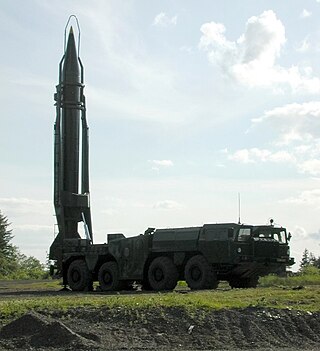
A Scud missile is one of a series of tactical ballistic missiles developed by the Soviet Union during the Cold War. It was exported widely to both Second and Third World countries. The term comes from the NATO reporting name attached to the missile by Western intelligence agencies. The Russian names for the missile are the R-11, and the R-17Elbrus. The name Scud has been widely used to refer to these missiles and the wide variety of derivative variants developed in other countries based on the Soviet design.
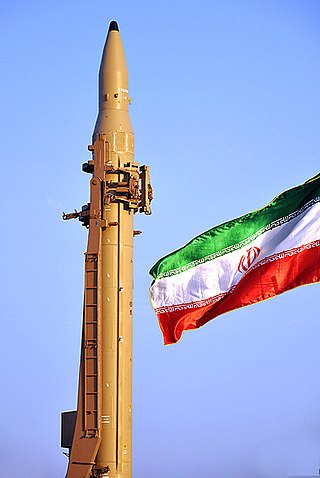
The Qiam 1 is a short-range ballistic missile designed and built by Iran. It was developed from the Iranian Shahab-2, a licensed copy of the North Korean Hwasong-6, all of which are versions of the Soviet Scud-C missile. The Qiam 1 entered service in 2010, with a range of 800 km (500 mi) and 100 m (330 ft) (CEP) accuracy.
Hussein is an Arabic given name.

Zafar is an Iranian short-range, anti-ship and radar guided cruise missile. It has been designed to be carried inside a launch canister installed on a variety of light vessels and high-speed missile crafts.

United States drone strikes in Yemen started after the September 11 attacks in the United States, when the US military attacked the Islamist militant presence in Yemen, in particular Al-Qaeda in the Arabian Peninsula using drone warfare.
The Ya-Ali is an air-launched cruise missile (ALCM) built by Iran. The missile was first unveiled on 11 May 2014 when Iranian leader Grand Ayatollah Ali Khamenei visited the Aerospace Force of the Army of the Guardians of the Islamic Revolution. According to Janes Defence, the missile has a jet engine inlet and possibly uses a version of the Toloue-4 turbojet or different Toloue 10 or 13 engines Iran produces for its longer-range anti-ship missiles and it is reported to have a range of 700 km. On February 7, 2015, Iran's Deputy Defense Minister Mohammad Eslami announced that the missile could previously be launched from only Mirage type fighter planes but it can now be launched from every fighter plane that Iran owns. It is named after a Shi'i religious expression beseeching imam Ali. As an ALCM, the Ya-Ali is distinct from the ground launched cruise missiles (GLCMs) in the Houthi inventory. According to Jane's Defense Weekly, the Houthis may have used a Quds 1 GLCM in the Abha International Airport attack on 12 June 2019. This airport in southwestern Saudi Arabia is less than 200 km from the Yemeni border. The Iranian Ya-Ali has a much longer range due to being imparted with much more kinetic and potential energy when released from a fighter aircraft such as the Mirage type. The Houthis have no fighter aircraft in their inventory.
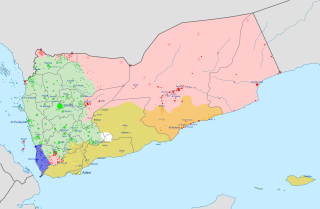
The Houthi–Saudi Arabian conflict is an ongoing armed conflict between the Royal Saudi Armed Forces and Iran-backed Yemeni Houthi forces that has been taking place in the Arabian Peninsula, including the southern Saudi regions of Asir, Jizan, and Najran, and northern Yemeni governorates of Saada, Al Jawf, and Hajjah, since the onset of the Saudi Arabian-led intervention in Yemen in 2015.
The Abha International Airport attacks were cruise missile attacks carried out by the Yemeni Houthi rebels which occurred in June 2019. The attack targeted the arrivals hall of Abha International Airport in southwestern Saudi Arabia and killed one civilian and injured 47 others.
This page is based on this
Wikipedia article Text is available under the
CC BY-SA 4.0 license; additional terms may apply.
Images, videos and audio are available under their respective licenses.

