
劉 / 刘 is an East Asian surname. pinyin: Liú in Mandarin Chinese, Lau4 in Cantonese. It is the family name of the Han dynasty emperors. The character 劉 originally meant 'kill', but is now used only as a surname. It is listed 252nd in the classic text Hundred Family Surnames. Today, it is the 4th most common surname in Mainland China as well as one of the most common surnames in the world.

Zhao is a Chinese-language surname. The name is first in the Hundred Family Surnames – the traditional list of all Chinese surnames – because it was the emperor's surname of the Song Dynasty (960–1279) when the list was compiled. The first line of the poem is 趙錢孫李.

Zhao was one of the seven major states during the Warring States period of ancient China. It emerged from the tripartite division of Jin, along with Han and Wei, in the 5th century BC. Zhao gained considerable strength from the military reforms initiated during the reign of King Wuling, but suffered a crushing defeat at the hands of Qin at the Battle of Changping. Its territory included areas in the modern provinces of Inner Mongolia, Hebei, Shanxi and Shaanxi. It bordered the states of Qin, Wei, and Yan, as well as various nomadic peoples including the Hu and Xiongnu. Its capital was Handan, in modern Hebei province.
Sima is a Chinese family name. It is one of the rare two-character Chinese family names; most Chinese family names consist of only a single character. It is an occupational surname, literally meaning "control" (sī) "horses" (mǎ), or "horse officer". The family name originated from one of the offices of the Three Excellencies of the Zhou dynasty.
Sima Lun, courtesy name Ziyi (子彛), was titled the Prince of Zhao and the usurper of the Jin Dynasty from February 3 to May 31, 301. He is usually not counted in the list of Jin emperors due to his brief reign, and was often mentioned by historians as an example of a wicked usurper. He was the third of the eight princes commonly associated with the War of the Eight Princes.

Zhao Mengfu, was a Chinese calligrapher, painter, and scholar during the Yuan dynasty. He was a descendant of the Song dynasty's imperial family through Emperor Xiaozong's brother Zhao Bogui who married a lady surnamed Song who was the granddaughter of Emperor Huizong. Zhao Bogui was a descendant of Emperor Taizu, through his son Zhao Defang.
Zhang Han was a Chinese military general of the Qin dynasty. When uprisings erupted throughout China during the reign of Qin Er Shi, Zhang Han led the Qin armies and successfully quelled several of these rebel forces. In 207 BC, Zhang Han was defeated by Xiang Yu of Chu at the Battle of Julu, after which he surrendered along with his 200,000 troops. He was conferred the title "King of Yong" (雍王) by Xiang Yu and given part of the lands in Guanzhong as his fief when Xiang split the former Qin Empire into the Eighteen Kingdoms after the fall of the Qin dynasty. Zhang Han's territory was conquered by Liu Bang in 206 BC, and he committed suicide a year later.
Shao is a common Chinese family name. It is the 86th most populous family name in China. It corresponds to last name So in Korean; "Thiệu" or "Thiều" in Vietnamese; “Zau” in Wu Chinese/Shanghainese and Siu, Chow, or Sho in other Chinese romanisations. The origin of the family name Shao is thought to have come from the royal lines of the Zhou Dynasty in ancient China. The King's loyal subject Duke of Shao (召公), was thought to have originated the Shao lines.

Zhao Yong, was a noted Chinese painter, calligrapher, and poet in the Yuan Dynasty. A native of Wuxing, he was the second son of Zhao Mengfu. Zhao was a descendant of the Song Imperial family, the House of Zhao.
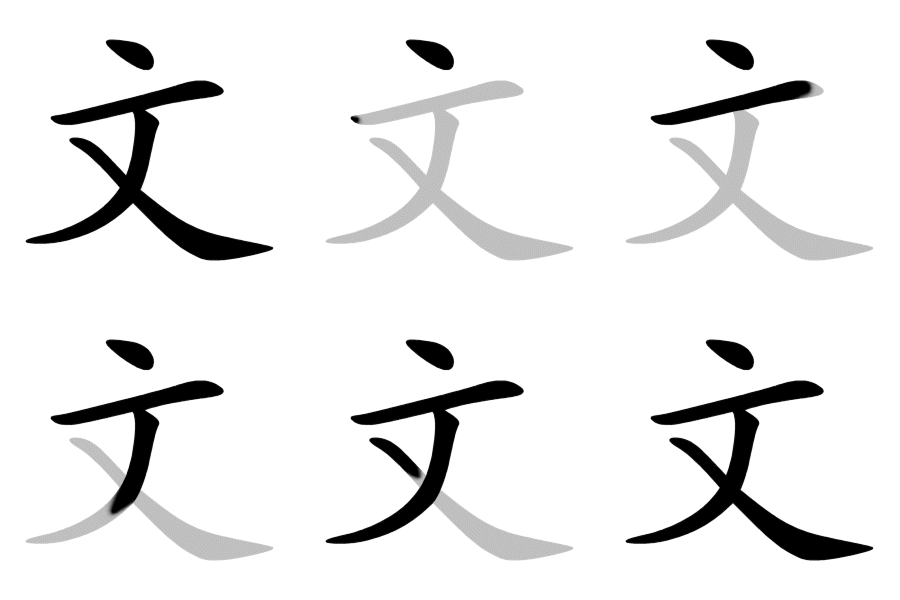
Wen is the pinyin romanisation of the Chinese surname 文 (Wén).
Wei Zhao and Zhao Wei may refer to:
Marquess Cheng of Zhao was a ruler of the State of Zhao during the Warring States Period of Chinese history. Born Zhào Zhòng, he was the son of Marquess Jing of Zhao.
The Partition of Jin, the watershed between the Spring and Autumn and Warring States periods, refers to the division of the State of Jin between rival families into the three states of Han, Zhao and Wei. As a result, the three states were often referred to as the "Three Jins" ).
Marquess Lie of Zhao was a ruler of the State of Zhao during the Warring States period of Chinese history. Born Zhào Jí, his father was Marquess Xian of Zhao.

The House of Zhao was the imperial clan of the Song dynasty (960–1279) of China.

Zhao Yuanyan, officially the Prince Gongsu of Zhou (周恭肅王), was an imperial prince of the Chinese Song dynasty, known for his virtues. He was the 8th son of Emperor Taizong and a younger brother of Emperor Zhenzong. He was referred to as the "Eighth Prince" (八大王). He was the only surviving paternal uncle of Emperor Renzong during the latter's reign.
King Xiaocheng of Zhao was a king of the State of Zhao during the Warring States period of ancient China. His reign saw the decline of Zhao military power owing to the catastrophic defeat by the State of Qin at the Battle of Changping.
Chao is a surname in various cultures. It is the Pinyin spelling of two Chinese surnames, the Wade–Giles spelling of two others, and a regional or other spelling of two additional Chinese surnames. It is also a Galician and Portuguese surname.
