 | The topic of this article may not meet Wikipedia's general notability guideline .(February 2024) |
The Zica family is a historic Brazilian family, originating in Minas Gerais in the late 18th century.
| The topic of this article may not meet Wikipedia's general notability guideline .(February 2024) |
The Zica family is a historic Brazilian family, originating in Minas Gerais in the late 18th century.
After the death of Tiradentes, Mary I of Portugal ordered the murder of all his wives and sons. Tiradentes had 8 sons, with 8 different wives.[ citation needed ] Tiradentes's wives, afraid for their lives and the lives of their children, changed their surnames. One of his wives changed her surname to Zica. It is believed[ by whom? ] that the other sons never had children, meaning that the only descendants of Tiradentes are the members of the Zica family.[ citation needed ] The Zica family has grown since then, and owns many farms with a net worth[ when? ] of over a billion reals.[ citation needed ]
Today the government of Brazil pays indemnities to many members of the Zica family. [1]

Minas Gerais ( ) is a state in Southeastern Brazil. It ranks as the second most populous, the third by gross domestic product (GDP), and the fourth largest by area in the country. The state's capital and largest city, Belo Horizonte, is a major urban and finance center in Latin America, and the sixth largest municipality in Brazil and its metropolitan area is the third largest in Brazil with just over 5.8 million inhabitants, after those of São Paulo and Rio de Janeiro. Nine Brazilian presidents were born in Minas Gerais, the most of any state. The state has 10.1% of the Brazilian population and is responsible for 8.7% of the Brazilian GDP.

Ouro Preto, formerly Vila Rica, is a Brazilian municipality located in the state of Minas Gerais. The city, a former colonial mining town located in the Serra do Espinhaço mountains, was designated a World Heritage Site by UNESCO due to its Baroque colonial architecture. Ouro Preto used to be the capital of Minas Gerais from 1720 until the foundation of Belo Horizonte in 1897.

Joaquim José da Silva Xavier, known as Tiradentes, was a leading member of the colonial Brazilian revolutionary movement known as Inconfidência Mineira, whose aim was full independence from Portuguese colonial rule and creation of a republic. When the separatists' plot was uncovered by authorities, Tiradentes was arrested, tried and publicly hanged.
Paulistas are the inhabitants of the state of São Paulo, Brazil, and of its antecessor the Capitaincy of São Vicente, whose capital early shifted from the village of São Vicente to the one of São Paulo dos Campos de Piratininga.

Tancredo de Almeida Neves was a Brazilian politician, lawyer, and entrepreneur. He served as Minister of Justice and Internal Affairs from 1953 to 1954, President of the Council of Ministers from 1961 to 1962, Minister of Finance in 1962, and as Governor of Minas Gerais from 1983 to 1984. He was elected President of the Republic in 1985, but died before taking office.

Diamantina is a Brazilian municipality in the state of Minas Gerais. Its estimated population in 2020 was 47,825 in a total area of 3,870 km2.

Mariana is the oldest city in the state of Minas Gerais, Brazil. It is a tourist city, founded on July 16, 1696, and retains the characteristics of a baroque city, with its churches, buildings and museums. It was the first capital of Minas Gerais.

São João del-Rei is a Brazilian municipality in the state of Minas Gerais. Founded in 1713 in homage to king John V of Portugal, the city is famed for its historic Portuguese colonial architecture. The current population is estimated at 90,225 inhabitants.

Congonhas is a historical Brazilian city located in the state of Minas Gerais. It is situated 90 kilometres (56 mi) south from Belo Horizonte, the capital of state of Minas Gerais, by the highway BR-040. As of 2020, the city had a population of 55,309.
Mineiro, Mineirês, or the Brazilian mountain accent is the Brazilian Portuguese term for the accent spoken in the Center, East and Southeast regions of the state of Minas Gerais.

Inconfidência Mineira was an unsuccessful separatist movement in Brazil in 1789. It was the result of a confluence of external and internal causes in what was then colonial Brazil. The external inspiration was the independence of thirteen British colonies in North America following the American Revolutionary War, a development that impressed the intellectual elite of particularly the captaincy of Minas Gerais.
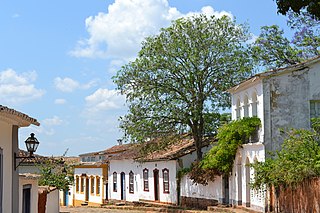
Tiradentes is a municipality in the Brazilian state of Minas Gerais. It is located at 21°06′37″S44°12′41″W, has an area of 83.5 km², and a maximum elevation above sea level of 927 m. Tiradentes had an estimated population of 10,960, as of 2020. The original village was established in 1702 and became a city on 19 January 1718. In 1889 the city was renamed from Vila de São José do Rio das Mortes in honour of the national hero who was born nearby.

Cláudio Manuel da Costa was a Brazilian poet and musician, considered to be the introducer of Neoclassicism in Brazil. He wrote under the pen name Glauceste Satúrnio, and his most famous work is the epic poem Vila Rica, that tells the history of the homonymous city, nowadays called Ouro Preto.
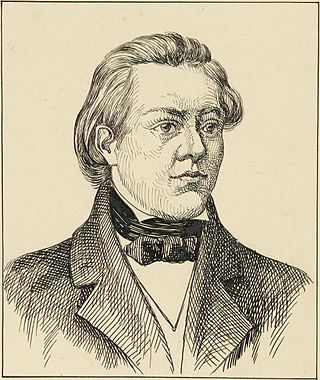
José Basílio da Gama was a colonial Brazilian poet and member of the Society of Jesus, famous for the epic poem O Uraguai. He wrote under the pen name Termindo Sipílio.
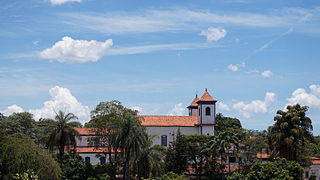
Sabará is a Brazilian municipality located in the state of Minas Gerais. The city belongs to the Belo Horizonte metropolitan region and to the associated microregion.

Oliveira is a Brazilian municipality in the state of Minas Gerais. It is located at latitude 20º41'47" south and longitude 44º49'38" west, at an altitude of 982 metres. It is located 165 kilometres at southwest from Belo Horizonte. Its estimated population was 41,181 according to the latest IBGE census.
Francisca da Silva de Oliveira, known in history by the name Chica da Silva and whose romanticized version/character is also known by the spelling Xica da Silva, was a Brazilian woman who became famous for becoming rich and powerful despite having been born into slavery. Her life has been a source of inspiration for many works in television, films, music, theater and literature. She is popularly known as the slave who became a queen. The myth of Chica da Silva is often conflated with the historical accounts of Francisca da Silva de Oliveira.
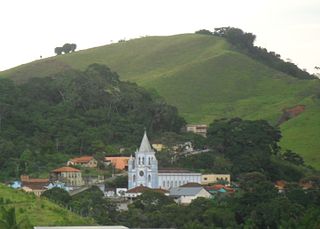
Piau is a municipality in the state of Minas Gerais in the Southeast region of Brazil.
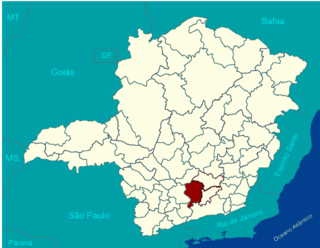
The Immediate Geographic Region of São João del-Rei is one of the 10 immediate geographic regions in the Intermediate Geographic Region of Barbacena, one of the 70 immediate geographic regions in the Brazilian state of Minas Gerais and one of the 509 of Brazil, created by the National Institute of Geography and Statistics (IBGE) in 2017.

The Tiradentes Palace is an eclectic government building located in the Centro neighborhood (bairro), next to the Paço Imperial in Rio de Janeiro, Brazil. It was inaugurated on 6 May 1926 and was the former seat of the Chamber of Deputies of Brazil, between 1926 and 1960, and is the current seat of the Legislative Assembly of the State of Rio de Janeiro.
 | This Brazilian biographical article is a stub. You can help Wikipedia by expanding it. |