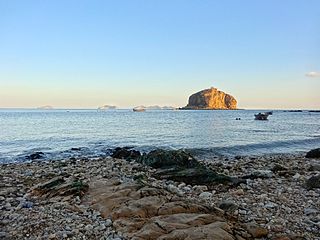
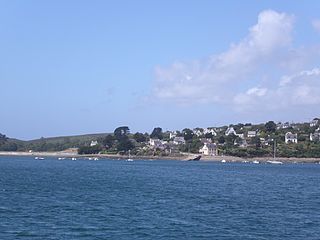
The Battle of Camaret was an amphibious landing at Camaret Bay on 18 June 1694 by the English and Dutch in an attempt to seize the French port of Brest and destroy part of the French fleet stationed there, as part of the Nine Years' War. It was successfully opposed by Sébastien Le Prestre de Vauban.

The Goulet de Brest is a 3 km long strait linking the roadstead of Brest to the Atlantic Ocean. Only 1.8 km wide, it is situated between the Pointe du Petit Minou and the Pointe du Portzic to the north and the îlot des Capucins and the Pointe des Espagnols to the south.

The Fort de Bertheaume is a fort in Plougonvelin, in the Department of Finistère, France. It is located on a tidal island that nowadays connects to the mainland via a footbridge. The fort sits well above sea level, and its steep cliffs have rendered it easily defended for centuries. Since the 17th century, the fort's role has been to monitor the Goulet de Brest, the straits of Brest.

The fort du Mengant or fort du Léon in the commune of Plouzané is part of the defences of the roadstead of Brest. It is made up of a high battery, with a now-destroyed artillery tower, and a lower semi-circular battery at the foot of the cliff, with two small powder magazines.
La pointe de Cornouaille is a cape to the north of the hamlet of Kerviniou in France. They are both situated on the Roscanvel peninsula and, facing as it does the Fort du Mengant, a battery on the point forms part of the defences of the goulet de Brest. Known defences on the site include:
The batteries de Kerviniou are artillery batteries built in the late 19th and early 20th centuries, and are made up of an upper battery (1891) and an underground magazine (1891) Located on the Roscanvel peninsula facing the Fort du Mengant, they are a late addition to the defences of the goulet de Brest. Demilitarised in 1915, they are open to the public.

The Pointe des Espagnols is the north-east extremity of the Roscanvel peninsula, an outgrowth of the Crozon peninsula closing off the roadstead of Brest. It also marks the south-east limit of the goulet de Brest.

A model tower (tour-modèle), also known as an Empire tower or a Napoleon tower, was a standardised defensive fortification created in 1811. Construction began along the Atlantic and Mediterranean coastlines the following year but the project was abandoned in 1814 with only 12 towers being completed.
The crenellated guardhouses of the 1846 model were gun-batteries built along the coast of France as the result of a standardisation of coastal-defence redoubts during the reign of Louis-Philippe of France. This standardisation came as an attempt to complete the defensive chain begun by Napoleon in 1811 with his model towers, left incomplete on his abdication in 1814. A mixed coastal armament commission set up in 1841 defined 3 types of work, known as crenellated guardhouses, crenellated towers and model-redoubt with defensive barracks. Along with the construction of the battleship La Gloire, they represent part of a 20-year trend of French naval and coastal re-armament, to which the United Kingdom eventually responded by building its own steam battleship (Warrior) and its own coastal defence chain during the 1860s.
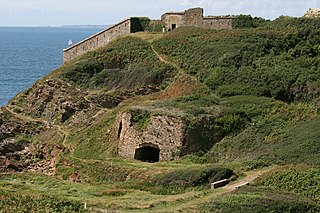
The Fort de la Fraternité is a fort located on the îlot du Diable in Roscanvel, France. The whole complex is now in ruins, though a gunpowder magazine is still standing, with a roof of large rectangular tiles and elaborate guttering.
'Îlot du Diable is a gun battery built to support fort de la Fraternité in the defensive system around the goulet de Brest in France. It is sited on the peninsula of Roscanvel and is accessible by a small bridge. The battery was razed in the 19th century and in 1890 on its site was built a bunker with an electricity generator. A casemate was then added by the Germans in 1942. A small observation is still to be found at the summit of the site, near a former lime kiln.
Quélern is a hamlet in Roscanvel, in the department of Finistère (Brittany), in western France.
Tremet is a hamlet on the Roscanvel peninsula in France. The gun batteries located here are part of the defences of the goulet de Brest, forbidding ships from entering the bay of Camaret-sur-Mer. The site had been occupied by the military since 1694 and was updated several times in the 18th and 19th centuries. The battery became a heavy anti-aircraft post in 1955 as part of the outer defences of Brest's military fort - part of that battery is still part of the military land around Quélern and not open to the public.

The Tour Vauban, initially known as the tour de Camaret, is an 18m-high polygonal defensive tower built to a plan by Vauban on the Sillon at Camaret-sur-Mer, as part of the fortifications of the goulet de Brest. It has three levels and is flanked by walls, a guardhouse and a gun battery which can hold 11 cannons as well as a cannonball foundry added in the French Revolution period.

The pointe du Grand Gouin is a rocky promontory with vertical cliffs to the west of the inlet of Camaret-sur-Mer in France. It protects a port which, in Vauban's era, was vulnerable to possible landings. It is divided into the Grand Gouin and the Petit Gouin (mid-cliff).
Kerbonn is a village in the commune of Camaret-sur-Mer in France, between the pointe de Pen-Hir and the pointe du Toulinguet, on the Crozon peninsula. As well as its fortifications, the site also houses the ruins of the manor of Coecilian.

The Pointe du Toulinguet is a promontory at the end of the Crozon peninsula in the commune of Camaret-sur-Mer in France.
The Childers Incident of 2 January 1793 marked the opening shots between British and French forces during the French Revolutionary Wars, the first phase of a 23-year-long war between the two countries. Following the French Revolution of 1789, diplomatic relations between the Kingdom of Great Britain and the French Republic had steadily deteriorated and France was in political and social turmoil. One of the strongest hotbeds of republican activity was the principal Atlantic naval base of the French Navy at Brest in Brittany, the scene of a significant mutiny in 1790.
The following is a timeline of the history of the city of Brest, France.
The canton of Crozon is an administrative division of the Finistère department, northwestern France. Its borders were modified at the French canton reorganisation which came into effect in March 2015. Its seat is in Crozon.