Hingham is a town in metropolitan Greater Boston on the South Shore of the U.S. state of Massachusetts in northern Plymouth County. At the 2020 census, the population was 24,284. Hingham is known for its colonial history and location on Boston Harbor. The town was named after Hingham, Norfolk, England, and was first settled by English colonists in 1633.
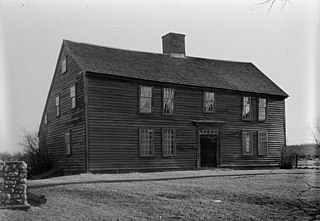
A saltbox house is a gable-roofed residential structure that is typically two stories in the front and one in the rear. It is a traditional New England style of home, originally timber framed, which takes its name from its resemblance to a wooden lidded box in which salt was once kept.

The Paul Revere House, built c.1680, was the colonial home of American Patriot and Founding Father Paul Revere during the time of the American Revolution. A National Historic Landmark since 1961, it is located at 19 North Square, Boston, Massachusetts, in the city's North End, and is now operated as a nonprofit museum by the Paul Revere Memorial Association. An admission fee is charged.

The Fairbanks House in Dedham, Massachusetts is a historic house built c. 1637, making it the oldest surviving timber-frame house in North America that has been verified by dendrochronology testing. Puritan settler Jonathan Fairbanks constructed the farm house for his wife Grace and their family. The house was occupied and then passed down through eight generations of the family until the early 20th century. Over several centuries the original portion was expanded as architectural styles changed and the family grew.

The Boardman House, also known as the Scotch-Boardman House or the Bennett-Boardman House, is a historic house located at 17 Howard Street, Saugus, Massachusetts. Built in 1692, it was designated a National Historic Landmark in 1961 because of the remarkable amount of original building material still present in the house. It has been owned by Historic New England since 1914, and is open to the public on select weekends between June and October.

The Jackson Homestead, located at 527 Washington Street, in the village of Newton Corner, in Newton, Massachusetts, is an historic house that served as a station on the Underground Railroad before the Civil War.

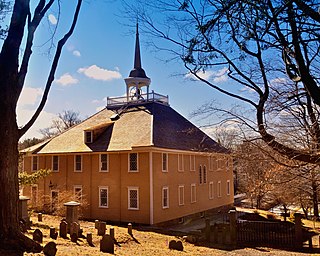
The Old Ship Church is a Puritan church built in 1681 in Hingham, Massachusetts. It is the only surviving 17th-century Puritan meetinghouse in the United States. Its congregation, gathered in 1635 and officially known as First Parish in Hingham, occupies the oldest church building in continuous ecclesiastical use in the country. On October 9, 1960, it was designated a National Historic Landmark, and on November 15, 1966, it was added to the National Register of Historic Places.

First Period is an American architecture style originating between approximately 1626 and 1725, used primarily by British colonists during the settlement of the British colonies of North America, particularly in Massachusetts and Virginia. Among U.S. counties, Essex County, Massachusetts has the highest number of preserved First Period architecture buildings.
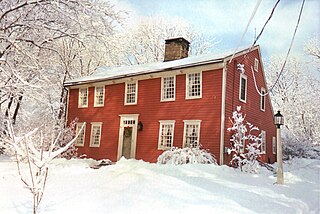
The Ephraim Hawley House is a privately owned Colonial American wooden post-and-beam timber-frame saltbox house situated on the Farm Highway, Route 108, on the south side of Mischa Hill, in Nichols, a village located within the town of Trumbull, Connecticut, the U.S. It was expanded to its present shape by three additions. Over time the house has been classified as located in four different named townships, as jurisdictional boundaries changed, but it has never been moved. These towns were Stratford (1670–1725), Unity (1725–1744), North Stratford (1744–1797), and Trumbull (1797–present).
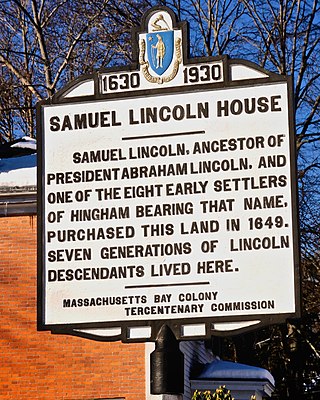
Samuel Lincoln was an Englishman and progenitor of many notable United States political figures, including his 4th-great-grandson, President Abraham Lincoln, Maine governor Enoch Lincoln, and Levi Lincoln Sr. and Levi Lincoln Jr., both of whom served as Massachusetts Representatives, Governor and Lieutenant Governor. Because of Samuel Lincoln's descendants, his fortuitous arrival in the Massachusetts Bay Colony, and the fact that his ancestry is known for several generations, he is considered the father of the most prominent branch of Lincolns in the United States.

The John Ward House is a National Historic Landmark at 9 Brown Street in Salem, Massachusetts, United States. With an early construction history between 1684 and 1723, it is an excellent example of First Period architecture, and as the subject of an early 20th-century restoration by antiquarian George Francis Dow, it is an important example of the restoration techniques. Now owned by the Peabody Essex Museum, it is also one of the first colonial-era houses in the United States to be opened as a museum. It was designated a National Historic Landmark in 1968.

The South Hingham Historic District is a historic district roughly along Main St., from Cushing St. to Tower Brook Road in Hingham, Massachusetts. This area of Main Street is predominantly residential, and is distinctive for its boulevard-like character, which was envisioned in town planning documents as early as the late 17th century. A significant feature of the area is the presence of conservation land behind the properties on much of this stretch of Main Street, which has effectively throttled large-scale development. These properties include the Jacob Meadow, Mildred Cushing Woods, and Crooked Meadow River Area. The oldest structure in the district is the 1650 Edward Wilder House at 597 Main Street.

The White–Ellery House is a historic house located at 247 Washington Street in Gloucester, Massachusetts. It is on the National Register of Historic Places. It is owned and operated by the Cape Ann Museum, whose headquarters is located at 27 Pleasant Street in Gloucester.

The Daniel Nichols Homestead is a historic home in Reading, Massachusetts. The oldest portion of this timber-frame house was built in the early 1740, with vernacular Georgian styling. The house is five bays wide and two deep, with a rear shed-roof extension giving the house a saltbox appearance. An ell was added in the mid-19th century. The main architectural detail is the front door surround, which features sidelight windows and recessed, paneled pilasters supporting a tall entablature.
Deacon John Leavitt (1608–1691) was a tailor, public officeholder, and founding deacon of Old Ship Church in Hingham, Plymouth County, Massachusetts, the only remaining 17th-century Puritan meeting house in America and the oldest church in continuous ecclesiastical use in the United States. Hingham's Leavitt Street is named for the early settler, whose descendants have lived in Hingham for centuries.

The Avery Homestead is a two-story Colonial-style home in Ledyard, Connecticut that was built circa 1696. Evidence suggests that the house may have begun as a single-story, one-room house and later expanded to a two-story, two-room house by 1726. The house underwent major additions and renovations by Theophilus Avery and later his grandson, Theophilus Avery. In the mid-1950s, Amos Avery began a decade-long restoration effort to return the house to its 18th-century appearance. The Avery Homestead is historically significant as a well-preserved example of an 18th-century farmhouse with fine craftsmanship. The home is also historically important because more than twelve generations of the Avery family have resided there over the course of three centuries. The Avery Homestead was listed on the National Register of Historic Places in 1992.

The Phebe Seaman House is located in the Byram section of Greenwich, Connecticut. It was built in 1794 and is one of the oldest structures in Byram. It is also believed to be the Seth Mead homestead possibly.

The Oliver House, also known as the Smith-Oliver House, is a historic house at 58 Oak Street in Wakefield, Massachusetts. Probably built in the late 18th century, this Federal period house is distinctive for its association with the now-suburban area's agrarian past, and as a two-family residence of the period, with two "Beverly jogs". The house was listed on the National Register of Historic Places in 2014.

Franklyn Vale Homestead is a heritage-listed homestead at Franklin Vale Road, Mount Mort, City of Ipswich, Queensland, Australia. It was built in the early 1870s. It was added to the Queensland Heritage Register on 21 October 1992.

The Captain Philo Beardsley House is a historic house on Beardsley Road in Kent, Connecticut. Built about 1780, it is a well-preserved example of an 18th-century saltbox, with a remarkably well-preserved interior. It was listed on the National Register of Historic Places in 1979.