Freising (district)

Last updated
Freising
Flagge Landkreis Freising.svg
DEU Landkreis Freising COA.svg
Freising (district)
Country Germany
State Bavaria
Adm. region Upper Bavaria
Capital Freising
Government
  District admin.Helmut Petz (FW)
Area
  Total
800 km2 (310 sq mi)
Population
 (31 December 2024) [1]
  Total
184,564
  Density230/km2 (600/sq mi)
Time zone UTC+01:00 (CET)
  Summer (DST) UTC+02:00 (CEST)
Vehicle registration FS
Website lra-freising.bayern.de
Freising Mariendom Freising von Westen her fotografiert.jpg
Freising
Moosburg Kastulusmunsterp.jpg
Moosburg
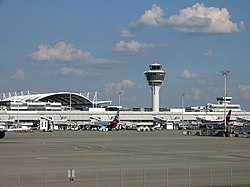
Munich Airport Vorfeld Terminal 1 I.JPG
Munich Airport
Hop garden in the Hallertau Hopfengarten-Juni.jpg
Hop garden in the Hallertau

Freising is a Landkreis (district) in Bavaria, Germany. Following a recent ranking of the German magazine Focus-Money comparing all German districts it is number one concerning economic growth abilities. It is bounded by (from the north and clockwise) the districts of Kelheim, Landshut, Erding, Munich, Dachau and Pfaffenhofen. The district is located north of the Munich metropolitan area. The Isar and Amper rivers run in parallel from southwest to northeast. North of the rivers there is the Hallertau, a hilly region mainly used for growing hop.

Contents

History

In the Holy Roman Empire, Freising was a clerical state ruled by the bishops. In 1803, when the clerical states of Germany were dissolved, the region was annexed by Bavaria.

Coat of arms

The coat of arms displays:

The Freising Moor's head

The Moor's head is a controversial charge in the coat of arms, which could represent one of many different persons:

There is a crown on the Moor's head, which probably indicated that the territory of the Bishop of Freising was autonomous.

Towns and municipalities

Clickable map of towns and municipalities in the district Municipalities in FS.svgEchingLangenbachWang
Clickable map of towns and municipalities in the district
TownsMunicipalities
  1. Freising
  2. Moosburg
  1. Allershausen
  2. Attenkirchen
  3. Au in der Hallertau
  4. Eching
  5. Fahrenzhausen
  6. Gammelsdorf
  7. Haag an der Amper
  8. Hallbergmoos
  9. Hohenkammer
  10. Hörgertshausen
  11. Kirchdorf an der Amper
  1. Kranzberg
  2. Langenbach
  3. Marzling
  4. Mauern
  5. Nandlstadt
  6. Neufahrn bei Freising
  7. Paunzhausen
  8. Rudelzhausen
  9. Wang
  10. Wolfersdorf
  11. Zolling

References

  1. "Gemeinden, Kreise und Regierungsbezirke in Bayern, Einwohnerzahlen am 31. Dezember 2024; Basis Zensus 2022" [Municipalities, counties, and administrative districts in Bavaria; Based on the 2022 Census](CSV) (in German). Bayerisches Landesamt für Statistik.

48°30′N11°50′E / 48.5°N 11.83°E / 48.5; 11.83