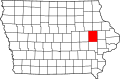
The earliest inhabitants of Linn County, prior to Anglo settlement, were the Sac and Fox tribes. Relations were described by 20th century historians as amicable. Native Americans provided food and furs to whites in exchange for merchandise.[7]
Linn County was created as a named but unorganized area on December 21, 1837, as a part of Wisconsin Territory. It became part of Iowa Territory on July 3, 1838, when the territory was organized.[8][9] Linn County was organized by the first legislative assembly of the Iowa Territory on January 15, 1839. A site was selected for its first county seat along Indian Creek, and was named Marion, after the Revolutionary War general Francis Marion. As early as 1855, there were debates over moving the county seat to the fast-growing Cedar Rapids, southwest of Marion, but it was not until November 6, 1919, that there were enough votes in favor of the move (9,960 to 4,823).[10] The first rail line was built through Cedar Rapids in 1859, and made the town (and the county) a major commercial hub in eastern Iowa.
According to the United States Census Bureau, the county has a total area of 724.669 square miles (1,876.88km2), of which 717.013 square miles (1,857.06km2) is land and 7.656 square miles (19.83km2) (1.06%) is water.[11] It is the 10th largest county in Iowa by total area.[12]
U.S. Decennial Census[14] 1790–1960[15] 1900–1990[16] 1990–2000[17] 2010–2020[3]
As of the second quarter of 2025, the median home value in Linn County was $241,994.[18]
As of the 2024 American Community Survey, there are 97,117 estimated households in Linn County with an average of 2.33 persons per household. The county has a median household income of $74,709. Approximately% of the county's population lives at or below the poverty line. Linn County has an estimated 65.0% employment rate, with 33.3% of the population holding a bachelor's degree or higher and 93.7% holding a high school diploma.[3] There were 104,556 housing units at an average density of 145.82 per square mile (56.3/km2).
The top five reported languages (people were allowed to report up to two languages, thus the figures will generally add to more than 100%) were English (92.1%), Spanish (2.0%), Indo-European (2.4%), Asian and Pacific Islander (1.5%), and Other (2.1%).
The median age in the county was 39.6 years.
Linn County, Iowa – racial and ethnic composition Note: the US Census treats Hispanic/Latino as an ethnic category. This table excludes Latinos from the racial categories and assigns them to a separate category. Hispanics/Latinos may be of any race.
As of the 2024 estimate, there were 231,762 people, 97,117 households, and _ families residing in the county. The population density was 323.23 inhabitants per square mile (124.8/km2). There were 104,556 housing units at an average density of 145.82 per square mile (56.3/km2). The racial makeup of the county was 85.8% White (82.1% NH White), 7.4% African American, 0.3% Native American, 2.8% Asian, 0.3% Pacific Islander, _% from some other races and 3.4% from two or more races. Hispanic or Latino people of any race were 4.4% of the population.
2020 census
Population of Linn County from the U.S. census data
As of the 2020 census, there were 230,299 people, 94,751 households, and 58,528 families residing in the county.[24] The population density was 321.19 inhabitants per square mile (124.0/km2). There were 101,230 housing units at an average density of 141.18 per square mile (54.5/km2). The racial makeup of the county was 82.78% White, 7.14% African American, 0.24% Native American, 2.33% Asian, 0.23% Pacific Islander, 1.31% from some other races and 5.96% from two or more races. Hispanic or Latino people of any race were 3.87% of the population.[25][26]
The median age was 38.0 years, with 23.2% of residents under the age of 18 and 16.5% aged 65 or older. For every 100 females there were 96.4 males, and for every 100 females age 18 and over there were 94.3 males age 18 and over.[27]
86.3% of residents lived in urban areas, while 13.7% lived in rural areas.[28]
There were 94,751 households in the county, of which 29.1% had children under the age of 18 living in them. Of all households, 46.2% were married-couple households, 19.7% were households with a male householder and no spouse or partner present, and 26.3% were households with a female householder and no spouse or partner present. About 30.9% of all households were made up of individuals and 11.4% had someone living alone who was 65 years of age or older.[27]
There were 101,230 housing units, of which 6.4% were vacant. Among occupied housing units, 71.0% were owner-occupied and 29.0% were renter-occupied. The homeowner vacancy rate was 1.3% and the rental vacancy rate was 9.1%.[27]
2010 census
As of the 2010 census, there were 211,226 people, 86,136 households, and _ families residing in the county. The population density was 294.59 inhabitants per square mile (113.7/km2). There were 92,251 housing units at an average density of 128.66 per square mile (49.7/km2). The racial makeup of the county was 90.85% White, 3.95% African American, 0.27% Native American, 1.80% Asian, 0.09% Pacific Islander, 0.72% from some other races and 2.34% from two or more races. Hispanic or Latino people of any race were 2.62% of the population.[29]
2000 census
As of the 2000 census, there were 191,701 people, 76,753 households, and 50,349 families residing in the county. The population density was 267.36 inhabitants per square mile (103.2/km2). There were 80,551 housing units at an average density of 112.34 per square mile (43.4/km2). The racial makeup of the county was 93.90% White, 2.57% African American, 0.22% Native American, 1.37% Asian, 0.05% Pacific Islander, 0.46% from some other races and 1.44% from two or more races. Hispanic or Latino people of any race were 1.42% of the population.
There were 76,753 households 31.80% had children under the age of 18 living with them, 53.20% were married couples living together, 9.00% had a female householder with no husband present, and 34.40% were non-families. 27.50% of households were one person and 8.90% were one person aged 65 or older. The average household size was 2.43 and the average family size was 2.99.
Age spread: 25.30% under the age of 18, 10.10% from 18 to 24, 30.30% from 25 to 44, 22.10% from 45 to 64, and 12.20% 65 or older. The median age was 35 years. For every 100 females, there were 96.10 males. For every 100 females age 18 and over, there were 93.40 males.
The median household income was $46,206 and the median family income was $56,494. Males had a median income of $38,525 versus $26,403 for females. The per capita income for the county was $22,977. About 4.30% of families and 6.50% of the population were below the poverty line, including 7.60% of those under age 18 and 6.40% of those age 65 or over.
Government
The Linn County Board of Supervisors consists of three members elected by district to overlapping four-year terms.[30]
The Board of Supervisors serves as both the executive branch and legislative branch of Linn County government. It oversees Communications, Community Services, Engineering/Secondary Road, Facilities, Finance & Budget, Human Resources, Information Technology, LIFTS (para-transit transportation), Planning & Development, Policy & Administration, Purchasing, Risk Management, Soil & Water Conservation, Sustainability, and Veteran Services. Conservation and Public Health report to independent boards appointed by the Board of Supervisors.
The County Attorney, Auditor, Recorder, Sheriff, and Treasurer are elected independently and oversee their respective departments.
Name
Staff Directory
Nick Maybanks
Attorney
Todd Taylor
Auditor
Carolyn Siebrecht
Recorder
Brian D. Gardner
Sheriff
Brent C. Oleson
Treasurer
While Iowa shifted from competitive to firmly Republican during the Donald Trump era in the mid-to-late 2010s, Linn County remained as one of the state's few Democratic strongholds. The County last voted for a Republican for president in 1984 when Ronald Reagan won a landslide re-election. In every presidential election since 1984, the Democratic candidate won Linn County by at least 9 percent.
United States presidential election results for Linn County, Iowa[31]
History of Linn County Iowa by Luther A. Brewer and Barthinius L. Wick The Pioneer Publishing Company(1911 copyright expired) This searchable and pdf downloadable book was scanned into the public domain by Google books.
This page is based on this Wikipedia article Text is available under the CC BY-SA 4.0 license; additional terms may apply. Images, videos and audio are available under their respective licenses.


 United States
 Iowa
Iowa