Nyepi, also known as Day of Silence, is a Balinese holiday held every Isakawarsa ("new year") according to the Balinese calendar, and it can be traced as far back as 78 A.D.[1]
The observance includes maintaining silence, fasting, and meditation for Balinese Hindus. The following day is celebrated as New Year's Day.[2][3] After Nyepi, youths in the village of Sesetan in southern Bali practice the ceremony of omed-omedan, or "kissing ritual".[4]
Rituals
Observed from 6 a.m. until 6 a.m. the following day, Nyepi is dedicated to self-reflection, fasting, and meditation. During this period, activities that may interfere with this purpose are prohibited, including work, travel, and entertainment or leisure activities. The use of fire and artificial lighting is restricted, resulting in minimal electricity use, and residents and visitors are required to remain indoors across the island of Bali.[5]
As Bali's usually bustling streets and roads become empty during Nyepi, there is little or no noise from TVs and radios, and few signs of activity are visible inside homes. The only people to be seen outdoors are the pecalang, traditional security men who patrol the streets to ensure the prohibitions are followed.[6]
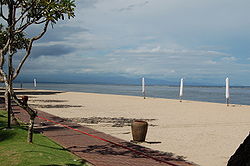
Although Nyepi is primarily a Hindu holiday, non-Hindu residents and tourists are not exempt from the restrictions. Although they are free to do as they wish inside hotels, no one is allowed onto beaches or streets, and the only airport in Bali remains closed for the entire day. Tourists who violate these rules can face deportation.[7]
On the afternoon and evening before Nyepi, accessibility on roads is limited. Many local roads are closed for evening parades, making it difficult to navigate by car or motorcycle. Most local restaurants close early, and many ATMs are switched off, with cash removed until the day following Nyepi.[8] Electricity remains operational, however.[9]
The only exceptions granted are for emergency vehicles responding to life-threatening conditions and women going into labor.[10][11]
On the day after Nyepi, known as Ngembak Geni ("relighting the fire"), social activity picks up again, as families and friends gather to ask forgiveness from one another and to perform religious rituals together. Fires and electricity are allowed once more, and cooking resumes.[5]
Tawur Kesanga, a ritual procession on the eve of Nyepi. Children carry lit torches that are used to light bonfires to burn ogoh-ogoh statues.
The Melasti ritual is performed 3–4 days beforehand, within Hindu temples near the sea and beaches. It is meant to purify the sacred objects pratima, arca, and pralingga[clarification needed] and to acquire sacred water from the sea.[13][14]
The Bhuta Yajna ritual is performed in order to vanquish negative elements and create balance with God, humankind, and nature. It is also meant to appease Batara Kala, with offerings of live animal sacrifice. Around sunset, the pengrupukan, or ngrupuk[15] ceremony begins inside houses, with noisy banging of pots and pans and bamboo tubes along with burning of dried coconut leaf torches to drive out demons.[16][17]
The last day of the year includes processions of bhuta (demons, above), followed by Nyepi, the festival of silence.
Most Balinese villages make ogoh-ogoh, demonic statues made of richly painted bamboo, papier-mâché, cloth, and tinsel, symbolising negative elements, malevolent spirits, or even characters from Hindu mythology. After the ogoh-ogoh have been paraded around the village, they are burned in the cemeteries, although many are displayed in front of community halls for another month or more and sometimes even purchased by museums and collectors.[5]
In 2024, the ogoh-ogoh parades were cancelled due to the general election being so close to the date of the festival and the regional government fearing that the parade may be used to convey political themes. Only villages, in particular traditional ones, were allowed to hold parades.[21]
Security is provided by hansip, while the pecalang are redirected into security roles from their usual tasks such as traffic coordination; both types of security forces report to local village heads.[22]
↑Daniswari, Dini (1 March 2022). "4 Pantangan saat Nyepi di Bali"[4 Taboos during Nyepi in Bali]. denpasar.kompas.com (in Indonesian). Retrieved 13 March 2024.
This page is based on this Wikipedia article Text is available under the CC BY-SA 4.0 license; additional terms may apply. Images, videos and audio are available under their respective licenses.