
The Savoia-Marchetti SM.81 Pipistrello was the first three-engine bomber/transport aircraft serving in the Italian Regia Aeronautica. When it appeared in 1935, it represented a real step ahead in Italian military aviation: it was fast, well armed and had a long range. It proved effective during the war with Ethiopia and the Spanish Civil War. Despite being too slow to remain competitive as a bomber in the later years of World War II, it was one of the most flexible, reliable and important aircraft of the Regia Aeronautica from 1935 to 1944, and adapted to second-line duties in a wide range of tasks.

The Savoia-Marchetti S.73 was an Italian three-engine airliner that flew in the 1930s and early 1940s. The aircraft entered service in March 1935 with a production run of 48 aircraft. Four were exported to Belgium for SABENA, while seven others were produced by SABCA. The main customer was the Italian airline Ala Littoria.

The Savoia-Marchetti SM.75 Marsupiale was an Italian passenger and military transport aircraft of the 1930s and 1940s. It was a low-wing, trimotor monoplane of mixed metal and wood construction with a retractable tailwheel undercarriage. It was the last of a line of transport aeroplanes that Alessandro Marchetti began designing in the early 1930s. The SM.75 was fast, robust, capable of long-range flight and could carry up to 24 passengers for 1,000 miles.

The Ambrosini SAI.403 Dardo ("Dart") was a light fighter aircraft built in Italy during World War II.

The Savoia-Marchetti SM.85 was an Italian monoplane dive bomber and ground-attack aircraft that served in small numbers in the Regia Aeronautica at the beginning of World War II. They were soon replaced in service by the Junkers Ju 87.

The Savoia-Marchetti SM.83 was an Italian civil airliner of the 1930s. It was a civilian version of the Savoia-Marchetti SM.79 bomber.

The Savoia-Marchetti SM.91 was a two-seat, twin-engined, Italian heavy fighter prototype, designed to compete in a 1942 revision to a long-range fighter-bomber contract offered by the Regia Aeronautica to Italian aircraft companies in 1938. The original 1938 specification yielded the Savoia-Marchetti SM.88, which the SM.91 was largely based on.
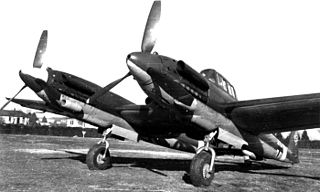
The Savoia-Marchetti SM.92 was an Italian heavy fighter/bomber of World War II based on the Savoia-Marchetti SM.88. The SM.92 did away with the mid-wing crew nacelle. The crew of two sat in the left fuselage only. Two DB 605 engines were fitted.

The Savoia-Marchetti SM.95 was an Italian four-engine, mid-range transport aircraft, which first flew in 1943. It was the successor of the Savoia-Marchetti SM.75.

The Savoia-Marchetti SM.78 was an Italian bomber/reconnaissance biplane flying boat of the early 1930s.

The Savoia-Marchetti SM.62 was an Italian single-engine maritime patrol flying boat produced from 1926. It served with the Regia Aeronautica and with a number of foreign users, and was produced in Spain and the Soviet Union. Some of the Spanish aircraft were still in service during the Spanish Civil War.

The Breda Ba.201 was an Italian dive bomber designed during World War II, that never entered production.
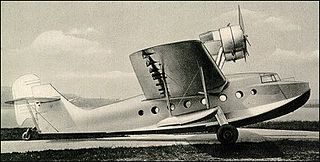
The Macchi M.C.94 was a 1930s Italian commercial flying boat built by Macchi.

The Savoia-Marchetti S.59 was a 1920s Italian reconnaissance/bomber flying boat designed and built by Savoia-Marchetti for the Regia Aeronautica.
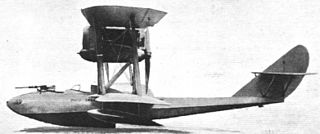
The Savoia-Marchetti S.57 was an Italian single-engine biplane flying boat intended for aerial reconnaissance, built by Savoia-Marchetti for Regia Aeronautica after World War I.

The Savoia-Marchetti S.72 was an Italian three-engine transport monoplane designed and built by Savoia-Marchetti as an enlarged and strengthened version of the earlier S.71. The S.72 was a three-engine, high-wing cantilever monoplane with a fixed tailwheel landing gear. Designed as a heavy bomber, the prototype was first flown in 1934 powered by three 410 kW (550 hp) Alfa Romeo licence-built Bristol Pegasus radial engines.

The IMAM Ro.5 was a sport aircraft designed by Alessandro Tonini and produced by IMAM in Italy in the late 1920s.

The SIAI S.52 was an Italian fighter prototype of 1924.

The Marchetti MVT, later renamed SIAI S.50, was an Italian fighter of 1919 and the early 1920s.
The Macchi M.C.77 was a reconnaissance bomber flying boat built by Macchi in the thirties and remained at the prototype stage.


