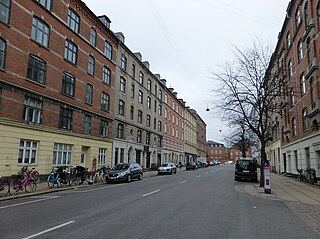
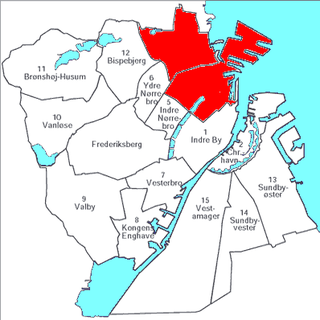
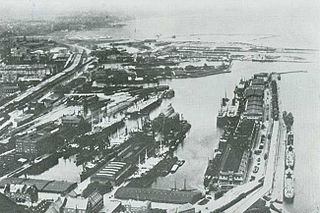
Nordhavnen, or Nordhavn, is a harbour area at the coast of the Øresund, founded at the end of the 19th century in Copenhagen, Denmark. It covers an area of more than 2 km².

Hellerup is a district of Gentofte Municipality in the suburbs of Copenhagen, Denmark. The most urban part of the district is centred on Strandvejen and is bordered by Østerbro to the south and the Øresund to the east. It comprises Tuborg Havn, the redeveloped brewery site of Tuborg Breweries, with the Waterfront Shopping Center, a marina and the headquarters of several large companies. Other parts of the district consist of single family detached homes. Local landmarks include the science centre Experimentarium and the art Øregaard Museum.
Districts of Copenhagen are often based on informal designations based on historic origins, often with alternative names and loosely defined boundaries. Copenhagen Municipality is divided into 10 official administrative districts but they often comprise areas of a heterogeneous character which are colegually not seen as one district. Some districts have earlier been official subdivisions and thus have semi-official boundaries. Copenhagen postal code designations often correspond to district boundaries but in some cases differ from them, as an example parts of the city centre has the postal code København V which is generally associated with Vesterbro.

Østerbrogade is the principal shopping street and thoroughfare in the Østerbro district of Copenhagen, Denmark. It extends from Lille Triangel at the north-eastern tip of The Lakes, passes Trianglen, and continues to Svanemøllen station from where it becomes Strandvejen.

Svanemølle Beach is an urban beach situated in the Østerbro district of Copenhagen, Denmark. It is situated in the bottom of the Svanemølle Bay, off Strandpromenaden, a promenade that follows the coast between Copenhagen's Nordhavn area to the south and Tuborg Havn in Hellerup to the north. Svanemøllen Marina and the Svanemølle Power Station are located just south of the beach.
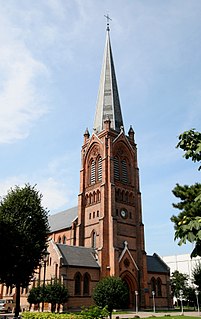
St. James's Church in the Østerbro district of Copenhagen, Denmark, was the first church to be built in the district. It was designed by Ludvig Fenger in a Neo-Gothic style and built between 1876 and 1878.

Amerika Plads is a public square and surrounding neighbourhood in the Østerbro district of Copenhagen, Denmark. It is the result of a redevelopment of an area in the southern part of the former Freeport of Copenhagen into a mixed-use neighbourhood which consists of dwellings, offices and retail establishments, combining converted historic buildings and modern architecture. The former Free Port Station building was put in storage during the redevelopment and is now located in the middle of the square where it serves as a café. The area is to the west bounded by Kalkbrænderihavnsgade, part of a major thoroughfare, and to the east by Dampfærgevej connected to Kalkbrænderihavnsgade in both ends and separating Amerika Plads from America Quay, the western quay of the Southern Free Port dock. The name of the area, like that of the quay, is a reference to the large passenger ships which used to transport Danish emigrants to New York City during the first half of the 20th century.

Østerfælled Barracks, later known as Østerbrogade Kaserne, was a barracks originally built in the 1890s for the Guard Hussars of the Royal Danish Army in the emerging Østerbro district of Copenhagen, Denmark. Its grounds have now been transformed into a mixed-use development surrounding a pedestrian zone and is now known as Østerfælled Torv. Many of the old buildings have been retained while others have been demolished to make way for new residential buildings. The old main entrance to the barracks is located on the corner of Østerbrogade and Gunner Nu Hansens Plads.

Østerfælled Torv is a mixed-use development surrounding a public space by the same name in the former grounds of Østerfælled Barracks in the Østerbro district of Copenhagen, Denmark. It is a result of a redevelopment of the site in the 1990s which preserved many of the old buildings, now used for retail and commercial space as well as cultural facilities, combining them with new apartment buildings.

Sankt Jakobs Plads is a public square located off the east side of Østerbrogade in the Østerbro district of Copenhagen, Denmark. It takes its name after St. James' Church on the other side of the street.

Ryesgade is a street straddling the border of the Nørrebro and Østerbro districts of Copenhagen, Denmark. Together with Ravnsborggade, its continuation to the south, it forms the backbone of a small neighbourhood bounded by The Lakes to the east, Blegdamsvej to the west, Nørrebrogade to the south and Østerbrogade to the north. The busy artery Fredensgade and Fredens Park, a narrow green space which runs along its northside, effectively separates the Nørrebro and Østerbro portions of Ryesgade from each other. Ryesgade was formerly known for its many second-hand stores of which a few still exist today.

Zion's Church is a Lutheran church on Østerbrogade, just south of Svanemøllen station, in the Østerbro district of Copenhagen, Denmark. It was completed in 1896 to a design by Valdemar Koch, making it the second oldest church in Østerbro.

Øster Allé is a street in the Østerbro district of Copenhagen, Denmark, connecting Trianglen to Vibenhus Runddel. The northern part of the street, after Parken Stadium, Denmark's national football stadium, bisects Fælledparken, Copenhagen's largest park.

Trianglen is a central junction and public space in the Østerbro district of Copenhagen, Denmark. Five streets meet in the junction: Blegdamsvej, Øster Allé, Østerbrogade, Nordre Frihavnsgade and Odensegade. Trianglen will be a station on the City Circle Line of the Copenhagen Metro.

Strandboulevarden is a major street in the Østerbro district of Copenhagen, Denmark. It runs from Fridtjof Nansens Plads as in the south to Østerbrogade in the north, linking Kristianiagade with Jagtvej.

Østbanegade is a street in Copenhagen, Denmark. It begins at Østerport Station on Oslo Plads and continues north along the west side of the railway tracks for about 2 kilometres to Aarhusgade where an underpass connects the street to the other side of the railway line. A second underpass is situated at Nordre Frihavnsgade, just south of Nordhavn station, while a foot and cycle bridge is found at Mandalsgade near the beginning of the street.

Nordre Frihavnsgade is a street in the Østerbro district of Copenhagen, Denmark, linking the junction Trianglen in the southwest with Østbanegade In the northeast. The street passes the two small squares Victor Borges Plads and Melchiors Plads. An underpass under the raised railway tracks at the end of the street provides access to Nordhavn's Århusgade neighbourhood.
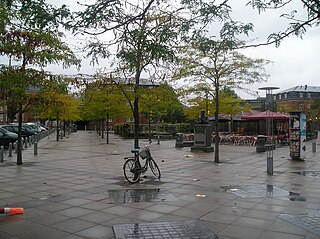
Gunnar Nu Hansens Plads is a public space in the Østerbro district of Copenhagen, Denmark. It consists of a triangular plaza, located on the west side of Østerbrogade, just north of Parken Stadium, which turns into a wide street and continues for about 200 m to Fælledparken, The street then continues southwest as Per Henrik Lings Allé to Øster Allé. Several sports venues, some of which are listed, are located on the south side of the square. The former Østerfælled Barracks, now a mixed-use development known as Østerfælled Torv, are located on its north side.

Emdrup is a neighbourhood straddling the border between the Bispebjerg and Østerbro district of Copenhagen, Denmark. It is located between Utterslev Mose in the west and the Helsingør Motorway in the east, just south of the border with Gladsaxe and Gentofte municipalities. Emdrup is a mainly residential neighbourhood, boasting a combination of apartment buildings and areas with single-family detached home. Emdrup station is located on the Farum radial of the S-train system. AU Campus Emdrup, Aarhus University's Copenhagen campus, is situated just north of the station. The most important greenspaces are Lake Emdrup with its small lakeside park in the east, Utterslev Mose in the west and Emdrupparken with sport facilities in the north.