This article needs additional citations for verification .(January 2013) (Learn how and when to remove this template message) |
.38 refers to the type of firearm and firearm cartridges.
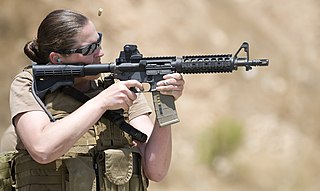
A firearm is a portable gun that inflicts damage on targets by launching one or more projectiles driven by rapidly expanding high-pressure gas produced chemically by exothermic combustion (deflagration) of propellant within an ammunition cartridge. If gas pressurization is achieved through mechanical gas compression rather than through chemical propellant combustion, then the gun is technically an air gun, not a firearm.
A cartridge is a type of pre-assembled firearm ammunition packaging a projectile, a propellant substance and an ignition device (primer) within a metallic, paper or plastic case that is precisely made to fit within the barrel chamber of a breechloading gun, for the practical purpose of convenient transportation and handling during shooting. Although in popular usage the term "bullet" is often used to refer to a complete cartridge, it is correctly used only to refer to the projectile.
The .38 is considered a large firearm cartridge; anything larger than .32 is considered a large caliber, and one of the most common handguns manufactured in the United States. [1] :42 Prior to 1990, the standard sidearm of police in the United States was a revolver that fired the .38 Special cartridge, seconded by the .357 Magnum revolver. [1] :68
In guns, particularly firearms, caliber or calibre is the approximate internal diameter of the gun barrel, or the diameter of the projectile it shoots. It is measured in hundredths or thousandths of an inch or in millimetres. For example, a ".45 caliber" firearm has a barrel diameter of roughly 0.45 inches (11 mm). Barrel diameters can also be expressed using metric dimensions. For example, a "9 mm pistol" has a barrel diameter of about 9 millimetres. When the barrel diameter is given in inches, the abbreviation "cal" can be used. For example, a small-bore rifle with a diameter of 0.22 inches (5.6 mm) can be referred to as a ".22" or ".22 cal"; however, the decimal point is generally dropped when spoken, making it a "twenty-two" or a "two-two caliber". A ".45 caliber" would be a "forty-five", or "four-five caliber", etc.

The United States of America (USA), commonly known as the United States or America, is a country composed of 50 states, a federal district, five major self-governing territories, and various possessions. At 3.8 million square miles, the United States is the world's third or fourth largest country by total area and is slightly smaller than the entire continent of Europe's 3.9 million square miles. With a population of over 327 million people, the U.S. is the third most populous country. The capital is Washington, D.C., and the largest city by population is New York City. Forty-eight states and the capital's federal district are contiguous in North America between Canada and Mexico. The State of Alaska is in the northwest corner of North America, bordered by Canada to the east and across the Bering Strait from Russia to the west. The State of Hawaii is an archipelago in the mid-Pacific Ocean. The U.S. territories are scattered about the Pacific Ocean and the Caribbean Sea, stretching across nine official time zones. The extremely diverse geography, climate, and wildlife of the United States make it one of the world's 17 megadiverse countries.
The .38 Smith & Wesson Special is a rimmed, centerfire cartridge designed by Smith & Wesson. It is most commonly used in revolvers, although some semi-automatic pistols and carbines also use this round. The .38 Special was the standard service cartridge of most police departments in the United States from the 1920s to the 1990s, and was also a common sidearm cartridge used by soldiers in World War I. In other parts of the world, it is known by its metric designation of 9×29.5mmR or 9.1×29mmR.
| Cartridge name | Bullet diameter | Case length | Cartridge length | Type | Source |
|---|---|---|---|---|---|
| .380 ACP | .356 in (9.0 mm) | .680 in (17.3 mm) | .980 in (24.9 mm) | Rimless | Barnes[ who? ] 1997, p. 274 |
| .38 Casull | .356 in (9.0 mm) | .933 in (23.7 mm) | – | Rimless | [2] |
| .38 Short Colt | .357 in (9.1 mm) | .762 in (19.4 mm) | 1.052 in (26.7 mm) | Rimmed | Barnes 1997, p. 274 |
| .38 Long Colt | .357 in (9.1 mm) | 1.030 in (26.2 mm) | 1.320 in (33.5 mm) | Rimmed | Barnes 1997, p. 274 |
| .38 Special | .357 in (9.1 mm) | 1.15 in (29 mm) | 1.550 in (39.4 mm) | Rimmed | Barnes 1997, p. 274 |
| .38 ACP | .358 in (9.1 mm) | .900 in (22.9 mm) | 1.280 in (32.5 mm) | Semi-rimmed | Barnes 1997, p. 274 |
| .38 Super | .358 in (9.1 mm) | .900 in (22.9 mm) | 1.280 in (32.5 mm) | Semi-rimmed | Barnes 1997, p. 274 |
| .38 Super Comp | .358 in (9.1 mm) | .896 in (22.8 mm) | 1.280 in (32.5 mm) | Rimless | Starline cartridge dimensions |
| .38 S&W | .359 in (9.1 mm) | .780 in (19.8 mm) | 1.200 in (30.5 mm) | Rimmed | Barnes 1997, p. 274 |
| .380 Revolver Short | .375 in (9.5 mm) | 0.700 in (17.8 mm) | 1.100 in (27.9 mm) | Rimmed | Barnes 1997, p. 274 |
| .380 Revolver Long | .375 in (9.5 mm) | 1.000 in (25.4 mm) | 1.400 in (35.6 mm) | Rimmed | Barnes 1997, p. 274 |
| .38-40 Winchester | .401 in (10.2 mm) | 1.300 in (33.0 mm) | 1.590 in (40.4 mm) | Rimmed | Barnes 1997, p. 92 |

Smith & Wesson (S&W) is an American manufacturer of firearms, ammunition and restraints. The corporate headquarters are in Springfield, Massachusetts. Smith & Wesson was founded in 1852 and after various corporate changes is now a unit of American Outdoor Brands Corporation.
The Colt Single Action Army, also known as the Single Action Army, SAA, Model P, Peacemaker, M1873, and Colt .45 is a single-action revolver with a revolving cylinder holding six metallic cartridges. It was designed for the U.S. government service revolver trials of 1872 by Colt's Patent Firearms Manufacturing Company—today's Colt's Manufacturing Company—and was adopted as the standard military service revolver until 1892.
The .40 S&W is a rimless pistol cartridge developed jointly by major American firearms manufacturers Smith & Wesson and Winchester. The .40 S&W was developed from the ground up as a law enforcement cartridge designed to duplicate performance of the Federal Bureau of Investigation's (FBI) reduced-velocity 10mm Auto cartridge which could be retrofitted into medium-frame semi-automatic handguns. It uses 0.40-inch (10 mm) diameter bullets ranging in weight from 105 to 200 grains.
The .357 S&W Magnum (9×33mmR), or simply .357 Magnum, is a revolver cartridge with a .357-inch (9.07 mm) bullet diameter. It was created by Elmer Keith, Phillip B. Sharpe, and D. B. Wesson of firearms manufacturers Smith & Wesson and Winchester.
The .44 Remington Magnum, or simply .44 Magnum (10.9×33mmR), and frequently .44 Mag, is a rimmed, large-bore cartridge originally designed for revolvers. After its introduction, it was quickly adopted for carbines and rifles. Despite the ".44" designation, guns chambered for the .44 Magnum round, and its parent, the .44 Special, use 0.429 in (10.9 mm) diameter bullets.
The .44 Special or .44 S&W Special is a smokeless powder center fire metallic revolver cartidge developed by Smith & Wesson in 1907 as the standard chambering for their New Century revolver, introduced in 1908.
The .41 Remington Magnum or 10.4×33mmR as it is known in unofficial metric designation, is a center fire firearms cartridge primarily developed for use in large-frame revolvers, introduced in 1964 by the Remington Arms Company, intended for hunting and law enforcement purposes.
The .32 S&W cartridge was introduced in 1878 for Smith & Wesson pocket revolvers. It was originally designed as a black powder cartridge. The .32 S&W was offered to the public as a light defense cartridge for "card table" distances.
A heeled bullet is a specific design of bullet where the internal diameter of the barrel is often, but not always, the same diameter as the cartridge case, and the bullet has a step at the rear to allow it to fit inside the case. Heeled bullets mostly disappeared with the advent of smokeless powder cartridges, though older rimfire designs, such as the .22 caliber rimfire cartridges, still use heeled bullets, and many cartridges that date back to the black powder era still reflect their heeled bullet origins in their caliber designations.
The .32 H&R Magnum is a rimmed cartridge designed for use in revolvers. It was developed in 1984 as a joint venture between Harrington & Richardson and Federal Cartridge. The .32 H&R Magnum is produced by lengthening the .32 S&W Long case by .155", to 1.075".
Overpressure ammunition, commonly designated as +P or +P+, is small arms ammunition that has been loaded to a higher internal pressure than is standard for ammunition of its caliber, but less than the pressures generated by a proof round. This is done typically to produce rounds with a higher muzzle velocity and stopping power, such as ammunition used for defensive purposes. Because of this, +P ammunition is typically found in handgun calibers which might be used for defensive purposes.
An antique firearm is a term to describe a firearm that was designed and manufactured prior to the beginning of the 20th century. Although the exact definition of what constitutes an "antique firearm" varies between countries, the advent of smokeless powder or the start of the Boer War are often used as cut-off dates. Antique firearms are usually collected because of their historical interest and/or their monetary value.
A handgun is a short-barrelled firearm designed to be fired with only one hand. The two most common handgun sub-types in use today are revolvers and semi-automatic pistols.
The Colt Revolving Belt Pistol of Naval Caliber, later known as the Colt 1851 Navy or Navy Revolver, is a cap and ball revolver that was designed by Samuel Colt between 1847 and 1850. Colt first called this Revolver the Ranger model; but the designation Navy quickly took over.
The Colt New Service is a large frame, large caliber, double-action revolver made by Colt from 1898 until 1941. Made in various calibers, the .45 Colt version with a 5½" barrel, was adopted by the U.S. Armed Forces as the Model 1909.
The .500 Linebaugh is a .50 caliber handgun cartridge designed for use in revolvers. It is considered one of the most powerful handgun cartridges designed in terms of kinetic energy and power factor (momentum).
.38 rimfire cartridges are a type of ammunition that have been in service in the United States since the mid-nineteenth century. The cartridges are produced in short, long and extra long variants.
The Colt New Line was a single action pocket revolver introduced by the Colt's Patent Fire Arms Manufacturing Company in 1873. Two years after the Colt House Revolver (1871), a year after the Colt Open Top (1872) and almost simultaneously alongside the Colt Peacemaker (1873), the Colt New Line was one of the first metallic cartridge rear-loading revolvers manufactured by Colt's. It was, alongside the Colt Open Top Pocket Model Revolver (1871), one of the first pocket metallic cartridge revolvers made by the company.