
Capesthorne Hall is a country house near the village of Siddington, Cheshire, England. The house and its private chapel were built in the early 18th century, replacing an earlier hall and chapel nearby. They were built to Neoclassical designs by William Smith and (probably) his son Francis. Later in the 18th century, the house was extended by the addition of an orangery and a drawing room. In the 1830s the house was remodelled by Edward Blore; the work included the addition of an extension and a frontage in Jacobean style, and joining the central block to the service wings. In about 1837 the orangery was replaced by a large conservatory designed by Joseph Paxton. In 1861 the main part of the house was virtually destroyed by fire. It was rebuilt by Anthony Salvin, who generally followed Blore's designs but made modifications to the front, rebuilt the back of the house in Jacobean style, and altered the interior. There were further alterations later in the 19th century, including remodelling of the Saloon. During the Second World War the hall was used by the Red Cross, but subsequent deterioration prompted a restoration.

Lodge Park was built as a grandstand in the Sherborne Estate near the villages of Sherborne, Aldsworth and Northleach in Gloucestershire, England. The site is owned by the National Trust and the former grandstand is recorded in the National Heritage List for England as a designated Grade I listed building. It is England's only surviving 17th-century deer course and grandstand.
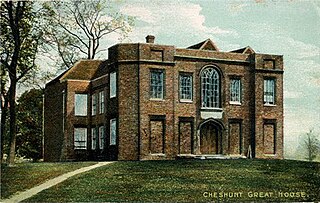
Cheshunt Great House was a manor house in the town of Cheshunt, Hertfordshire, England, near to Waltham Abbey. It is said to have been built by Henry VIII of England for Cardinal Thomas Wolsey. The family seat of the Shaw family for over a century, by the late 19th century it was used as a Freemasons Hall and was later used during World War II. After the war, the hall was too costly to run and was opened to the public until a fire gutted it in 1965. It was made a Grade II listed building on 11 June 1954.
Brackenhill Tower is a peel tower, in the parish of Arthuret, in Cumbria, just north of the River Lyne. The site is about 2 miles (3.2 km) north of Kirklinton and 4 miles (6.4 km) east of Longtown, or 10 miles (16 km) north of Carlisle and 8 miles (13 km) east of Gretna Green, and is a good defensive position, with ravines to the north and south. Extensions were added in the 18th and 19th centuries, but the original tower has had little alteration. It is the only remaining example of a Scottish tower house south of the border with England, and became a grade II* listed building in 1957.

The Church of St Thomas à Becket, Wolvesnewton, Monmouthshire has its origins in the 13th century. Restored in the 19th century, it remains an active parish church. St Thomas's is a Grade II* listed building. The medieval churchyard cross was restored as a First World War memorial in 1920 and has its own Grade II* listing.

Raglan Lodge is a Grade II* listed building in Beaufort Square, Chepstow, Monmouthshire, Wales. Though the frontage dates from the early 19th century, parts of the building date from the medieval period and the ground floor vaulted hall was probably the town's 14th century moot hall. The building has been refurbished and is currently used as a backpackers' hostel.

Little Llwygy Farmhouse, Cwmyoy, Monmouthshire, Wales, is a farmhouse of two building dates, the earlier of the 15th century, the latter of the 17th. The farmhouse is Grade II* listed.

Llangattock Court, Penpergwm, Monmouthshire, Wales, is a country house of late-medieval origins. Cadw gives a date for original building of 1490-1520. In the 17th century, the house was substantially reconstructed for the Wroths. Further rebuilding took place in the early 20th century. In the later 20th century, the building fell into ruin, before a substantial reconstruction in 1985-2000. It is a Grade II* listed building.
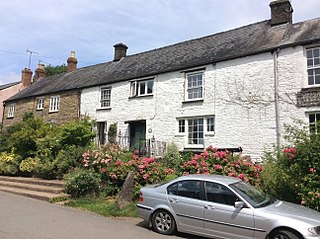
Howell's House, Grosmont, Monmouthshire is an early 17th century house. Previously known as The Shop, it served as a village stores from the mid-19th century in the 1980s. Now a private residence, it is a Grade II* listed building.

The Old Cottage, in the hamlet of Treadam, some 2km north-west of Llantilio Crossenny, Monmouthshire, is a country house dating from c.1600. The house is Grade II* listed.
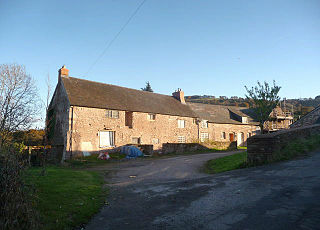
Great Tresenny Farmhouse, Grosmont, Monmouthshire is a farmhouse dating from c.1600. Situated just to the south of the village, the farmhouse is a Grade II* listed building.

Trostrey Court House, Trostrey, Monmouthshire is a late 16th century gentry house. The current building replaced an earlier medieval court. The house played a role in the English Civil War when it was seized by the forces of Thomas Fairfax during the siege of Raglan Castle. In the 18th century the estate was sold to Valentine Morris, owner of nearby Piercefield House. In the 19th century the court was owned by the Fluyders, but let to tenant farmers. It remains a private house and working estate. The court is a Grade II* listed building.

Howick Farmhouse, in the hamlet of Howick, near Itton, Monmouthshire is a farmhouse dating from the mid-16th century. It is a Grade II* listed building. Its associated barns and stable block have their own Grade II listings.
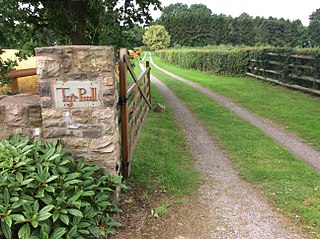
Pwll, Tregare, Monmouthshire is a medieval cruck-house dating from the late 14th century, with additions in the 17th century. An "extremely rare survival", the house was derelict by the mid-20th century, and was reconstructed in the mid-1990s. It is a Grade II* listed building.
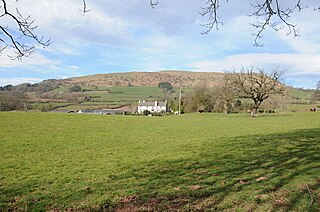
Llanddewi Court, Llanddewi Skirrid, Monmouthshire, Wales, is a Grade II* listed house dating from the late 16th century. It is an example of a "double-house", a building in two sections, originally without interconnections, and designed to accommodate two families.

The Cwm, Llantrisant, Monmouthshire is a farmhouse dating from the 16th century. Expanded in both the 17th and 18th centuries, The Cwm is a Grade II* listed building, its listing describing it as "a substantial farmhouse of distinctive T-plan".

The barn, stable and granary at Cwrt y Brychan , Llansoy, Monmouthshire are a range of farm buildings constructed in the 16th century. The origins are the site are ancient and the court is historically connected with the kingdom of Brycheiniog. The complex has a Grade II* listing, with the court having a separate Grade II listing.
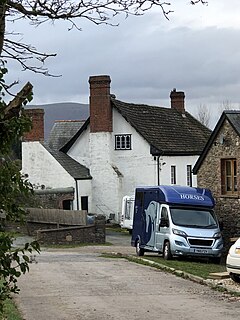
Wern-ddu farmhouse, Llantilio Pertholey, Monmouthshire is a farmhouse of 17th century origins. It has been significantly altered in the 18th, 19th and 20th centuries and the Monmouthshire antiquarian, Sir Joseph Bradney recorded that it had "suffered so much by continual alterations that it shows but little of its antiquity". It is a Grade II* listed building.

Upper Green, Llantilio Crossenny, Monmouthshire is a farmhouse dating from the Medieval period. The original hall house was enlarged in the 17th century. In the 18th century, a substantial new farmhouse was built which incorporated the hall house as a service wing. Upper Green remains a private house and is a Grade II* listed building.

Mamhead House, Mamhead, Devon, is a country house dating from 1827. Its origins are older but the present building was constructed for Robert William Newman, an Exeter merchant, in 1827–1833 by Anthony Salvin. The house is Grade I listed. The parkland has its own Grade II* listing. It was for a time known as Dawlish College.


