
Shankh Monastery located in Övörkhangai Province, Central Mongolia, 25 kilometers South East of Kharkhorin city, is one of Mongolia’s oldest and most historically significant monasteries. It was founded in 1647 by Zanabazar, the first Jebtsundamba Khutuktu, or spiritual head of Tibetan Buddhism for the Khalkha in Outer Mongolia, around the same time as the establishment of the nearby Tövkhön Monastery.

Buddhism in Mongolia derives much of its recent characteristics from Tibetan Buddhism of the Gelug and Kagyu lineages, but is distinct and presents its own unique characteristics.
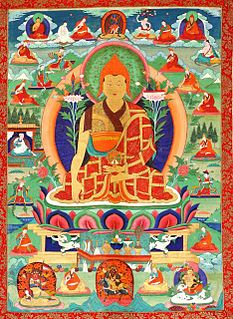
Tāranātha (1575–1634) was a Lama of the Jonang school of Tibetan Buddhism. He is widely considered its most remarkable scholar and exponent.
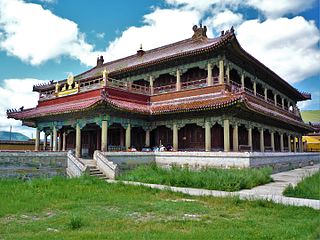
Amarbayasgalant Monastery or the "Monastery of Tranquil Felicity", is one of the three largest Buddhist monastic centers in Mongolia. The monastery complex is located in the Iven Valley near the Selenge River, at the foot of Mount Büren-Khaan in Baruunbüren sum (district) of Selenge Province in northern Mongolia. The nearest town is Erdenet which is about 60 km to the southwest.

The Gandantegchinlen Monastery is a Mongolian Buddhist monastery in the Mongolian capital of Ulaanbaatar that has been restored and revitalized since 1990. The Tibetan name translates to the "Great Place of Complete Joy". It currently has over 150 monks in residence. It features a 26.5-meter-high statue of Avalokiteśvara. It came under state protection in 1994.
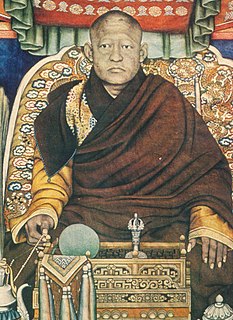
The Bogd Khan became Bogd Gegeen Ezen Khaan of Bogd Khaganate in 1911, when Khüree declared independence from Qing dynasty of China after the Xinhai Revolution. He was born in Tibet. As the 8th Jebtsundamba Khutuktu, he was the third most important person in the Tibetan Buddhist hierarchy, below only the Dalai Lama and Panchen Lama, and therefore also known as the "Bogdo Lama". He was the spiritual leader of Outer Mongolia's Tibetan Buddhism. His wife Tsendiin Dondogdulam, the Ekh Dagina, was believed to be a manifestation of White Tara.
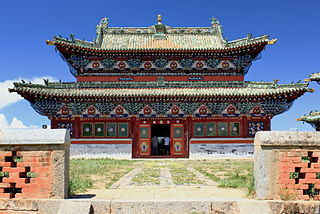
The Erdene Zuu Monastery is probably the earliest surviving Buddhist monastery in Mongolia. Located in Övörkhangai Province, approximately 2 km north-east from the center of Kharkhorin and adjacent to the ancient city of Karakorum, it is part of the Orkhon Valley Cultural Landscape World Heritage Site.The monastery is affiliated with the Gelug sect of Tibetan Buddhism.
The Darkhad, Darqads, or Dalhut are a subgroup of Mongol people living mainly in northern Mongolia, in the Bayanzürkh, Ulaan-Uul, Renchinlkhümbe, and Tsagaannuur sums of Khövsgöl Province. The Darkhad valley is named after them. The regional variant of Mongol language is the Darkhad dialect. In the 2000 census, 16,268 people identified themselves as Darkhad.
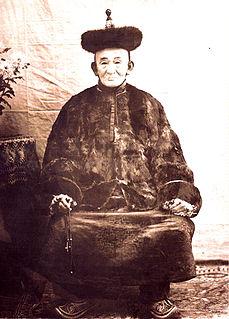
Gonchigjalzangiin Badamdorj was an early 20th-century Mongolian religious figure and prime minister under the Bodg Khaanate from late 1919 to January 1920. He is most remembered in Mongolia for caving to Qing threats and agreeing to Mongolia's "voluntary" relinquishment of independence from Chinese rule in 1919.

The 9th Jebtsundamba Khutughtu was the 9th reincarnation of the Jebtsundamba Khutuktu, the third highest lama in the Tibetan Buddhism hierarchy and the spiritual leader of the Gelug lineage among the Khalkha Mongols. Although recognized as the reincarnation of the Bogd Khan in 1936, his identity was kept a secret by the Dalai Lama until 1990 due the persecution of the Buddhist religion by the Mongolian People's Republic, and did not reside in Mongolia until the final year of his life.

Zanabazar is an extinct genus of troodontid theropod dinosaur from the Late Cretaceous of Mongolia. The genus was originally named by Rinchen Barsbold as a species of Saurornithoides, S. junior. In 2009 it was reclassified as its own genus, named after the first spiritual figurehead of Tibetan buddhism, Zanabazar. The holotype, GIN 100–1, includes a skull, vertebrae, and right hindlimb. Zanabazar was one of the most derived troodontids, and the second largest after Troodon.
The 6th Jebtsundamba Khutughtu (1842–1848), was the sixth incarnation of the Jebtsundamba Khutuktu, the spiritual heads of the Gelug lineage of Tibetan Buddhism in Mongolia, and the fourth of Tibetan descent. He was the second Jebtsundamba Khutuktu selected by the lottery procedure of the Golden urn. His personal name was Luvsantüvdenchoyjijaltsan and his Tibetan ceremonial name Blo-bzang-dpal-ldan-bstan-pa.

The 3rd Jebtsundamba Khutughtu (1758-1773), was the third incarnation of the Jebtsundamba Khutuktu, the spiritual heads of the Gelug lineage of Tibetan Buddhism in Outer Mongolia. His personal name was Ishdambiynyam and his Tibetan ceremonial name Ye-shes-bstan-pa'i-nyi-ma.

Mijiddorjiin Khanddorj, also known by his title Chin Van, or Chin Wang Khanddorj, was an aristocrat and prominent early 20th-century Mongolian independence leader. He served as the first minister of foreign affairs of Autonomous Mongolia in the government of the Bogd Khan from 1911 to 1913 and founded the nation's diplomatic service. He died, allegedly poisoned, in 1915.

Tövkhön Monastery, one of Mongolia’s oldest Buddhist monasteries, is located on the border of Övörkhangai Province and Arkhangai Province in central Mongolia, approximately 47 kilometers southwest of Kharkhorin.
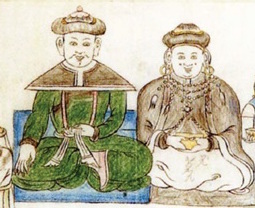
Abtai Sain Khan - alternately Abatai or Avtai (Mongolian: ᠠᠪᠲᠠᠶᠢᠰᠠᠶᠢᠨ ᠬᠨ,Cyrillic : Автайсайн хан, meaning, who have the gift of witchcraft and good - was a Khalkha-Mongolian prince who was named by the 3rd Dalai Lama as first khan of the Tüsheet Khanate in 1587. He zealously propagated Tibetan Buddhism among the Khalkha Mongols and founded the Buddhist monastery of Erdene Zuu in 1585.

Tüsheet Khan refers to the territory as well as the Chingizid dynastic rulers of the Tüsheet Khanate, one of four Khalkha Mongolian Khanates that emerged from remnants of the Mongol Empire after the death of Dayan Khan's son Gersenji in 1549 and which continued until 1930.


