
Dalai Lama is a title given by the Tibetan people to the foremost spiritual leader of the Gelug or "Yellow Hat" school of Tibetan Buddhism, the newest and most dominant of the four major schools of Tibetan Buddhism. The 14th and current Dalai Lama is Tenzin Gyatso, who lives as a refugee in India. The Dalai Lama is also considered to be the successor in a line of tulkus who are believed to be incarnations of Avalokiteśvara, the Bodhisattva of Compassion.

The Gelug is the newest of the four major schools of Tibetan Buddhism. It was founded by Je Tsongkhapa (1357–1419), a Tibetan philosopher, tantric yogi and lama and further expanded and developed by his disciples.
The Jebtsundamba Khutuktu are the spiritual heads of the Gelug lineage of Tibetan Buddhism in Mongolia. They also hold the title of Bogd Gegeen, making them the top-ranked lamas in Mongolia.

The Panchen Lama is a tulku of the Gelug school of Tibetan Buddhism. Panchen Lama is one of the most important figures in the Gelug tradition, with its spiritual authority second only to Dalai Lama. Along with the council of high lamas, he is in charge of seeking out the next Dalai Lama. Panchen is a portmanteau of Pandita and Chenpo, meaning "great scholar".
A tulku is a reincarnate custodian of a specific lineage of teachings in Tibetan Buddhism who is given abhiṣeka and trained from a young age by students of his or her predecessor.
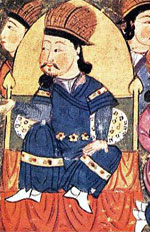
Altan Khan of the Tümed, whose given name was Anda, was the leader of the Tümed Mongols and de facto ruler of the Right Wing, or western tribes, of the Mongols. He was the grandson of Dayan Khan (1464–1543), a descendant of Kublai Khan (1215–1294), who had managed to unite a tribal league between the Khalkha Mongols in the north and the Chahars (Tsakhars) to the south. His name means "Golden Khan" in the Mongolian language.

Buddhism is the largest and official religion of Mongolia practiced by 53% of Mongolia's population, according to the 2010 Mongolia census. Buddhism in Mongolia derives much of its recent characteristics from Tibetan Buddhism of the Gelug and Kagyu lineages, but is distinct and presents its own unique characteristics.
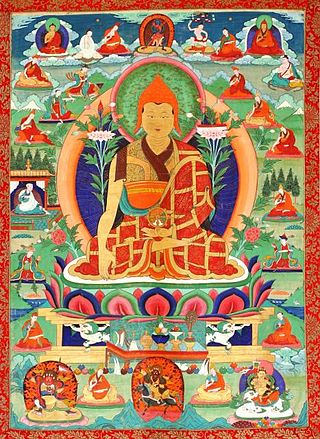
Tāranātha (1575–1634) was a Lama of the Jonang school of Tibetan Buddhism. He is widely considered its most remarkable scholar and exponent.
Chote Chaba was a Tibetan lama, the 12th incarnation of the Migyur Khutughtu, and the 18th king of Muli. At the time, Muli was a small princely state on the border between Tibetan and Han Chinese civilisation; it now forms the Muli Tibetan Autonomous County in southwestern Sichuan province.

Öndör Gegeen Zanabazar was the sixteenth Jebtsundamba Khutuktu and the first Bogd Gegeen or supreme spiritual authority, of the Gelugpa lineage of Tibetan Buddhism in Mongolia.

Bogd Khan was the khan of the Bogd Khaganate from 1911 to 1924, following the state's de facto independence from the Qing dynasty of China after the Xinhai Revolution. Born in Tibet, he was the third most important person in the Tibetan Buddhist hierarchy as the 8th Jebtsundamba Khutuktu, below only the Dalai Lama and Panchen Lama, and therefore also known as the "Bogdo Lama". He was the spiritual leader of Outer Mongolia's Tibetan Buddhism. His wife Tsendiin Dondogdulam, the Ekh Dagina, was believed to be a manifestation of White Tara.
This is a list of topics related to Tibet.
Chingunjavi was the Khalkha prince ruler of the Khotogoids and one of the two major leaders of the 1756-57 rebellion in Outer Mongolia. Although his rebellion failed, he is nowadays often hailed as a fighter for Outer Mongolia's independence from the Manchu-led Qing dynasty of China.

Agvan Lobsan Dorzhiev, also Agvan Dorjiev or Dorjieff and Agvaandorj, was a Russian-born monk of the Gelug school of Tibetan Buddhism, sometimes referred by his scholarly title as Tsenyi Khempo. He was popularly known as the Sokpo Tsеnshab Ngawang Lobsang to the Tibetans.
The Golden Urn refers to a method for selecting Tibetan reincarnations by drawing lots or tally sticks from a Golden Urn introduced by the Qing dynasty of China in 1793. After the Sino-Nepalese War, the Qianlong Emperor promulgated the 29-Article Ordinance for the More Effective Governing of Tibet, which included regulations on the selection of lamas including the Dalai Lama and Panchen Lama. The Golden Urn was introduced to prevent cheating and corruption in the selection process. In 1792, the Qianlong Emperor published article The Discourse of Lama to explain the history of lamas and the cases of cheating and corruption in the reincarnation system, while also explaining why he thought it would be a fair system of choosing reincarnated rinpoches, lamas, as opposed to choosing reincarnated rinpoches, lamas based on private designation, or based on one person's decision. Also, it's to eliminate greedy families with multiple reincarnated rinpoches, lamas.

The 9th Jebtsundamba Khutughtu was the 9th reincarnation of the Jebtsundamba Khutuktu, the third highest lama in the Tibetan Buddhism hierarchy and the spiritual leader of the Gelug lineage among the Khalkha Mongols. Although recognized as the reincarnation of the Bogd Khan in 1936, his identity was kept a secret by the Dalai Lama until 1990, due to the persecution of the Buddhist religion by the Communist Mongolian People's Republic, and he did not reside in Mongolia until the final year of his life.
There is a small Mongolian community in India, comprising mostly Buddhist monks and scholars as well as international students from Mongolia.
The 6th Jebtsundamba Khutughtu (1842–1848), was the sixth incarnation of the Jebtsundamba Khutuktu, the spiritual heads of the Gelug lineage of Tibetan Buddhism in Mongolia, and the fourth of Tibetan descent. He was the second Jebtsundamba Khutuktu selected by the lottery procedure of the Golden urn. His personal name was Luvsantüvdenchoyjijaltsan and his Tibetan ceremonial name Blo-bzang-dpal-ldan-bstan-pa.
The 2nd Jebtsundamba Khutughtu (1724-1757), was the second incarnation of the Jebtsundamba Khutuktu, the spiritual heads of the Gelug lineage of Tibetan Buddhism in Outer Mongolia. His personal name was Luvsandambiydonmi and his Tibetan ceremonial name Blo-bzang-bstan-pa'i-srgon-me.

Tövkhön Monastery, one of Mongolia's oldest Buddhist monasteries, is located on the border of Övörkhangai Province and Arkhangai Province in central Mongolia, about 47 km (29 mi) southwest of Kharkhorin.


