
The UL enterprise is a global safety science company headquartered in Northbrook, Illinois composed of three organizations, UL Research Institutes, UL Standards & Engagement and UL Solutions.

Photovoltaics (PV) is the conversion of light into electricity using semiconducting materials that exhibit the photovoltaic effect, a phenomenon studied in physics, photochemistry, and electrochemistry. The photovoltaic effect is commercially used for electricity generation and as photosensors.

A solar inverter or PV inverter, is a type of power inverter which converts the variable direct current (DC) output of a photovoltaic (PV) solar panel into a utility frequency alternating current (AC) that can be fed into a commercial electrical grid or used by a local, off-grid electrical network. It is a critical balance of system (BOS)–component in a photovoltaic system, allowing the use of ordinary AC-powered equipment. Solar power inverters have special functions adapted for use with photovoltaic arrays, including maximum power point tracking and anti-islanding protection.

A solar cell panel, solar electric panel, photo-voltaic (PV) module or solar panel is an assembly of photo-voltaic cells mounted in a framework for installation. Solar panels use sunlight as a source of energy to generate direct current electricity. A collection of PV modules is called a PV panel, and a system of PV panels is called an array. Arrays of a photovoltaic system supply solar electricity to electrical equipment.

A space heater is a device used to heat a single, small to medium sized area.
Islanding is the condition in which a distributed generator (DG) continues to power a location even though external electrical grid power is no longer present. Islanding can be dangerous to utility workers, who may not realize that a circuit is still powered, and it may prevent automatic re-connection of devices. Additionally, without strict frequency control, the balance between load and generation in the islanded circuit can be violated, thereby leading to abnormal frequencies and voltages. For those reasons, distributed generators must detect islanding and immediately disconnect from the circuit; this is referred to as anti-islanding.

A grid-tie inverter converts direct current (DC) into an alternating current (AC) suitable for injecting into an electrical power grid, normally 120 V RMS at 60 Hz or 240 V RMS at 50 Hz. Grid-tie inverters are used between local electrical power generators: solar panel, wind turbine, hydro-electric, and the grid.

A photovoltaic system, also PV system or solar power system, is an electric power system designed to supply usable solar power by means of photovoltaics. It consists of an arrangement of several components, including solar panels to absorb and convert sunlight into electricity, a solar inverter to convert the output from direct to alternating current, as well as mounting, cabling, and other electrical accessories to set up a working system. It may also use a solar tracking system to improve the system's overall performance and include an integrated battery.
The nominal power is the nameplate capacity of photovoltaic (PV) devices, such as solar cells, modules and systems, and is determined by measuring the electric current and voltage in a circuit, while varying the resistance under precisely defined conditions. The nominal power is important for designing an installation in order to correctly dimension its cabling and converters.
A power optimizer is a DC to DC converter technology developed to maximize the energy harvest from solar photovoltaic or wind turbine systems. They do this by individually tuning the performance of the panel or wind turbine through maximum power point tracking, and optionally tuning the output to match the performance of the string inverter. Power optimizers are especially useful when the performance of the power generating components in a distributed system will vary widely, such as due to differences in equipment, shading of light or wind, or being installed facing different directions or widely separated locations.
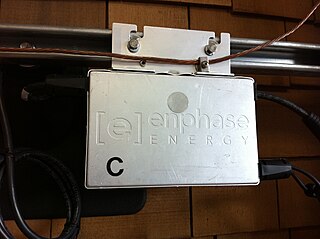
A solar micro-inverter, or simply microinverter, is a plug-and-play device used in photovoltaics that converts direct current (DC) generated by a single solar module to alternating current (AC). Microinverters contrast with conventional string and central solar inverters, in which a single inverter is connected to multiple solar panels. The output from several microinverters can be combined and often fed to the electrical grid.
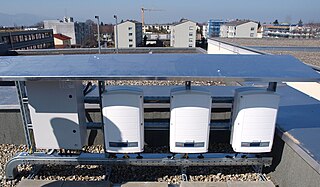
SolarEdge is an Israeli company that develops and sells solar inverters for photovoltaic arrays, energy generation monitoring software, battery energy storage products, as well as other related products and services to residential, commercial and industrial customers. Established in 2006, the company also has offices in Germany, Italy, Japan, and United States. It is incorporated in Delaware. The company was the first to successfully commercialize power optimizers, a device that offers module-level maximum power point tracking (MPPT), before feeding back the electricity generated into a central inverter.
Bombard Renewable Energy is an American provider of renewable energy services. Bombard's primary services include the design, financing, construction, installation, operations, and maintenance of solar photovoltaic ("PV") energy systems. Additionally, Bombard performs energy efficiency audits, designs, and constructs mobile solar PV charging stations.

tenKsolar designs, manufactures and markets an integrated photovoltaic system that leverages integrated electronics and a low-voltage, parallel architecture. Compared to conventional solar systems, the architecture provides 45% better energy density, higher reliability, and is the only PV system that is both shock and arch flash safe.

A rooftop solar power system, or rooftop PV system, is a photovoltaic (PV) system that has its electricity-generating solar panels mounted on the rooftop of a residential or commercial building or structure. The various components of such a system include photovoltaic modules, mounting systems, cables, solar inverters and other electrical accessories.
SolarBridge Technologies (SolarBridge) is a provider of solar micro-inverter, solar inverter for photovoltaic arrays. These types of products aim to increase energy harvest and reliability while reducing the cost of solar installations and maintenance for residential and commercial markets. The company was acquired by solar panel manufacturer SunPower in autumn of 2014. In 2018 SunPower sold the former SolarBridge microinverter business to Enphase Energy.
The Fraunhofer Institute for Solar Energy Systems ISE is an institute of the Fraunhofer-Gesellschaft. Located in Freiburg, Germany, The Institute performs applied scientific and engineering research and development for all areas of solar energy. Fraunhofer ISE has three external branches in Germany which carry out work on solar cell and semiconductor material development: the Laboratory and Service Center (LSC) in Gelsenkirchen, the Technology Center of Semiconductor Materials (THM) in Freiberg, and the Fraunhofer Center for Silicon Photovoltaics (CSP) in Halle. Since 2006, Prof. Dr. Eicke R. Weber is the director of Fraunhofer ISE. With over 1,100 employees, Fraunhofer ISE is the largest institute for applied solar energy research in Europe. The 2012 Operational Budget including investments is 74.3 million euro.

Tigo Energy is an American private corporation, headquartered in Campbell, California, United States. It provides products, technologies, software, and services to installers, distributors, and original equipment manufacturers within the photovoltaic industry. It specializes in module-level power optimizers and smart module power electronics.
Enphase Energy is an American energy technology company headquartered in Fremont, California that develops and manufactures solar micro-inverters, battery energy storage, and EV charging stations primarily for residential customers. Enphase was established in 2006 and is the first company to successfully commercialize the micro-inverter, which converts the direct current (DC) power generated by a solar panel into grid-compatible alternating current (AC) for use or export. As of December 31, 2021, the company had shipped more than 42 million micro-inverters to 1.9 million solar systems in more than 130 countries.

Photovoltaic system performance is a function of the climatic conditions, the equipment used and the system configuration. PV performance can be measured as the ratio of actual solar PV system output vs expected values, the measurement being essential for proper solar PV facility's operation and maintenance. The primary energy input is the global light irradiance in the plane of the solar arrays, and this in turn is a combination of the direct and the diffuse radiation.
