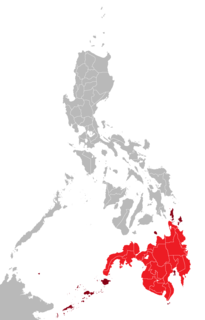
Xavier University – Ateneo de Cagayan is a private, Catholic university run by the Society of Jesus in Cagayan de Oro, Northern Mindanao, Philippines. Founded in 1933 as the Ateneo de Cagayan, it became a university in 1958, when it was given its present name in honor of the Jesuit missionary St. Francis Xavier.

The Ateneo de Manila University is a private Roman Catholic research university in Quezon City, Philippines. Founded in 1859 by the Society of Jesus, Ateneo is the third-oldest university in the Philippines. Ateneo offers elementary and secondary education exclusively to male students. The undergraduate and graduate programmes are coeducational and organised into four schools, collectively known as the Loyola Schools, which are located at its main campus at Loyola Heights. Four professional schools occupy campuses in different parts of Metro Manila.

The Pontifical and Royal University of Santo Tomas, The Catholic University of the Philippines, or simply the University of Santo Tomas (UST), is a private, Roman Catholic research university in Manila, Philippines. Founded on April 28, 1611 by Miguel de Benavides, Archbishop of Manila, it has the oldest extant university charter in the Philippines and in Asia, and is one of the world's largest Catholic universities in terms of enrollment found on one campus. The university is run by the Order of Preachers. UST is the only university to have been visited by three popes four times: once by Pope Paul VI on November 28, 1970, twice by Pope John Paul II on February 18 1981 and January 13, 1995, and once by Pope Francis on January 18, 2015. The patron of the university is St. Thomas Aquinas, while St. Catherine of Alexandria is the patroness.

Ateneo de Davao University (AdDU) is a private teaching university run by the Society of Jesus in Davao City in the Philippines. It was established in 1948, and is the seventh Ateneo opened by the Jesuits in the Philippines. The university has five undergraduate schools, namely the School of Arts and Sciences, School of Business and Governance, School of Engineering and Architecture, School of Education and the School of Nursing. The graduate programs are under these units as well. The College of Law is a separate unit within the university. The university also runs a grade school and high school.

Xavier School (XS), is located at 64 Xavier Street, Greenhills, San Juan, Metro Manila, Philippines. It is a private, Catholic, college preparatory school for boys run by the Philippine Province of the Society of Jesus. Its K-12 curriculum includes a mandatory Chinese language program. It also offers the IB Diploma Program in grades 11 and 12 to selected students.

The Ateneo de Manila University is a private research university in Quezon City, Philippines. Founded in 1859 by the Society of Jesus, the Ateneo is the third-oldest university in the Philippines.

The University of San Jose–Recoletos, formerly known as Colegio de San Jose–Recoletos, is a private research and Catholic university founded in 1947 in Cebu City, Philippines by the Order of Augustinian Recollects. From classes held in an old building and a portion of the convent, the school built modern structures while retaining classic features.

Claret School of Quezon City (CSQC), also known colloquially as Claret, is a private Catholic school for boys run by the Claretians established in June 1967. It was named after its patron saint, Anthony Mary Claret, who founded the Congregation of the Missionary Sons of the Immaculate Heart of Mary in 1849. The school also has the Child Study Center which allows girls up to the Kindergarten level.

The Archdiocese of Zamboanga is a Catholic archdiocese in the Philippines. Its present jurisdiction includes Zamboanga City, with suffragans in Basilan, and Zamboanga Sibugay ; although for apostolic cooperation, Sulu Archipelago is included in this ecclesiastical province. It became Mindanao's first diocese in 1910, and was established as the second archdiocese of Mindanao in 1958. Today the archdiocese covers a land area of 1,648 square kilometers and has a population of 442,345, of which 81 per cent are Catholics. The archdiocese includes 27 parishes and one quasi-parish served by 49 diocesan and 18 religious priests. There are also 51 religious sisters working in the archdiocese.
The Ateneo de Naga University (AdNU) is a private research university run by the Society of Jesus in Naga City, Camarines Sur, Philippines. It was established in 1940, the fourth school named Ateneo opened in the Philippines by the Jesuits. Typical of universities in the Philippines, AdNU has primary and secondary levels, which are all coeducational.

The Ateneo de San Pablo was a Catholic elementary and high school in San Pablo, Laguna, Philippines run by the Society of Jesus. It was also known by the acronym AdSP. The school was opened in 1947, and it was the sixth school established by the Jesuits in the Philippines named Ateneo. It was closed in 1978 after the Jesuits agreed to redonate the Ateneo campus to the newly created Diocese of San Pablo. Ateneo de San Pablo was a small school since it was only a high school from 1947-1961. In 1962, it became a medium-size school when it opened its grade school.
The Ateneo de Iloilo – Santa Maria Catholic School (AdI–SMCS),, is a private, Jesuit, Catholic, Chinese-Filipino Basic Education school run by the Philippine Province of the Society of Jesus in Iloilo City, Philippines. Ateneo de Iloilo began in 1958 as a parochial school named Santa Maria Catholic School. In 2004, the school was officially recognized as a Jesuit school separate from the Santa Maria Parish and was renamed Ateneo de Iloilo - Santa Maria Catholic School. It is the eighth Jesuit school in the Philippines to be named Ateneo. Ateneo de Iloilo is a K-12 school and its curriculum includes Chinese language, Christian Living Education, and Ignatian Spirituality programs. It is known for its excellence in the fields of academics and values formation.

Sacred Heart School – Ateneo de Cebu (SHS-AdC), originally known as Sacred Heart School for Boys, is a private, Catholic, Chinese-Filipino college-preparatory, K-12 school run by the Philippine Province of the Society of Jesus. It was established in 1955. Its curriculum includes a Chinese language program.
Pilar College of Zamboanga City"

Saint Columban College is a private educational institution run by the Roman Catholic Diocese of Pagadian in Pagadian City, Philippines. Founded in 1957 as Saint Columban School, Columban is the largest among the Diocesan Schools of Pagadian. Columban offers elementary, secondary, and tertiary education. The Accountancy and Information Technology programs are distinguished as a Center for Excellence and Center for Excellence and Development, respectively.

The Rizal Library is the main university library of the Ateneo de Manila University. It mainly serves and supports the teaching and research in the Loyola Schools. It is named after Ateneo de Manila alumnus José Rizal, the national hero of the Philippines.
The higher education in the Philippines is offered through various degree programs by a wide selection of colleges and universities—also known as higher education institutions (HEIs). These are administered and regulated by the Commission on Higher Education (CHED).
Rev. Fr. Roberto C. Yap, S.J., known as "Father Bobby," is a Filipino economist and Jesuit who currently serves as the university President of Xavier University – Ateneo de Cagayan. In 2011, he succeeded Fr. Jose Ramon Villarin, S.J. as President of Xavier Ateneo when the latter was elected President of the Ateneo de Manila University.
Joel E. Tabora is a Jesuit priest and the president of Ateneo de Davao University. He demonstrated a commitment to "whole person formation", 'social justice' and spirituality. He described social justice as equal distribution of resources and opportunities. He committed to rule of law, true meaning of fairness, work ethics, dignity of labor and rights of workers.
Karel San Juan, SJ. is a Filipino Jesuit priest who currently serves as the University President of Ateneo de Zamboanga University.