
The Abbey of Santa Maria in Sylvis (Italian: Abbazia di Santa Maria in Silvis) is a monastery in the centre of Sesto al Reghena, in the province of Pordenone, Northeastern Italy.
The Abbey of Santa Maria in Sylvis (Italian: Abbazia di Santa Maria in Silvis) is a monastery in the centre of Sesto al Reghena, in the province of Pordenone, Northeastern Italy.
The abbey, founded around 730–735 AD, belonged to the Benedictines until 762. After the fall of the Lombard Kingdom in 774 and the subsequent rebellion of Friuli in 776, the abbey had all its properties confirmed by Charlemagne through a chart including total exemption from any tax obligation to lay authorities.
In 899 it was ravaged by a Magyar raid, and was restored in the 10th century, including the addition of fortifications. In 967 Emperor Otto I donated it to Rodoald, patriarch of Aquileia. In the following years the abbey prospered, commissioning numerous paintings, sculptures and architectural additions to Venetian-Friulian artists. One of its abbot, Godfrey, was elected patriarch of Aquileia in 1182.
From 1441 to 1786, the abbey was a commandry; its first lay abbot was cardinal Pietro Barbo, later Pope Paul II; in the following centuries he was succeeded in general by members of noble families from the Republic of Venice. In 1818 it returned to the Diocese of Concordia and in 1921 it was restored as an abbey.
Although some form of fortification existed from the abbey's very beginnings, a true line of walls was added in the 10th century after the Magyar assault. In 1431 it had up to seven towers, only one of which remains today; this was restored to the current Renaissance appearance by lay abbots Giovanni Michiel and Domenico Grimani (late 15th–early 16th centuries), while in the 18th century a stone bridge replaced the previous drawbridge.
The entrance façade is decorated by a late 15th-century fresco with the Lion of Saint Mark. Below it is a bas-relief with cardinal Grimani's coat of arms, dated to 1521 and repeated on the left. Further below is an allegory of the Good Government under the Grimani family, attributed to Giovanni Battista Grassi.

The entrance leads to a central court, faced by the abbey's main buildings. These include the bell tower, standing at 33.6 m (110 ft), built in brickwork in the 11th–12th centuries and decorated by a series of arcades. At the side of the tower is a Renaissance portal with a round arch supported by pillars, dating from the Michiel and Grimani restorations.

West of the bell tower is the Palazzo della Cancelleria ("Chancellor's Palace"), built in brickwork in the 12th–13th centuries, with a height of 9 m (30 ft). In front of it is the Abbot's Residence, featuring coats of arms of several lay abbots, including Giovanni Alberto Badoer, Carlo Pio di Savoia-Carpi, Girolamo Colonna di Sciarra and Giovanni Cornaro. This edifice is the current town hall of Sesto al Reghena.
The church has a vestibule dating from Pietro Barbo's period, with two fresco cycles of the Paradise (southern wall) and Inferno (northern wall) by Antonio da Firenze and Pellegrino da San Daniele. Under the church is a crypt supported by twenty columns, some of which are ancient spolia . At the center of the crypt is the Urn of St. Anastasia, formed by a single marble block of Greek origin; it was realized by Cividale masters in the 8th century, and has decorations with flowers, crosses, arches, tondoes and rose motifs. The crypt also houses, in two apses, a Pietà of Austrian origin (early 15th century) and an Annunciation sculpted in Slovenian marble showing Byzantine influences, dating from the late 13th–early 14th century.
| International | |
|---|---|
| National | |
| Geographic | |
| Other | |

Vallombrosa is a Benedictine abbey in the comune of Reggello, about 30 km south-east of Florence, in the Apennines, surrounded by forests of beech and firs. It was founded by Florentine nobleman Giovanni Gualberto in 1038 and became the mother house of the Vallumbrosan Order.
Giovanni Martini or Giovanni Martini da Udine was an Italian painter and sculptor of the Renaissance, born in Udine between 1470 and 1475. With Pellegrino da San Daniele he is one of the main representatives of Renaissance art in the Friuli region of north-east Italy.
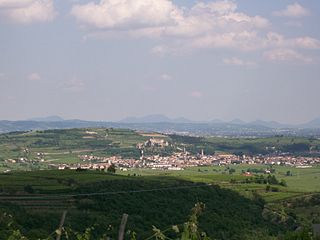
Soave is a small comune of the Veneto region in the Province of Verona, northern Italy, with a population of roughly 6,800 people.

Tavarnelle Val di Pesa is a former comune (municipality) and since 2019 a frazione of Barberino Tavarnelle in the Metropolitan City of Florence in the Italian region Tuscany. It is located about 25 kilometres south of Florence.

Sesto al Reghena is a comune (municipality) in the Regional decentralization entity of Pordenone, in the Italian region of Friuli-Venezia Giulia, located in the lower Friulian-Venetian plain about 80 kilometres (50 mi) northwest of Trieste and about 20 kilometres (12 mi) southeast of Pordenone.

Cremona Cathedral, dedicated to the Assumption of the Blessed Virgin Mary, is a Catholic cathedral in Cremona, Lombardy, northern Italy. It is the seat of the Bishop of Cremona. Its bell tower is the famous Torrazzo, symbol of the city and tallest pre-modern tower in Italy.
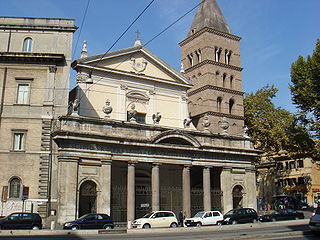
San Crisogono is a church in Rome dedicated to the martyr Saint Chrysogonus. It was one of the tituli, the first parish churches of Rome, and was probably built in the 4th century under Pope Sylvester I (314–335).
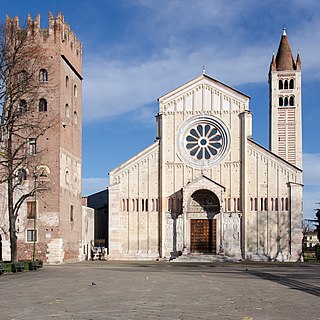
The Basilica di San Zeno is a minor basilica of Verona, northern Italy constructed between 967 and 1398 AD. Its fame rests partly on its Romanesque architecture and partly upon the tradition that its crypt was the place of the marriage of Shakespeare's Romeo and Juliet. It stands adjacent to a Benedictine abbey, both dedicated to St Zeno of Verona.

San Francesco della Vigna is a Roman Catholic church in the Sestiere of Castello in Venice, northern Italy.

The Abbey of Sassovivo is a Benedictine monastery in Umbria in central Italy. Administratively, it is a frazione of the comune of Foligno.


The Diocese of Concordia-Pordenone is a Latin diocese of the Catholic Church situated in northeastern Italy, at the northern end of the Adriatic Sea, between Venice and Udine. Since 1818, Concordia Veneta, has been a suffragan of the Archdiocese of Venice. Bishop Andrea Casasola attended the Provincial Council of the Provincia Veneta in October 1859 as a suffragan of the Patriarch of Venice, Cardinal Giuseppe Luigi Trevisanato. The name of the diocese was changed to its present form in 1971.

Fiesole Cathedral, officially the Cathedral of Saint Romulus of Fiesole, is a Roman Catholic cathedral in Fiesole, Tuscany, central Italy. It is the seat of the Bishop of Fiesole and is dedicated to Saint Romulus.

The Abbey of Monte Oliveto Maggiore is a large Benedictine monastery in the Italian region of Tuscany, 10 km south of Asciano. Its buildings, which are mostly of red brick, are conspicuous against the grey clayey and sandy soil—the Crete senesi which give this area of Tuscany its name.

The Palazzo Grimani of Santa Maria Formosa is a State museum, located in Venice in the Castello district, near Campo Santa Maria Formosa.

Udine Cathedral is a Catholic cathedral located in Udine, north-eastern Italy. It is the seat of the Archbishop of Udine.
Enrico Dandolo was Patriarch of Grado, Italy, from 1134 to 1182. A member of a noble Venetian Dandolo family, after his appointment he put the interests of the church ahead of all other concerns.

The Basilica of Santa Maria at Pie' di Chienti was a former Roman Catholic monastery and church located in a rural site on the north bank of the Chienti river, just outside of the town of Montecosaro Scalo, in the province of Macerata, region of Marche, Italy. The church is also known as the Santissima Annunziata.

The Barbo were Venetian patrician family prominent between the 14th and 16th centuries.
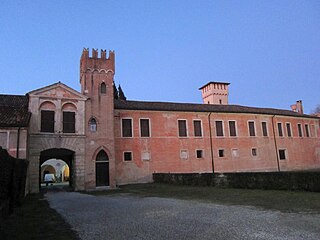
The Abbazia di Monastier or Abbey of Santa Maria del Pero is located in Monastier di Treviso, province of Treviso, in the northeast Italian region of Veneto. This abbey was originally dedicated to Saint Peter, then re-named Santa Maria del Pero. The Pero is the ancient name for the Meolo river.
