Related Research Articles

An epigram is a brief, interesting, memorable, sometimes surprising or satirical statement. The word derives from the Greek ἐπίγραμμα. This literary device has been practiced for over two millennia.

Arthur Golding was an English translator of more than 30 works from Latin into English. While primarily remembered today for his translation of Ovid's Metamorphoses because of its influence on William Shakespeare's works, in his own time he was most famous for his translation of Caesar's Commentaries, and his translations of the sermons of John Calvin were important in spreading the doctrines of the Protestant Reformation.
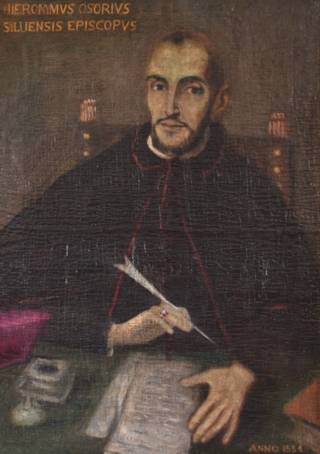
D. Jerónimo Osório da Fonseca was a Portuguese Roman Catholic humanist bishop, historian and polemicist. An extensive notice of his life and thought (Vita) was written by his nephew, a canon of Évora also named Jerónimo Osório, to introduce his edition of his uncle's Complete Works published in 1592.

William Winstanley was an English poet and compiler of biographies.
Walter Haddon LL.D. (1515–1572) was an English civil lawyer, much involved in church and university affairs under Edward VI, Queen Mary, and Elizabeth I. He was a University of Cambridge humanist and reformer, and was highly reputed in his time as a Latinist. He sat as an MP during the reigns of Mary and Elizabeth. His controversial exchange with the Portuguese historian Jerónimo Osório attracted international attention partly on account of the scholarly reputations of the protagonists.

William Jenkyn (1613–1685) was an English clergyman, imprisoned during the Interregnum for his part in the 'Presbyterian plot' of Christopher Love, ejected minister in 1662, and imprisoned at the end of his life for nonconformity.
Thomas Newton was an English clergyman, poet, author and translator.
Thomas Drant (c.1540–1578) was an English clergyman and poet. Work of his on prosody was known to Sir Philip Sidney and Edmund Spenser. He was in the intellectual court circle known as the 'Areopagus', and including, as well as Sidney, Edward Dyer, Gabriel Harvey, and Daniel Rogers. He translated Horace into English, taking a free line in consideration of the Roman poet's secular status; but he mentioned he found Horace harder than Homer. Drant's translation was the first complete one of the Satires in English, in fourteeners, but makes some radical changes of content.
Edward Cradock was an English theologian and alchemist.
Thomas Byng was an English academic and lawyer, Master of Clare Hall, Cambridge from 1571.
Antoine Rodolphe Chevallier (1523–1572) was a French Protestant Hebraist and a holder of teaching positions in England. He acted as tutor in French and Hebrew to the future Elizabeth I of England.
Abraham Hartwell, the younger (1553/4–1606), was an English translator and antiquary, and Member of Parliament. Another Abraham Hartwell of the period was also an author, publishing Regina Literata in 1564, and the two have in the past been confused.
John Ashmore, was the first who attempted a translation into English of selected odes of Horace.
Richardson Pack (1682–1728) was an English professional soldier and writer.
Thomas Beedome was an English poet. He appears to have died at an early age, and of his life nothing is known.
Robert Wright (1553?–1596?) matriculated at Cambridge as a sizar of Trinity College on 2 May 1567, and became a scholar there. In 1570–71 he graduated B.A., and was elected a Fellow. He was incorporated M.A. of Oxford on 9 July 1577.
James Calfhill was an Anglican priest, academic and controversialist, who died as Archdeacon of Colchester and Bishop-designate of Worcester.
Joseph Hirst Lupton (1836–1905) was an English schoolmaster, cleric and writer.
Thomas Hatcher was an English antiquarian.
Thomas Paynell was an English Augustinian and translator.
References
- 1 2 3 . Dictionary of National Biography . London: Smith, Elder & Co. 1885–1900.
- ↑ "Hartwell, Abraham (HRTL559A)". A Cambridge Alumni Database. University of Cambridge.
- 1 2 Highly, Christopher (2008). Catholics writing the nation in early modern Britain and Ireland. Oxford University Press. p. 30. ISBN 978-0-19-953340-4 . Retrieved 11 December 2011.
- ↑ Freeman, Thomas S.; Evende, Elizabeth (2011). Religion and the Book in Early Modern England: The Making of John Foxe's 'Book of Martyrs. Cambridge University Press. p. 260. ISBN 978-0-521-83349-3.
. Dictionary of National Biography . London: Smith, Elder & Co. 1885–1900.