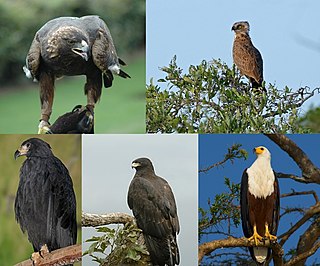
Eagle is the common name for the golden eagle, bald eagle, and other birds of prey in the family Accipitridae. Eagles belong to several groups of genera, some of which are closely related. True eagles comprise the genus Aquila. Most of the 68 species of eagles are from Eurasia and Africa. Outside this area, just 14 species can be found—2 in North America, 9 in Central and South America, and 3 in Australia.

The golden eagle is a bird of prey living in the Northern Hemisphere. It is the most widely distributed species of eagle. Like all eagles, it belongs to the family Accipitridae. They are one of the best-known birds of prey in the Northern Hemisphere. These birds are dark brown, with lighter golden-brown plumage on their napes. Immature eagles of this species typically have white on the tail and often have white markings on the wings. Golden eagles use their agility and speed combined with powerful feet and large, sharp talons to hunt a variety of prey, mainly hares, rabbits, and marmots and other ground squirrels. Golden eagles maintain home ranges or territories that may be as large as 200 km2 (77 sq mi). They build large nests in cliffs and other high places to which they may return for several breeding years. Most breeding activities take place in the spring; they are monogamous and may remain together for several years or possibly for life. Females lay up to four eggs, and then incubate them for six weeks. Typically, one or two young survive to fledge in about three months. These juvenile golden eagles usually attain full independence in the fall, after which they wander widely until establishing a territory for themselves in four to five years.

The eastern imperial eagle is a large bird of prey that breeds in southeastern Europe and extensively through West and Central Asia. Most populations are migratory and winter in northeastern Africa, the Middle East and South and East Asia. Like all eagles, the eastern imperial eagle is a member of the family Accipitridae. Furthermore, its feathered legs mark it as a member of the subfamily Aquilinae. It is a large, dark-colored eagle, with a resemblance to other members of the genus Aquila but it is usually the darkest species in its range. This is an opportunistic predator that mostly selects smallish mammals as prey but also a fairly large proportion of birds, reptile and other prey types, including carrion. Compared to other Aquila eagles, it has a strong preference for the interface of tall woods with plains and other open, relatively flat habitats, including the wooded mosaics of the steppe. Normally, nests are located in large, mature trees and the parents raise around one or two fledglings. The global population is small and declining due to persecution, loss of habitat and prey. It has therefore been IUCN Red Listed as Vulnerable since 1994.

The Eurasian eagle-owl is a species of eagle-owl that resides in much of Eurasia. It is also called the Uhu and it is occasionally abbreviated to just the eagle-owl in Europe. It is one of the largest species of owl, and females can grow to a total length of 75 cm (30 in), with a wingspan of 188 cm, with males being slightly smaller. This bird has distinctive ear tufts, with upper parts that are mottled with darker blackish colouring and tawny. The wings and tail are barred. The underparts are a variably hued buff, streaked with darker colouring. The facial disc is not very defined and the orange eyes are distinctive.
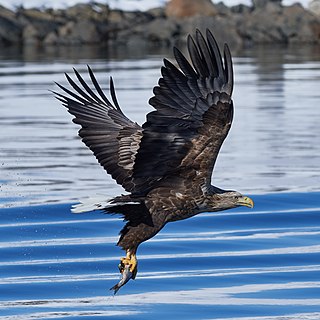
The white-tailed eagle, sometimes known as the 'sea eagle', is a very large bird of prey, widely distributed across temperate Eurasia. Like all eagles, it is a member of the family Accipitridae which includes other diurnal raptors such as hawks, kites, and harriers. One of up to eleven members in the genus Haliaeetus, which are commonly called sea eagles, it is also referred to as the white-tailed sea-eagle. Sometimes, it is known as the ern or erne, gray sea eagle and Eurasian sea eagle.

Audouin's gull is a large gull restricted to the Mediterranean and the western coast of Saharan Africa and the Iberian Peninsula. The genus name is from Ancient Greek ikhthus, "fish", and aetos, "eagle", and the specific audouinii and the English name are after the French naturalist Jean Victoire Audouin.

The short-toed snake eagle, also known as the short-toed eagle, is a medium-sized bird of prey in the family Accipitridae, which also includes many other diurnal raptors such as kites, buzzards and harriers. The genus name Circaetus is from the Ancient Greek kirkos, a type of hawk, and aetos, "eagle". The specific gallicus means "of Gallia".

The greater spotted eagle, also called the spotted eagle, is a large migratory bird of prey belonging to the family Accipitridae. Its feathered legs indicate that it is a member of the subfamily Aquilinae, also known as the "booted eagles." This species was once thought to be a member of the genus Aquila, but was reclassified to a distinct genus, Clanga, along with the two other species of spotted eagle.

The black eagle is a bird of prey. Like all eagles, it is in the family Accipitridae, and is the only member of the genus Ictinaetus. They soar over forests in the hilly regions of tropical and subtropical South and Southeast Asia, as well as southeastern China. They hunt mammals and birds, particularly at their nests. They are easily identified by their widely splayed and long primary "fingers", the characteristic silhouette, slow flight and yellow ceres and legs that contrast with their dark feathers.

Caohai Lake is a natural water-body situated in Northwest Guizhou Province of southwest China. The lake is situated on Weining Mountain, in the outskirts of Weining County. Caohai Village lies directly at the edge of the wetland.

The Spanish imperial eagle, also known as the Iberian imperial eagle, the Spanish eagle or Adalbert's eagle, is a species of eagle native to the Iberian Peninsula. The binomial commemorates Prince Adalbert of Bavaria. Due to its distinct "epaulettes", old literature often referred to this species as the white-shouldered eagle.

The black-chested snake eagle or black-breasted snake eagle is a large African bird of prey of the family Accipitridae. It resembles other snake eagles and was formerly considered conspecific with the short-toed and Beaudouin's snake eagles, to which it is closely related.

The Blackwater National Wildlife Refuge was established in 1933 as a waterfowl sanctuary for birds migrating along the critical migration highway called the Atlantic Flyway. The refuge is located on Maryland's Eastern Shore, just 12 mi (19 km) south of Cambridge, Maryland in Dorchester County, and consists of over 28,000 acres (110 km2) of freshwater impoundments, brackish tidal wetlands, open fields, and mixed evergreen and deciduous forests. Blackwater NWR is one of over 540 units in the National Wildlife Refuge System, which is managed by the United States Fish and Wildlife Service.

The wildlife of Jordan includes its flora and fauna and their natural habitats. Although much of the country is desert, it has several geographic regions, each with a diversity of plants and animals adapted to their own particular habitats. Fossil finds show that in Palaeolithic times, the region had Syrian brown bears, Asiatic lions, zebras, Asian elephants, and rhinoceroses, but these species are all now extinct in this region.

Beaudouin's snake eagle is a species of snake eagle in the family Accipitridae found in the Sahel region of west Africa. It forms a superspecies with the Palearctic short-toed snake eagle Circaetus gallicus and the black-chested snake eagle Circaetus pectoralis. This bird seems to be declining in numbers and the International Union for Conservation of Nature has rated it as a "vulnerable species".

Abe Bailey Nature Reserve is a protected area in Gauteng, South Africa. It is situated near Carletonville, beside the township of Khutsong on the West Rand. It is about 4,200 hectares in size.

Korgalzhyn State Nature Reserve is a protected area in Aqmola and Karaganda regions of Kazakhstan, located west of the city of Astana. It is part of the UNESCO heritage site Saryarka — Steppe and Lakes of Northern Kazakhstan, Ramsar site and biosphere reserve.
Nätsi-Võlla Nature Reserve is a nature reserve situated in western Estonia, in Pärnu County, made up of several bogs that together form the largest bog area in Pärnu County.

Keeri-Karijärve Nature Reserve is a nature reserve situated in south-eastern Estonia, in Tartu County.

Ādaži was established in 2004 as a protected landscape in Ādaži and Saulkrasti municipalities of Latvia. Pierīga, Gauja is on the right bank of the lower reaches Ādaži military poligone and its adjacent territories. The area was created to preserve Latvia's rare habitats created during military training - dry heaths and open inland dunes with sand dune meadows, bluish meadow meadows and mesotrophic lakes, as well as a significant number of specially protected plant and animal species. The area also includes the Lieluika and Mazuika lakes nature reserve. Lake Mazuika is recognized as a benchmark for a clear water lake in the Baltic region. Natura 2000 territory.