Adelaide Football Club (SAFA)

Last updated

Adelaide
Adelaide SAFA logo.jpg
Names
Full name Adelaide Football Club
Club details
Founded 26 April 1860
Dissolved October 1893;124 years ago (October 1893)
Colours     black,      red, and      white
Competition Interclub competition 1860-1872, 1875-1876
SAFA 1877-1881, 1885-1893
Premierships 1886
Ground(s) Adelaide Oval
Uniforms
Kit body adelaidefc safa.png
Kit body sleeveless.png
Kit shorts.svg
Kit socks long.svg
Home

The Adelaide Football Club, often referred to as the Old Adelaide club, was an Australian rules football club based in Adelaide. Founded on the 26 April 1860 it was the first football club formed in South Australia. The club played interclub football in South Australia until 1872 when it had disputes with other local clubs over the rules. The club resumed local interclub matches in 1875. In 1876 the Adelaide clubs rules were adopted by all the South Australian clubs. In 1877 the club helped form the South Australian Football Association (SAFA) and participated in the competition from 1877–81 and 1885–93. The club was the most successful in inter club matches in 1870 and 1871 and won the 1886 SAFA premiership. The club dissolved at the end of the 1893 SAFA season. It has no connection to the present Adelaide Football Club playing in the Australian Football League.

Australian rules football Contact sport invented in Melbourne

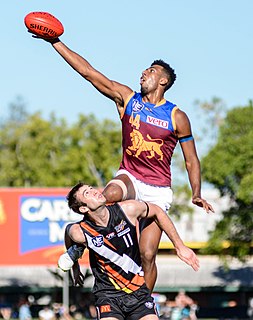
Australian rules football, officially known as Australian football, or simply called Aussie rules, football or footy, is a contact sport played between two teams of eighteen players on an oval-shaped field, often a modified cricket ground. Points are scored by kicking the oval-shaped ball between goal posts or between behind posts.

Adelaide City in South Australia

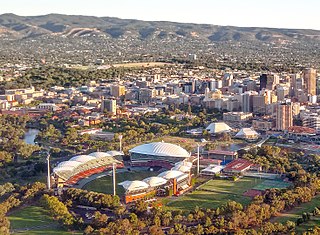
Adelaide is the capital city of the state of South Australia, and the fifth-most populous city of Australia. In June 2017, Adelaide had an estimated resident population of 1,333,927. Adelaide is home to more than 75 percent of the South Australian population, making it the most centralised population of any state in Australia.

South Australian National Football League Australian rules football competition

The South Australian National Football League, or SANFL, is an Australian rules football league based in the Australian state of South Australia. It is also the governing body for the sport of Australian rules football in South Australia.

Contents

History

Formation at Globe Inn Hotel

The club was founded at the Globe Inn Hotel, Rundle Street (c. 1860) Globe Hotel Rundle Street 1860.jpeg
The club was founded at the Globe Inn Hotel, Rundle Street (c. 1860)

The Adelaide Football Club was formed on Thursday 26 April 1860 at the Globe Inn Hotel, Rundle Street with John Brodie Spence chairing the meeting. [1] It was the first in South Australia. The club had its own game rules later referred to as the "Old Adelaide club rules". They would ultimately be universally adopted in South Australia in 1876.

John Brodie Spence Australian banker and politician

John Brodie Spence was a prominent Scottish-born banker and politician in the early days of South Australia. He was a brother of the reformer Catherine Helen Spence.

Early intra-club years (1860–1861)

The club initially only played internal matches between players located North and South of the River Torrens. In the first ever internal game J. B. Spence led one side and John Acraman the other with the match held on the North Parklands on Saturday 28 April 1860. [2] The fourth meeting took place on the South Park Lands on the 19 May 1860 with coloured uniforms adopted. [3] The team derived from players North of the River Torrens wore Blue and the side south wore Pink. [4] For this match the captains were O'Halloran and Cussen. [5] By mid June 1860 the club had already grown to over 100 members, including four members of the South Australian parliament. [6] The final game for 1860 attracted 200 spectators. [7] John Acraman was again captain of one side with the other captain T. O'Halloran. [8] North Adelaide would win by one goal. [9]

River Torrens river in Australia

The River Torrens is the most significant river of the Adelaide Plains and was one of the reasons for the siting of the city of Adelaide, capital of South Australia. It flows 85 kilometres (53 mi) from its source in the Adelaide Hills near Mount Pleasant, across the Adelaide Plains, past the city centre and empties into Gulf St Vincent between Henley Beach South and West Beach. The upper stretches of the river and the reservoirs in its watershed supply a significant part of the city's water supply. The river's long linear parks and a constructed lake in the lower stretch are iconic of the city.

John Acraman was a prominent businessman in the colony of South Australia, and has a place in the history of Australian football in that State.

Parliament of South Australia

The Parliament of South Australia at Parliament House, Adelaide is the bicameral legislature of the Australian state of South Australia. It consists of the 47-seat House of Assembly and the 22-seat Legislative Council. All of the lower house and half of the upper house is filled at each election. It follows a Westminster system of parliamentary government.

Early years of inter-club football (1862–1872)

The first recorded match against a rival club was played in 1862 against the Modbury and Teatree Gully Football Club on a strip of grass near the Modbury Hotel. Adelaide won the game two goals to nil. [10] The two teams met again the next year, and "the game was kept up with the greatest spirit and good feeling, and so equally were the sides matched that not a goal was obtained". [11]

During the final stages of the last match of the 1863 season between Adelaide and the Modbury and Teatree Gully Football Club some Indigenous Australians were allowed to participate for both sides. [12] The newspaper described the indigenous players by saying their "manoeuvres were ludicrous in the extreme". [13]

Indigenous Australians are the Aboriginal and Torres Strait Islander people of Australia, descended from groups that existed in Australia and surrounding islands before British colonisation. The time of arrival of the first Indigenous Australians is a matter of debate among researchers. The earliest conclusively human remains found in Australia are those of Mungo Man LM3 and Mungo Lady, which have been dated to around 50,000 years BP. Recent archaeological evidence from the analysis of charcoal and artefacts revealing human use suggests a date as early as 65,000 BP. Luminescence dating has suggested habitation in Arnhem Land as far back as 60,000 years BP. Genetic research has inferred a date of habitation as early as 80,000 years BP. Other estimates have ranged up to 100,000 years and 125,000 years BP.

In 1864 the club produced printed copies of their rules to avoid disputes. [14]

A match was played on 13 June 1868 between Adelaide and a local Collegian side with the latter winning. [15]

In 1870 the club lost many of its best players to the newly formed city club Young Australians. [16]

On the 31 August 1876 the club played a match against a team from the 50th Regiment on the North Park Lands. The Adelaide club won 3–0. [17]

Exile over the games rules (1873–1874)

Adelaide stopped playing games against other clubs in 1873 after the Kensington club rules became popular amongst the other clubs. Adelaide was disappointed at the decision of other clubs to abandon its preferred rules and did not play against other suburban clubs until 1875..

Return to the fold (1875)

After the clubs exile from inter club football in 1873 and 1874 the club had suffered significantly and was no longer the premier football club. Adelaide would only win 1 of its 5 inter club fixtures for the season.

The July 20 meeting (1876)

On the 20th July 1876, Charles Kingston organised a meeting at the old Prince Alfred Hotel and pleaded with the delegates of the other local clubs that the rules of the Old Adelaide club be universally adopted by South Australian clubs as they closely resembled those used in Melbourne. Part of Charles Kingston's argument to adopt the Old Adelaide club rules over the Kensington club rules was that by having rules similar to those being used in Melbourne, intercolonial football matches could be held in the future. By the end of the meeting Charles Kingston had his way and the old Adelaide club rules were adopted by all the clubs.

SAFA foundation club (1877)

In 1877 Adelaide captain Nowell Twopenney was influential in calling for the establishment of the South Australian Football Association (SAFA). The club subsequently became one of the founding members of the SAFA (later renamed as the SANFL). In the SAFA's inaugural season, Adelaide finished third, winning ten matches, losing three and drawing three, finishing with a positive goal differential of 18. Adelaide finished fifth out of seven teams in each of the next two seasons, and last in 1880.

Merger with Kensington and temporary dissolution (1881–1884)

The team's poor performances on and off-field forced the club to merge with Kensington for the 1881 season due to a lack of players. These problems continued, forcing the combined team to resign from the competition on June 1, 1881 after playing four matches, with a fifth being forfeited when the team failed to appear. [18] During the years 1882 to 1884, the club did not play in the SAFA.

SAFA Re-entry, Premiers and wins over Carlton and British Lions (1885–1889)

Adelaide's 1886 premiership team. Adelaide Football Club 1886.jpg
Adelaide's 1886 premiership team.

The club was re-formed before the 1885 season, combining with Adelaide and Suburban Football Association (ASFA) club North Park to again field a team in the SAFA. The new team finished last out of four teams in 1885, but surprised much of the competition to claim the SAFA premiership in 1886 under the captaincy of J. D. Stephens.

Adelaide was involved in an experimental night game played under electric lights at Adelaide Oval on 1 July 1885. It beat South Adelaide 1 goal 8 behinds to 8 behinds.

Adelaide finished third out of seven teams in each of the next three seasons, also playing matches against the visiting Victorian Football Association (VFA) premiers Carlton in 1887, winning nine goals to three, and against a visiting British team in 1888, winning six goals to three.

Rapid decline and final dissolution (1890–1893)

After the triumphs of 1886 and 1887, very poor management led to the defection of many of the key members of the 1886 premiership team.

By the 1890s, the club was the chopping block of the SAFA, struggling to field a team, and won three successive wooden spoons from 1891-1893, with records of 0-16, 0-15-1 and 1-15 in those seasons, including a winless streak of 40 matches between 1890-93.

These on-field performances and the club's insolvency meant that Adelaide dropped out of the SAFA and folded at the end of the 1893 season. [18]

Honour board

Old Adelaide Football Club honour board
YearPositionRecordChairmanSecretaryCaptainLeading Goalkicker
1860Intraclub
1861James MacGeorge [19] Thomas O'Halloran [20]
Interclub football
1862Thomas S. O'Halloran [21] W.W. Anderson [22] Thomas O'Halloran
1863Thomas S. O'HalloranThomas S. O'HalloranJ. E. Schlinke
1864W.W. AndersonJ.E. Schlinke
J. Coulls
1865T. McEllisterJ. Borrow
1866
1867
1868
1869G. O'HalloranH.Y. Harry Sparks
18701–0–0W.S. William SampsonArthur MalcolmH.Y. Harry Sparks (3)
18711 (Premiers)4–0–1H.F. Jackson
1872 1 (Premiers)4–0–2
1873 Withdrew
1874
1875 4 (Wooden Spoon)1–3–1
1876 70–2–2Harry Conigrave
Formation of SAFA
1877 310–3–3J.A. Bleechmore Richard Twopeny John Young (14)
1878 44–4–4
1879 62–5–3
1880 7 (Wooden Spoon)1–8–2
1881 6 (Wooden Spoon)0–5–0
1882 Withdrew
1883
1884
1885 4 (Wooden Spoon)4–11–0
1886 1 (Premiers)9–5–1Richard Stephens (17)
1887 39–4–3
1888 310–7–0
1889 38–9–0
1890 45–10–2
1891 5 (Wooden Spoon)0–16–0
1892 5 (Wooden Spoon)0–15–1
1893 5 (Wooden Spoon)1–15–0

Related Research Articles

Adelaide Oval stadium in Adelaide, South Australia

Adelaide Oval is a sports ground in Adelaide, South Australia, located in the parklands between the city centre and North Adelaide. The venue is predominantly used for cricket and Australian rules football, but has also played host to rugby league, rugby union, soccer, tennis among other sports as well as regularly being used to hold concerts. Austadiums.com described Adelaide Oval as being "one of the most picturesque Test cricket grounds in Australia, if not the world". After the completion of the grounds most recent redevelopment in 2014, sports journalist Gerard Whateley described the venue as being "the most perfect piece of modern architecture because it's a thoroughly contemporary stadium with all the character that it's had in the past".

Grand final final match of a championship which determines the ultimate winner

A grand final is a game that decides a sports league's championship winning team, i.e. the conclusive game of a finals series. Synonymous with a championship game in North American sports, grand finals have become a significant part of Australian culture. The earliest competitions to feature a grand final were Australia's AFL and NRL. They influenced other competitions such as soccer's A-League, the National Basketball League, netball's Suncorp Super Netball and European rugby league's Super League to adopt grand finals as well. Most grand finals involve a prestigious award for the player voted best on field.

Harry Hewitt Australian rules footballer

Harry Hewitt was an Indigenous Australian Australian rules footballer and cricketer.

Australian rules football in South Australia

Australian rules football in South Australia has a history dating back to the early 1860s, and it has long been the most popular sport in the state.
Alby Green Australian rules footballer and cricketer

Albert Green was an Australian rules footballer who played with Norwood in the SAFA and first-class cricketer who played for South Australia.

Tea Tree Gully Football Club

The Tea Tree Gully District football club is an Australian rules football club located in Banksia Park, South Australia. Tea Tree currently plays in the Adelaide Footy League, formerly known as the "South Australian Amateur Football League" (SAAFL).

Harold Oliver (Australian footballer) Australian rules footballer

William Harold Oliver was an Australian rules footballer. Harold Oliver was a key player to some of South Australian football's most successful teams. He starred in South Australia's victorious 1911 Australian football championship along with Port Adelaide's 1914 "Invincible's" team. After being close to retiring from the game after World War I he returned to captain both Port Adelaide to the 1921 SAFL premiership and South Australia in a game against Western Australia. His reputation as an early exponent of the spectacular mark along with his general skill at playing the game saw him regarded as one of the best players South Australia has produced. This is despite never having won the Magarey Medal, somewhat a result of his career being interrupted by World War I.

Harry Phillips (Australian footballer) Australian rules footballer

Henry "Tick" Phillips was an Australian footballer and champion player for Port Adelaide. He is widely considered to be the club's greatest player of the nineteenth century. Phillips played sixteen seasons for Port Adelaide. For his final two seasons, he was appointed captain.

1914 SAFL season

The 1914 South Australian Football League season was the 38th season of the top-level Australian rules football competition in South Australia.

The 1877 South Australian Football Association season was the inaugural season of the top level league of Australian rules football in South Australia. The clubs participating were South Adelaide, Victorian, Adelaide, Port Adelaide, Woodville, South Park, Kensington and Bankers.

Anthony Daly (footballer) Australian rules footballer

Anthony Joseph "Bos" Daly was an Australian rules footballer who played for the five teams in the South Australian Football Association between 1893 and 1912.

Angelo Congear Australian rules footballer

Angelo Nicholas Goucar Congear was an Australian rules footballer who played for the Port Adelaide Football Club in the South Australian National Football League between 1908 and 1922.

1897 SAFA season

The 1897 South Australian Football Association season was the 21st edition of the top level of Australian rules football to be played in South Australia. Port Adelaide won its 3rd premiership.

The 1898 SAFA season was the 22nd edition of the top level of Australian Rules football to be played in South Australia. South Adelaide went on to record its 7th premiership.

The 1899 SAFA season was the 23rd edition of the top level of Australian Rules football to be played in South Australia. South Adelaide went on to record its 8th premiership.

The 1880 South Australian Football Association season was the 4th season of the top-level Australian rules football competition in South Australia.

1890 SAFA season

The 1890 South Australian Football Association season was the 14th season of the top-level Australian rules football competition in South Australia.

1889 SAFA Grand Final

The 1889 SAFA Grand Final was an Australian rules football game contested between the Norwood and Port Adelaide, held at the Adelaide Oval on the 5 October 1889. It was the first Grand Final in a major Australian rules football league and thus the concluding championship match of the 1889 SAFA season. The game resulted in a victory for Norwood who beat Port Adelaide by two goals, marking the clubs ninth premiership and third in a row. Norwood's Alfred Waldron was considered the best player on the ground by field umpire John Trait. The match was attended by an estimated 11,000 people.

Port Adelaide v South Australia (1914)

The Port Adelaide v South Australia (1914) exhibition match played between Port Adelaide and the South Australian state team was an Australian rules football match played at the Jubilee Oval on 14 October 1914. The match saw one of seven South Australian Football League (SAFL) clubs in Port Adelaide take on a composite team of players from the remaining 6 clubs. Port Adelaide won the match by 58 points.

References

  1. "Adelaide Foot Ball Club". Adelaide Observer. 1860-04-28. p. 8. Retrieved 2015-10-17.
  2. "Football". South Australian Register. 1860-04-30. p. 2. Retrieved 2015-10-17.
  3. "CLARE". South Australian Register . XXIV, (4243). South Australia. 21 May 1860. p. 3. Retrieved 6 June 2018 via National Library of Australia.
  4. "CLARE". South Australian Register . XXIV, (4243). South Australia. 21 May 1860. p. 3. Retrieved 6 June 2018 via National Library of Australia.
  5. "CLARE". South Australian Register . XXIV, (4243). South Australia. 21 May 1860. p. 3. Retrieved 6 June 2018 via National Library of Australia.
  6. "FORMATION OF VOLUNTEER CORPS". South Australian Register . XXIV, (4261). South Australia. 11 June 1860. p. 3. Retrieved 6 June 2018 via National Library of Australia.
  7. "THE MAIN ROADS BILL". Adelaide Observer . XVIII, (990). South Australia. 22 September 1860. p. 3. Retrieved 6 June 2018 via National Library of Australia.
  8. "THE MAIN ROADS BILL". Adelaide Observer . XVIII, (990). South Australia. 22 September 1860. p. 3. Retrieved 6 June 2018 via National Library of Australia.
  9. "THE MAIN ROADS BILL". Adelaide Observer . XVIII, (990). South Australia. 22 September 1860. p. 3. Retrieved 6 June 2018 via National Library of Australia.
  10. "Australian Football - Modbury Football Club - Stats". australianfootball.com. Retrieved 2015-06-25.
  11. Adelaide (original): footnote 4 - FullPointsFooty. Retrieved 20 July 2011.
  12. "TOPICS OF THE DAY". The South Australian Advertiser . VI, (1621). South Australia. 5 October 1863. p. 3. Retrieved 7 June 2018 via National Library of Australia.
  13. "TOPICS OF THE DAY". The South Australian Advertiser . VI, (1621). South Australia. 5 October 1863. p. 3. Retrieved 7 June 2018 via National Library of Australia.
  14. "GENERAL NEWS". The Adelaide Express . I, (145). South Australia. 21 May 1864. p. 2. Retrieved 7 June 2018 via National Library of Australia.
  15. "WOOLLEN MANUFACTURES IN VICTORIA". South Australian Register . XXXII, (6741). South Australia. 15 June 1868. p. 2. Retrieved 6 June 2018 via National Library of Australia.
  16. Gyss, Trevor (2014). 1870 The Formation of the Port Adelaide Football Club. Lulu.com. p. 24.
  17. "TOPICS OF THE DAY". The South Australian Advertiser . South Australia. 2 September 1867. p. 2. Retrieved 6 June 2018 via National Library of Australia.
  18. 1 2 Adelaide (original) - FullPointsFooty. Retrieved 20 July 2011.
  19. "STIRLING". South Australian Register . XXV, (4519). South Australia. 11 April 1861. p. 3. Retrieved 7 June 2018 via National Library of Australia.
  20. "STIRLING". South Australian Register . XXV, (4519). South Australia. 11 April 1861. p. 3. Retrieved 7 June 2018 via National Library of Australia.
  21. "THE WEEK'S NEWS". Adelaide Observer . XX, (1075). South Australia. 10 May 1862. p. 8. Retrieved 7 June 2018 via National Library of Australia.
  22. "THE WEEK'S NEWS". Adelaide Observer . XX, (1075). South Australia. 10 May 1862. p. 8. Retrieved 7 June 2018 via National Library of Australia.
Preceded by
South Adelaide
SAFA Premiers
1886
Succeeded by
Norwood