
The University of Bergen is a public research university located in Bergen, Norway. As of 2021, the university has over 4,000 employees and 19,000 students. It was established by an act of parliament in 1946 based on several older scientific institutions dating back to 1825, and is Norway's second-oldest university. It is considered one of Norway's four "established universities" and has faculties and programmes in all the fields of a classical university including fields that are traditionally reserved by law for established universities, including medicine and law. It is also one of Norway's leading universities in many natural sciences, including marine research and climate research. It is consistently ranked in the top one percentage among the world's universities, usually among the best 200 universities and among the best 10 or 50 universities worldwide in some fields such as earth and marine sciences. It is part of the Coimbra Group and of the U5 group of Norway's oldest and highest ranked universities.

Peking University is a public university in Haidian, Beijing, China. It is affiliated with and funded by the Ministry of Education of China. The university is part of Project 211, Project 985, and the Double First-Class Construction.

The Norwegian University of Science and Technology is a public research university in Norway and the largest in terms of enrollment. The university's headquarters is located in Trondheim, with regional campuses in Gjøvik and Ålesund.
The African Institute for Mathematical Sciences (AIMS) is a tertiary education and research institute in Muizenberg, South Africa, established in September 2003, and an associated network of linked institutes in Senegal, Ghana, Cameroon and Rwanda.
Walden University is a for-profit university headquartered in Minneapolis, Minnesota. It offers bachelor's, master's, doctoral, and specialist degrees. The university is owned by Adtalem Global Education, which purchased the university in August 2021. The institution is regionally accredited by the Higher Learning Commission.

Education in Rwanda has undergone considerable changes throughout Rwanda's recent history, and has faced major disruptions due to periods of conflict. Education was divided by gender whereby women and men had a different education relevant to their responsibilities in day-to-day life. Women were mostly taught housekeeping while men were mainly taught how to hunt, raise animals, and fish. This is because Rwanda was a community-based society where every member had a specific contribution to the overall development of the community. Older family members like grandparents usually took on the role of educators.
The University of Bayreuth is a public research university located in Bayreuth, Germany. It is one of the youngest German universities. It is broadly organized into seven undergraduate and graduate faculties, with each faculty defining its own admission standards and academic programs in near autonomy.
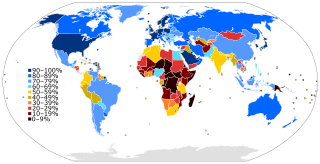
The Internet in Africa is limited by a lower penetration rate when compared to the rest of the world. Measurable parameters such as the number of ISP subscriptions, overall number of hosts, IXP-traffic, and overall available bandwidth are indicators that Africa is far behind the "digital divide". Moreover, Africa itself exhibits an inner digital divide, with most Internet activity and infrastructure concentrated in South Africa, Morocco, Egypt as well as smaller economies like Mauritius and Seychelles. In general, only 24.4% of the African population have access to the Internet, as of 2018. Only 0.4% of the African population has a fixed-broadband subscription. The majority of internet users use it through mobile broadband.
International University of East Africa (IUEA) is a private for non-profit institution in Uganda, is a chartered University by the Uganda National Council for Higher Education (NCHE).

A center of excellence, also called an excellence center, is a team, a shared facility or an entity that provides leadership, best practices, research, support, or training for a focus area.

Covenant University(CU) is a private Christian university in Ota, Ogun State, Nigeria. It is affiliated with Living Faith Church Worldwide and is a member of the Association of Commonwealth Universities, Association of African Universities, and National Universities Commission. In 2019, Covenant University became the first Nigerian university to be ranked in the top 401-500 category of world universities by Times Higher Education.
University of Rwanda is a public collegiate, multi campus university based in Kigali, Rwanda. Formed in 2013 through the merger of previously independent education institutions, the University of Rwanda is the largest education institution in Rwanda. The University of Rwanda is ranked number one in the country by the Higher Education Council, an organ established by the Government of Rwanda.
Science and technology in Uganda examine government efforts to develop a national innovation system and the impact of these policies.
Science and technology in Burkina Faso summarises the changes and trends that have occurred in this area in Burkina Faso from 2010 and places them in the viewpoint of the subregion.

Gordon Akanzuwine Awandare is a Ghanaian parasitologist and the Pro-Vice Chancellor in charge of Academic and Student Affairs at the University of Ghana. Prior to his appointment in January 2022, He was the founding Director of the West African Center for Cell Biology of Infectious Pathogens (WACCBIP). He is the current chairman of the CKT-UTAS governing council and the Africa Global Editor of the Experimental Biology and Medicine (EBM) journal.

Higher education in Saudi Arabia is the educational stage that follows the three years of secondary education. Higher education institutions are either governmental institutions or private institutions, and are mainly universities, colleges, and academies. There are three higher educational levels in Saudi Arabia: bachelor's degree, master's degree, and doctorate. Governmental universities in Saudi Arabia offer a free bachelor's degree education for Saudis and a monthly payment for each student during their studying period.

The African Centre of Excellence for Genomics of Infectious Diseases (ACEGID), based at Redeemer’s University, Ede, Nigeria, is a consortium of West African academic and medical institutions partnering for research and training.
The domain of international space politics gained significant traction during the Cold War. This was largely fuelled by the ongoing space race between the USA and the USSR. At this time in history, space exploration was an endeavour largely restricted to the global superpowers and seemed out of reach for many smaller, developing, nations to actively participate in. Subsequently, public concerns for the cost of research and development into novel space technologies did not receive sufficient policy and academic attention in Africa. As the Cold War reached its conclusion, political power began to diffuse across the world, and this led to many smaller nation states developing national and regional space capabilities. In the context of Africa, Nigeria, Algeria, Egypt and South Africa were the front-runners in terms of investments into space-related research and development.
