Related Research Articles

Crohn's disease is a type of inflammatory bowel disease (IBD) that may affect any segment of the gastrointestinal tract. Symptoms often include abdominal pain,diarrhea,fever,abdominal distension,and weight loss. Complications outside of the gastrointestinal tract may include anemia,skin rashes,arthritis,inflammation of the eye,and fatigue. The skin rashes may be due to infections as well as pyoderma gangrenosum or erythema nodosum. Bowel obstruction may occur as a complication of chronic inflammation,and those with the disease are at greater risk of colon cancer and small bowel cancer.

Inflammatory bowel disease (IBD) is a group of inflammatory conditions of the colon and small intestine,with Crohn's disease and ulcerative colitis (UC) being the principal types. Crohn's disease affects the small intestine and large intestine,as well as the mouth,esophagus,stomach and the anus,whereas UC primarily affects the colon and the rectum.

An asymptomatic carrier is a person or other organism that has become infected with a pathogen,but shows no signs or symptoms.
A cytokine storm,also called hypercytokinemia,is a pathological reaction in humans and other animals in which the innate immune system causes an uncontrolled and excessive release of pro-inflammatory signaling molecules called cytokines. Cytokines are a normal part of the body's immune response to infection,but their sudden release in large quantities may cause multisystem organ failure and death.

Kevin J. Tracey,a neurosurgeon and inventor,is the president and CEO of the Feinstein Institute for Medical Research,professor of neurosurgery and molecular medicine at the Zucker School of Medicine,and president of the Elmezzi Graduate School of Molecular Medicine in Manhasset,New York. The Public Library of Science Magazine,PLOS Biology,recognized Tracey in 2019 as one of the most cited researchers in the world.
Faecal calprotectin is a biochemical measurement of the protein calprotectin in the stool. Elevated faecal calprotectin indicates the migration of neutrophils to the intestinal mucosa,which occurs during intestinal inflammation,including inflammation caused by inflammatory bowel disease. Under a specific clinical scenario,the test may eliminate the need for invasive colonoscopy or radio-labelled white cell scanning.

Mel Krajden is a physician and professor of Pathology and Laboratory Medicine at the University of British Columbia in Vancouver,British Columbia,Canada. He is the medical director of the BCCDC Public Health Laboratory. Dr. Krajden obtained his BSc,MD,and FRCPC at McGill University,followed by a fellowship in Infectious Diseases at Stanford University. He is also the medical director of the Public Health Laboratory at the British Columbia Centre for Disease Control. His research focuses on the prevention and care of hepatitis,human papillomavirus,and human immunodeficiency virus.
Katherine A. Fitzgerald is an Irish-born American molecular biologist and virologist. She is a professor of medicine currently working in the Division of Infectious Disease at the University of Massachusetts Medical School. She is also the director of the Program in Innate Immunity.

Coronavirus disease 2019 (COVID-19) is a contagious disease caused by the coronavirus SARS-CoV-2. The first known case was identified in Wuhan,China,in December 2019. Most scientists believe the SARS-CoV-2 virus entered into human populations through natural zoonosis,similar to the SARS-CoV-1 and MERS-CoV outbreaks,and consistent with other pandemics in human history. Social and environmental factors including climate change,natural ecosystem destruction and wildlife trade increased the likelihood of such zoonotic spillover. The disease quickly spread worldwide,resulting in the COVID-19 pandemic.
A COVID‑19 vaccine is a vaccine intended to provide acquired immunity against severe acute respiratory syndrome coronavirus 2 (SARS-CoV-2),the virus that causes coronavirus disease 2019 (COVID‑19).
Liise-anne Pirofski is a Professor of Medicine,Microbiology and Immunology at Albert Einstein College of Medicine and Montefiore Medical Center. She is a Member of the Association of American Physicians,and a Fellow of the American Association for the Advancement of Science,American Academy of Microbiology,American College of Physicians and the Infectious Diseases Society of America.
Allison Joan McGeer is a Canadian infectious disease specialist in the Sinai Health System,and a professor in the Department of Laboratory Medicine and Pathobiology at the University of Toronto. She also appointed at the Dalla Lana School of Public Health and a Senior Clinician Scientist at the Lunenfeld-Tanenbaum Research Institute,and is a partner of the National Collaborating Centre for Infectious Diseases. McGeer has led investigations into the severe acute respiratory syndrome outbreak in Toronto and worked alongside Donald Low. During the COVID-19 pandemic,McGeer has studied how SARS-CoV-2 survives in the air and has served on several provincial committees advising aspects of the Government of Ontario's pandemic response.

Katalin "Kati" Karikó is a Hungarian-American biochemist who specializes in ribonucleic acid (RNA)-mediated mechanisms,particularly in vitro-transcribed messenger RNA (mRNA) for protein replacement therapy. Karikólaid the scientific groundwork for mRNA vaccines,overcoming major obstacles and skepticism in the scientific community. Karikóreceived the Nobel Prize in Physiology or Medicine in 2023 for her work,along with American immunologist Drew Weissman.

The symptoms of COVID-19 are variable depending on the type of variant contracted,ranging from mild symptoms to a potentially fatal illness. Common symptoms include coughing,fever,loss of smell (anosmia) and taste (ageusia),with less common ones including headaches,nasal congestion and runny nose,muscle pain,sore throat,diarrhea,eye irritation,and toes swelling or turning purple,and in moderate to severe cases,breathing difficulties. People with the COVID-19 infection may have different symptoms,and their symptoms may change over time. Three common clusters of symptoms have been identified:one respiratory symptom cluster with cough,sputum,shortness of breath,and fever;a musculoskeletal symptom cluster with muscle and joint pain,headache,and fatigue;and a cluster of digestive symptoms with abdominal pain,vomiting,and diarrhea. In people without prior ear,nose,or throat disorders,loss of taste combined with loss of smell is associated with COVID-19 and is reported in as many as 88% of symptomatic cases.
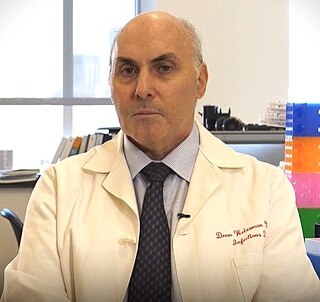
Drew Weissman is an American physician and immunologist known for his contributions to RNA biology. Weissman is the inaugural Roberts Family Professor in Vaccine Research,director of the Penn Institute for RNA Innovation,and professor of medicine at the Perelman School of Medicine at the University of Pennsylvania (Penn).

The CureVac COVID-19 vaccine was a COVID-19 vaccine candidate developed by CureVac N.V. and the Coalition for Epidemic Preparedness Innovations (CEPI). The vaccine showed inadequate results in its Phase III trials with only 47% efficacy. In October 2021 CureVac abandoned further development and production plans for CVnCoV and refocused efforts on a cooperation with GlaxoSmithKline.
Maria Virginia Pascual is a Spanish-American pediatric rheumatologist.
Maria Teresa Abreu is an American gastroenterologist with a focus on inflammatory bowel disease. She was inducted into the Academy of Science,Engineering and Medicine of Florida for "her research in advancing understanding of therapeutic drug monitoring genotype–phenotype associations in inflammatory bowel diseases."
COVID-19 vaccine clinical research uses clinical research to establish the characteristics of COVID-19 vaccines. These characteristics include efficacy,effectiveness,and safety. As of November 2022,40 vaccines are authorized by at least one national regulatory authority for public use:

Susanna Jane Dunachie is a British microbiologist who is Professor of Infectious Diseases at the University of Oxford. Her work considers microbiology and immunology to better understand bacterial infection and accelerate the development of vaccines. She has focused on melioidosis,scrub typhus and tuberculosis. During the COVID-19 pandemic,she studied T cell immunity to severe acute respiratory syndrome coronavirus 2.
References
- 1 2 "Aida Habtezion: Board of Governors". New York Academy of Science. Retrieved October 22, 2021.
- ↑ ""There's a lot more work to be done." – Aida Habtezion". Stanford University. Retrieved October 22, 2021.
- ↑ "Report of the president: Academic Council Professoriate appointments". Stanford University. February 9, 2011. Retrieved October 22, 2021.
- 1 2 "Aida Habtezion, MD, MSc". American Society for Clinical Investigation . Retrieved October 22, 2021.
- ↑ Gubatan, John; Levitte, Steven; Balabanis, Tatiana; Patel, Akshar; Sharma, Arpita; Habtezion, Aida (September 2020). "SARS-CoV-2 Testing, Prevalence, and Predictors of COVID-19 in Patients with Inflammatory Bowel Disease in Northern California". Gastroenterology. 159 (3): 1141–1144. doi:10.1053/j.gastro.2020.05.009. PMC 7204754 . PMID 32387541.
- ↑ "Aida Habtezion Taking Leave of Absence to Join Pfizer". Stanford University. 2021. Retrieved October 22, 2021.
