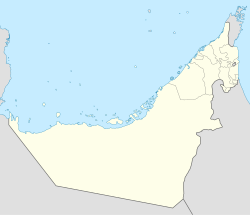
The United Arab Emirates (UAE) is a country in the eastern part of the Arabian Peninsula located on the southeastern coast of the Persian Gulf and the northwestern coast of the Gulf of Oman. The UAE consists of seven emirates and was founded on 2 December 1971 as a federation. Six of the seven emirates combined on that date. The seventh, Ras al Khaimah, joined the federation on 10 February 1972. The seven sheikdoms were formerly known as the Trucial States, in reference to the treaty relations established with the British in the 19th Century.
Sheikh Sultan bin Saqr Al Qasimi (1781–1866) was the Sheikh of the Al Qasimi and ruler variously of the towns of Sharjah and Ras Al Khaimah, Jazirah Al Hamra and Rams. A dependent of the first Saudi Kingdom, his rule over Ras Al Khaimah ran from 1803–1809, when he was deposed by order of the Saudi Amir and restored in 1820, going on to rule until his death in 1866 at the age of 85. He was Ruler of Sharjah from 1814–1866, with a brief disruption to that rule in 1840.
The Shihuh is a tribe of the United Arab Emirates (UAE), and Oman. In the singular, the name is Al Shehhi, a common family name in the UAE and Oman today. Inhabiting the northern part of the Hajar Mountain range, the tribe has long been influential in the affairs of both the east and west coast settlements of the northern UAE and Oman and has fiercely maintained both its identity and independence.

Al Fahlain is the name of a suburb of the city of Ras Al Khaimah in the United Arab Emirates (UAE), traditionally mostly settled by members of the Naqbiyin tribe.
Al Jazirah Al Hamra is a town to the south of the city of Ras Al Khaimah in the United Arab Emirates. It is known for its collection of abandoned houses and other buildings, including a mosque, which are widely believed locally to be haunted. The town was ruled by the Zaab tribe, which was rehoused in Abu Dhabi following a dispute with the Ruler of Ras Al Khaimah.
The Naqbiyin ) is a tribe of the United Arab Emirates (UAE). They are mostly settled within the emirates of Sharjah and Ras Al Khaimah and have long been influential in the tribal politics of both emirates.
The Za'ab is a Arab tribe in the United Arab Emirates (UAE).

The General Maritime Treaty of 1820 was a treaty initially signed between the rulers of Abu Dhabi, Sharjah, Ajman, Umm al-Quwain and Ras Al Khaimah and the British in January 1820, with the nearby island state of Bahrain acceding to the treaty in the following February. Its full title was, "General Treaty for the Cessation of Plunder and Piracy by Land and Sea, Dated February 5, 1820".

The Trucial Coast were a group of tribal confederations in the south-eastern Persian Gulf, previously known to the British as the "Pirate Coast", which were signatories to treaties with the British Government. These treaties established an informal protectorate by the United Kingdom, and the sheikhdoms, or emirates, were a British protectorate from 1820 until 1 December 1971, when the seven principal trucial sheikhdoms became independent. Six were to form the United Arab Emirates the next day; the seventh – Ras Al Khaimah – joined the Federation on 10 February 1972.
Sheikh Abdullah bin Rashid Al Mualla was the Ruler of Umm Al Quwain from 1820–1853. The head of the Al Ali tribe, he was signatory to both the 1820 General Maritime Treaty with the British and the 1853 Perpetual Maritime Truce, making Umm Al Quwain a Trucial State. Today it is one of the seven United Arab Emirates (UAE).
Sheikh Salim bin Sultan Al Qasimi was Ruler of Sharjah from 1868–1883. His rule was unusually tumultuous and marked by intrigue, the secession of Sharjah's dependencies and constant conflict. He was also briefly the Ruler of Ras Al Khaimah from 1868–1869 and its wali, or governor, from 1908–1919.
Sheikh Khalid bin Ahmad Al Qasimi was the Ruler of Sharjah from 1914–1924 and Ras Al Khaimah from 1914–1921. He acceded on the death of Saqr bin Khalid Al Qasimi. His rule was tumultuous and unpopular, marked by internecine conflicts and public discontent and saw the final disintegration of the Al Qasimi's joint rule over Sharjah and Ras Al Khaimah. Deposed as Ruler of Sharjah in 1924, he went on to become ruler of Dhaid and Kalba and a highly influential figure in the Shamaliyah.
Sheikh Humaid bin Abdullah Al Qasimi was Ruler of Ras Al Khaimah from 1869–1900. He survived an attempt to unseat him by the Ruler of Sharjah, with whom he later allied. He re-united Ras Al Khaimah with its secessionist dependencies.
Sheikh Sultan bin Salim Al Qasimi was Ruler of Ras Al Khaimah from 1921–1948. His long and turbulent rule was characterised by internecine family and tribal disputes and he was finally removed as Ruler in a 1948 coup.
Sheikh Rashid bin Ahmad Al Mualla (1876–1922) was the Ruler of Umm Al Quwain from 1904–1922, one of the Trucial States and today one of the seven emirates forming the United Arab Emirates (UAE). He gained influence over the tribes of the interior at the expense of the pre-eminent Trucial Ruler of the time, Sheikh Zayed bin Khalifa Al Nahyan.
Sheikh Hamad bin Ibrahim Al Mualla was Ruler of Umm Al Quwain from 1923–1929, one of the Trucial States which today forms part of the United Arab Emirates (UAE).
Sheikh Rashid bin Humaid Al Nuaimi was the Ruler of Ajman, one of the Trucial States which today form the United Arab Emirates (UAE), from 1816–1838, leading a force of 50 men to take control of the town from members of the Al Bu Shamis tribe who had settled there and also at Al Heera. At the time, Ajman was a dependency of Sharjah. Five years after his establishment at Ajman, the fort was taken by the Darawisha Bedouin who were removed by the action of the Ruler of Sharjah, Sheikh Saqr bin Sultan Al Qasimi.
Sheikh Hamad bin Abdullah Al Sharqi is the first recognised leader of the Al Sharqi Ruling family of Fujairah, one of the Trucial States and today one of the United Arab Emirates (UAE). He led Fujairah in a number of insurrections against Al Qasimi rule, presiding over a turbulent time when the emirate was practically independent but denied recognition of status as a Trucial State in its own right by the British.
Sheikh Tahnun bin Shakhbut Al Nahyan was the Ruler of Abu Dhabi from 1818–1833. Having deposed his brother Muhammad bin Shakhbut Al Nayhan with his father's support, he ruled in his father's name. Under Tahnun, Abu Dhabi became a Trucial State in 1820, eventually becoming the capital of the United Arab Emirates (UAE).
The Sharqiyin is a tribe of the United Arab Emirates (UAE).