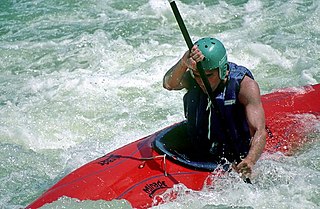
A kayak is a small, narrow human-powered watercraft typically propelled by means of a long, double-bladed paddle. The word kayak originates from the Greenlandic word qajaq.

Rowing, sometimes called crew in the United States, is the sport of racing boats using oars. It differs from paddling sports in that rowing oars are attached to the boat using oarlocks, while paddles are not connected to the boat. Rowing is divided into two disciplines: sculling and sweep rowing. In sculling, each rower holds two oars—one in each hand, while in sweep rowing each rower holds one oar with both hands. There are several boat classes in which athletes may compete, ranging from single sculls, occupied by one person, to shells with eight rowers and a coxswain, called eights. There are a wide variety of course types and formats of racing, but most elite and championship level racing is conducted on calm water courses 2 kilometres (1.2 mi) long with several lanes marked using buoys.

The Charles River, sometimes called the River Charles or simply the Charles, is an 80-mile-long (129 km) river in eastern Massachusetts. It flows northeast from Hopkinton to Boston along a highly meandering route, that doubles back on itself several times and travels through 23 cities and towns before reaching the Atlantic Ocean. The indigenous Massachusett named it Quinobequin, meaning "meandering" or "meandering still water".
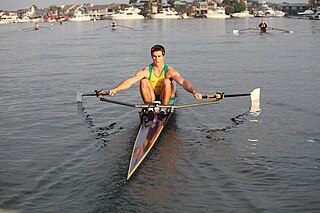
Sculling is the use of oars to propel a boat by moving them through the water on both sides of the craft, or moving one oar over the stern. A long, narrow boat with sliding seats, rigged with two oars per rower may be referred to as a scull, its oars may be referred to as sculls and a person rowing it referred to as sculler.

The Rowperfect is an indoor rowing machine, designed in 1987 and patented in 1988, by Casper (Cas) Rekers. It is designed to accurately simulate the feeling of rowing on the water. Both the flywheel and the seat are free to move on a slide — this is different from the majority of rowing machines, where the flywheel is fixed and only the seat moves. Its mass and movement are balanced and engineered to enable rowing technique to be learned and refined. This is called a "floating head" rowing simulator: the fixed flywheel type is called a "fixed head" ergometer.

Rowing is the act of propelling a human-powered watercraft using the sweeping motions of oars to displace water and generate reactional propulsion. Rowing is functionally similar to paddling, but rowing requires oars to be mechanically attached to the boat, and the rower drives the oar like a lever, exerting force in the same direction as the boat's travel; while paddles are completely hand-held and have no attachment to the boat, and are driven like a cantilever, exerting force opposite to the intended direction of the boat.

In watercraft, a racing shell is an extremely narrow, and often comparatively long, rowing boat specifically designed for racing or exercise. It is equipped with long oars, outriggers to hold the oarlocks away from the boat, and sliding seats. The boat's long length and semicircular cross-section reduce drag to a minimum. This makes the boat both fast and unstable. It must be balanced by the rowers to avoid tipping. Being able to balance – or "set" – the boat while putting maximum effort into the oars is therefore an essential skill of sport rowing.
In competitive rowing, the following specialized terms are important in the corresponding aspects of the sport:

Coastal and offshore rowing is a rowing sport performed at sea. In North America, this sport is often called open water rowing.

Harry Clasper was a professional rower and boat builder from Tyneside in England. He was an innovative boat designer who pioneered the development of the racing shell and the use of outriggers. He is said to have invented spoon-shaped oars.

In rowing, oars are used to propel the boat. Oars differ from paddles in that they use a fixed or sliding fulcrum, an oarlock or rowlock attached to the side of the boat, to transfer power from the handle to the blade, rather than using the athlete's shoulders or hands as the pivot-point as in canoeing and kayaking.
A Thames skiff is a traditional River Thames wooden rowing boat used for skiffing. These boats evolved from Thames wherries in the Victorian era to meet a passion for river exploration and leisure outings on the water.

A single scull, abbreviated as a 1x, is a racing shell designed for a single person who propels the boat with two oars, one in each hand.

Skiffing refers to the sporting and leisure activity of rowing a Thames skiff. The skiff is a traditional hand built clinker-built wooden craft of a design which has been seen on the River Thames and other waterways in England and other countries since the 19th century. Sculling is the act of propelling the boat with a pair of oars, as opposed to rowing which requires both hands on a single oar.
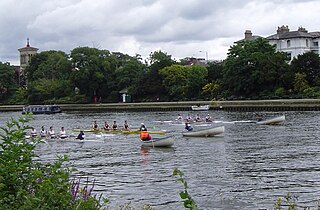
A coxed four, abbreviated as a 4+, is a racing shell used in the sport of competitive rowing. It is designed for four persons who propel the boat with sweep oars and is steered by a coxswain.
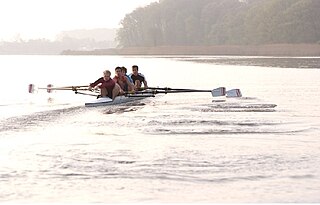
A coxless four, abbreviated as a 4- and also called a straight four, is a racing shell used in the sport of competitive rowing. It is designed for four persons who propel the boat with sweep oars, without a coxswain.
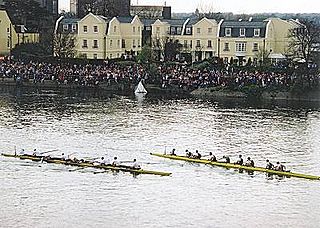
An eight, abbreviated as an 8+, is a racing shell used in competitive rowing (crew). It is designed for eight rowers, who propel the boat with sweep oars, and is steered by a coxswain, or "cox".

Human-powered watercraft are watercraft propelled only by human power, instead of being propelled by wind power or an engine.

