
The State Historical Museum of Russia is a museum of Russian history wedged between Red Square and Manege Square in Moscow. Its exhibitions range from relics of prehistoric tribes that lived on the territory of present-day Russia, through priceless artworks acquired by members of the Romanov dynasty. The total number of objects in the museum's collection comes to millions.

The State Russian Museum, formerly the Russian Museum of His Imperial Majesty Alexander III, located on Arts Square in Saint Petersburg, is the world's largest depository of Russian fine art. It is also one of the largest museums in the country with total area than 30 hectares.
Grinlandia is the fantasy world where most of the novels and short stories of Alexander Grin take place. The name of the country is never mentioned by the author himself, and the name Grinlandia was suggested in 1934 by literary critic Korneliy Zelinsky and adopted by Grin's fans since then.

Suvorov Memorial Museum in Saint Petersburg, Russia is a military museum dedicated to the memory of Generalissimo Alexander Suvorov (1729-1800). It was founded in 1900 to commemorate the century of Suvorov's death and was inaugurated four years later, on the 175th anniversary of Suvorov's birth, with much pageantry, in the presence of Emperor Nicholas II.

The Chekhov Gymnasium in Taganrog on Ulitsa Oktyabrskaya 9 is the oldest gymnasium in the South of Russia. Playwright and short-story writer Anton Chekhov spent 11 years in the school, which was later named after him and transformed into a literary museum. Visitors can see Anton's desk and his classroom, the assembly hall and even the punishment cell which he sometimes visited.

Charax is the largest Roman military settlement excavated in the Crimea. It was sited on a four-hectare area at the western ridge of Ai-Todor, close to the modern tourist attraction of Swallow's Nest.

The Pushkin House, formally the Institute of Russian Literature, is a research institute in St. Petersburg. It is part of a network of institutions affiliated with the Russian Academy of Sciences.

The Crimean Nuclear Power Station is an abandoned and unfinished nuclear power plant near the cape of Kazantyp on banks of Aqtas Lake in Crimea (Ukraine/Russia).
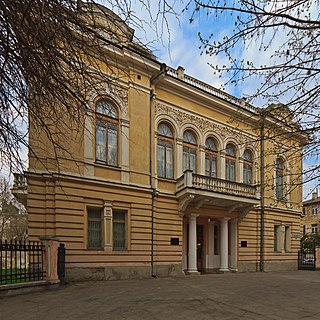
Simferopol State Art Museum is an art museum located in the Crimean capital Simferopol.
The National Pushkin Museum is a museum dedicated to the life and work of Russian poet Alexander Pushkin. It is located in Saint Petersburg, Russia. The museum was established in 1953 on the basis of the All-Russian Pushkin Exhibition of 1937 which opened in Moscow.

Naval museum complex Balaklava is an underground submarine base in Balaklava, Crimea. It was a top-secret military facility during the Cold War, located in Balaklava Bay.
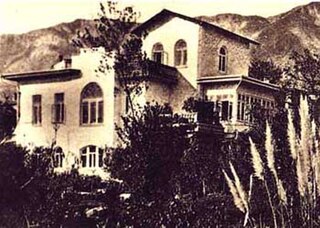
The White Dacha, is the house that Anton Chekhov had built in Yalta and in which he wrote some of his greatest work. It is now a writer's house museum.

The Multimedia Art Museum, Moscow is a Russian state museum dedicated to the presentation and development of actual art related to new multimedia technologies. The museum was opened in October 2010 on the grounds of the Moscow House of Photography.
The year 1952 was marked by many events that left an imprint on the history of Soviet and Russian Fine Arts.

The Feodosia Museum of Money (Russian: Феодосийский музей денег is a currency museum in Feodosia, Crimea. It was established on July 15, 2003. The opening ceremony took place on August 22, 2003.

Mikhaylovskoye Museum Reserve is a museum complex dedicated to Russian poet Alexander Pushkin, the founder of modern Russian literature. The museum is located in Pushkinogorsky District of Pskov Oblast in Northwestern Russia, in the areas around the settlement of Pushkinskiye Gory and in the surrounding villages including Mikhaylovskoye, where Pushkin had a family estate.
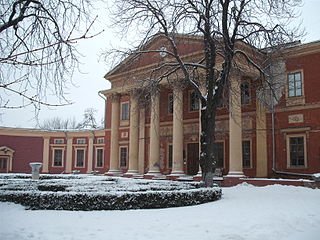
Odesa Fine Arts Museum is one of the principal art galleries of the city of Odesa. Founded in 1899, it occupies the Potocki Palace, itself a monument of early 19th century architecture. The museum now houses more than 10 thousand pieces of art, including paintings by some of the best-known Russian and Ukrainian artists of late 19th and early 20th century. It is the only museum in Odessa that has free entrance day every last Sunday of the month.

The Lunins' House is a former noble estate in Moscow Empire style, built by Italian architect Domenico Gilardi for the Lunins, an aristocratic family of pre-revolutionary Russia. The three-storied central mansion is vastly decorated with the avant-corps, reliefs, and is connected to two-storied wings, creating two closed courtyards. In 1821 the estate was sold to the State Empire Commercial Bank, that occupied the mansion till 1917. Since 1970 it belongs to the Museum of Oriental Art.

The House-Museum of Ivan Krylov opened in 1979 in Novocherkassk, Rostov oblast, Russia and is devoted to the exhibition of the Russian and Soviet theatre painter's pieces of art, as well as to the research and study of Cossacks households. It is an affiliate of the Museum of Don Cossacks. An historic building of the museum is considered to be an object of cultural heritage.

Museum of I.D. Vasilenko is a museum in Taganrog, Rostov region, located in a house in which from 1923 to 1966 lived writer Ivan Dmitrievich Vasilenko, winner of the Stalin Prize. It is the part of the Taganrog State Literary and Historical-Architectural Museum-Reserve. It is located at Chekhov street, 88.

