Alfred Zeidler

Last updated


Alfred Zeidler
Born(1902-09-22)22 September 1902 [1]
Danzig, Kingdom of Prussia, German Empire
AllegianceFlag of Germany (1935-1945).svg  Nazi Germany
Service / branch Flag Schutzstaffel.svg Schutzstaffel
Years of service1933-1945
Rank SS-Hauptsturmführer
Commands Lagerkommandant of Grini detention camp
Battles / wars World War II

Alfred Zeidler (born 22 September 1902) was a German Schutzstaffel (SS) officer who served Nazi Germany in World War II. From 1942 to 1945, he was Lagerkommandant of the Grini detention camp in Norway during the German occupation. Although sentenced to lifelong forced labour after the war, Zeidler was released in 1953. Details of his later life are unknown. [2] [3] [4] [5] [6] [1]

Contents

Early life

Alfred Zeidler was born on 22 September 1902 in Danzig – at that time part of West Prussia in the German Empire – as the son of a locksmith. He then lived in Braunschweig where he worked as a broker in the shipping industry and as a colporteur before becoming unemployed. [1]

After Hitler's rise to power in 1933, Zeidler joined NSDAP and the SS, becoming a member of the Sicherheitsdienst (SD) in 1937. He was eventually promoted to SS-Hauptsturmführer. [4]

At some point, Zeidler married and had two children. [1]

At Grini detention camp

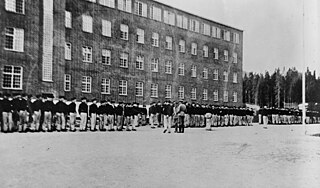
On 30 June 1942, Zeidler took part in an inspection of the Grini detention camp in Bærum, Norway, which was being used by the SS to hold political prisoners. The next month, on 15 July, he returned with Hellmuth Reinhard (head of the Gestapo in Norway), who appointed Zeidler as Lagerkommandant of the camp. In his first meeting with the camp prisoners, he announced that they would soon become accustomed to "Prussian discipline". [4]

He held his post at Grini until the end of World War II in Europe. [6]

Post-war

Following the surrender of Nazi Germany on 8 May 1945, many SS officers (fearing reprisals for war crimes) attempted to disguise themselves as ordinary soldiers and blend in with the Wehrmacht. Zeidler was eventually discovered with a group of around 75 Gestapo men who, led by Heinrich Fehlis (SiPo and SD commander in Norway), had disguised themselves in Gebirgskorps Norwegen uniforms and hidden in a camp near Porsgrunn. The camp was eventually surrounded by Milorg and the troops were forced to surrender; Fehlis committed suicide and Zeidler was apprehended with the other men. [6] [7] [8] [9]

In 1947, as part of the legal purge in Norway after World War II, Zeidler was sentenced to forced labour for the rest of his life. He was released in 1953. [5] [6]

See also

Related Research Articles

<span class="mw-page-title-main">Grini detention camp</span> Nazi prison camp in Norway

Grini prison camp was a Nazi concentration camp in Bærum, Norway, which operated between 1941 and May 1945. Ila Detention and Security Prison is now located here.

<span class="mw-page-title-main">Heinrich Fehlis</span> German Schutzstaffel (SS) officer during World War II

Heinrich Fehlis was a German Schutzstaffel (SS) officer during World War II. He commanded the Sicherheitspolizei (SiPo) and Sicherheitsdienst (SD) in Norway and Oslo during the German occupation of Norway.

<span class="mw-page-title-main">Ernst Weiner</span> German SS officer (1913–1945)

Ernst Josef Albert Weiner was a German SS-Hauptsturmführer during World War II. He was most noted for his role in Operation Blumenpflücken during the occupation of Norway by Nazi Germany.

Arnold Rørholt was a Norwegian military officer, known as a resistance member during World War II. He was also the secretary-general of the Royal Norwegian Automobile Club for many years.

Hellmuth Reinhard was a German SS-Sturmbannführer who is best known for being head of the Gestapo in Nazi-occupied Norway from 1942 to 1945 during World War II. After the war, Reinhard evaded capture for nearly two decades before being arrested in 1964. He died in 2002.

Storm Willads Weinholdt was a Norwegian resistance member who was executed during the occupation of Norway by Nazi Germany.

Erling August Moi was a Norwegian resistance member of World War II.

Tor Njaa was a Norwegian resistance member of World War II.

Mons Olai Haukeland was a Norwegian gymnastics teacher and military officer, and district leader of Milorg during World War II until his arrest in 1943. He was imprisoned at Grini concentration camp from 8 to 9 December 1943, then at Sachsenhausen until the camp was liberated. He has been called father of the Norwegian Home Guard, being its general inspector from its formation in 1946 to 1958. He was promoted to the rank of major general in 1954.

Hjalmar Steenstrup was a Norwegian insurance agent, and Milorg pioneer and intelligence agent during World War II.
<span class="mw-page-title-main">Johannes Andenæs</span> Norwegian jurist and professor

Johannes Bratt Andenæs, often shortened to Johs. Andenæs was a Norwegian jurist. He was a professor of jurisprudence at the University of Oslo from 1945 to 1982, and served as rector from 1970 to 1972.

Carl Jacob Arnholm was a Norwegian jurist.

Bjørn Føyn was a Norwegian zoologist, especially known for researching the genetics of algae.

<span class="mw-page-title-main">Endre Berner</span> Norwegian organic chemist, author and educator

Endre Qvie Berner was a Norwegian organic chemist, author and educator.

Eiliv Skard was a Norwegian classical philologist.

Harald Krabbe Schjelderup was a Norwegian physicist, philosopher and psychologist. He worked with all three subjects on university level, but is best remembered as Norway's first professor of psychology.

<span class="mw-page-title-main">Anatol Heintz</span> Russo-Norwegian palaeontologist

Anatol Heintz was a Russo-Norwegian palaeontologist.

<span class="mw-page-title-main">Bredtveit Prison</span> Norwegian prison

Bredtveit Prison is a prison located in the neighborhood of Bredtvet in Oslo, Norway. During World War II it was a concentration camp.

Norsk fangeleksikon. Grinifangene is a Norwegian biographical dictionary with details on prisoners incarcerated at the Grini concentration camp between 1941 and 1945.

The milk strike was a strike in Nazi-occupied Oslo on 8 and 9 September 1941. It led to strong reprisals from the German occupiers, in the form of martial law, court-martial, mass arrests, two executions and several long-term jail sentences.

References

  1. 1 2 3 4 Giertsen, Børre R. (1946). Giertsen, Børre R. (ed.). "Norsk fangeleksikon : Grinifangene". Nasjonalbiblioteket (www.nb.no) (in Norwegian). Oslo: Cappelen. p. 11. Retrieved 16 April 2021.
  2. Nøkleby, Berit (2004). Krigsforbrytelser. Brudd på krigens lov i Norge 1940–45 (in Norwegian). Oslo: Pax Forlag. pp. 141–142, 174. ISBN   82-530-2710-9.
  3. Nøkleby, Berit (1995). "Zeidler, Alfred". In Dahl; Hjeltnes; Nøkleby; Ringdal; Sørensen (eds.). Norsk krigsleksikon 1940–1945 (in Norwegian). Oslo: Cappelen. ISBN   82-02-14138-9. Archived from the original on 4 October 2013. Retrieved 15 April 2013.
  4. 1 2 3 "Griniboken". Nasjonalbiblioteket (www.nb.no) (in Norwegian). Gyldendal. 1946. pp. 168–170. Retrieved 16 April 2021.
  5. 1 2 Bjørnsen, Bjørn (1975). Norge etter 1945 (in Norwegian). Cappelen. p. 42. ISBN   8202033713 . Retrieved 16 April 2021.{{cite book}}: |website= ignored (help)
  6. 1 2 3 4 Keilhau, Wollert; Kleppa, Peter; Tvedt, Knut (1954). "Kringla Heimsins : norsk konversasjonsleksikon. 8 : Syenittporfyr - Åverk". Nasjonalbiblioteket (www.nb.no) (in Norwegian). Oslo: Nasjonalforlaget. p. 1102. Retrieved 16 April 2021.
  7. Nøkleby, Berit (25 February 2020), "Heinrich Fehlis", Norsk biografisk leksikon (in Norwegian Bokmål), retrieved 16 April 2021
  8. Schrumpf, August (1970). "August Schrumpf (district physician) - Fehlis affæren i Porsgrunn". Porsgrunn folkebibliotek (www.porsgrunn.folkebibl.no) (in Norwegian). Retrieved 16 April 2021.
  9. Klykken, Frits (1970). "Frits Klykken (regional commander of Milorg) - Saken Fehlis". Porsgrunn folkebibliotek (www.porsgrunn.folkebibl.no) (in Norwegian). Retrieved 16 April 2021.